
1967 to 1980, IBM, Yorktown Heights, New York
The coastline of everything
Benoit Mandelbrot, with Gaston Julia and Pierre Fatou fifty years ahead of him
A man at IBM asked how long the coast of Britain is and found out the question has no answer. Then he drew the shape that question makes, and it is the deepest picture anyone has ever made.
The question sounds like a trick and is not. How long is the coast of Britain? Look it up and you get a number. Look it up somewhere else and you get a different number, and the gap is not a rounding error. Lewis Fry Richardson, a Quaker meteorologist who spent his retirement looking for the mathematics of war, noticed that Spain and Portugal could not agree on the length of their shared border. Each country's reference books had a figure, and the figures differed by nearly a quarter. He worked out why, and then he died, and the finding sat in a yearbook nobody read until Benoit Mandelbrot found it.
The ruler is the answer
Here is the why. Measure the coast with a ruler a hundred miles long and you skip every bay. Use a ten mile ruler and you catch the bays but skip the coves. Use a one mile ruler and you catch the coves and skip the rocks. Every time you shorten the ruler, the coast gets longer, and it does not settle down. There is no number the measurements are sneaking up on. Push the ruler down to a grain of sand and the coast of a small island is, for practical purposes, endless.
Mandelbrot's 1967 paper said this out loud in Science, and then said the thing that mattered: the rate at which the length grows as the ruler shrinks is itself a stable number. For the west coast of Britain it comes out around 1.25. A smooth line is one-dimensional. A filled square is two. The coast of Britain is one and a quarter. It is more than a line and less than a surface, and it is like that at every magnification you care to try. He needed a word for shapes like that, and in 1975 he made one up from the Latin for broken: fractal.
It is like that everywhere
Once you have the word you cannot stop seeing the thing. A fern is a stem with small ferns on it, each of which is a stem with smaller ferns on it. A head of Romanesco broccoli at the farm stand is a cone of cones of cones, and you can photograph it from a foot away or an inch away and not be able to tell which. Clouds, lightning, the crack in the sidewalk, the river seen from a plane, the roots under the oak, the branches in your lungs, which split twenty-odd times from the windpipe down and pack something like seventy square meters of surface into your chest. None of these is smooth at any scale. Smooth was the exception the whole time. Euclid's circles and lines were a beautiful idea about a world that does not actually contain any.
That is the part that belongs on this shelf. The Hermetic writers said as above, so below, and meant it as a theology. A fractal is as above, so below with the theology taken out and the arithmetic left in. The pattern at the big scale is the pattern at the small scale because the same rule made both.
The picture
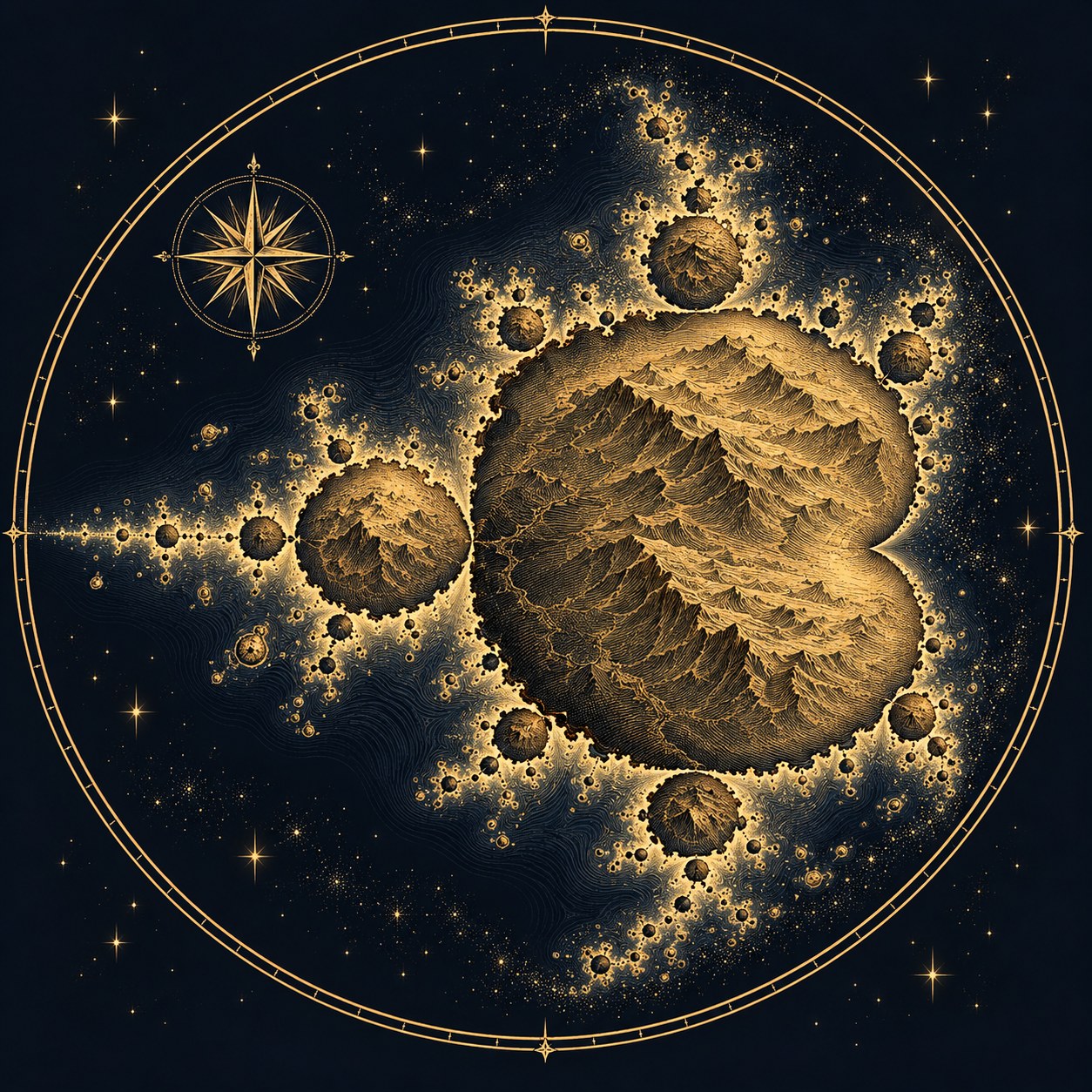
Now the showpiece. Take a number, square it, add a constant, square the result, add the same constant, and keep going. For some constants the numbers stay small forever. For others they blow up. Color every constant that stays put black and every constant that escapes by how fast it escapes, and you have drawn the Mandelbrot set.
That is the entire recipe. One line. Gaston Julia worked out the mathematics of it in 1918, in a hospital, after a bullet took his nose in the first winter of the war, and he never saw a picture of what he had described because nobody could compute one. Sixty years later Mandelbrot had IBM's machines and a printer, and the first printouts came out so strange that he assumed the specks were dust on the paper. They were not dust. The boundary of the set is infinitely detailed. Zoom in on any point of the edge and you find spirals, seahorses, lightning, and, eventually, a small perfect copy of the whole set, which has its own edge, which has its own copies. It never stops, and all of it was in that one line of arithmetic the whole time, waiting for somebody to look.
The instrument above is doing exactly that arithmetic, a few hundred times for every pixel on your screen, sixty times a second. The dive runs until your graphics card runs out of decimal places, a few thousand times in, and then starts again somewhere else on the edge. Nobody drew any of it. It is the shape of the rule.
The honest part
Two things people get wrong. First, fractal does not mean infinitely detailed in nature. A fern is self-similar for four or five levels and then it is cells. A coast is a coast down to about the size of a pebble, and then it is a pebble. Real things are fractal across a range of scales, not forever. The mathematical object is the idealization, and Mandelbrot was clear about that even when his fans were not.
Second, the Mandelbrot set is not in nature. Nobody has found one in a snowflake. It is a map of which Julia sets hold together in one piece, and the reason it matters for this shelf is not that the universe is secretly shaped like it. It is that a rule this short can hold a structure this deep. If one line of arithmetic can do that, then the question of how much order a universe can hold stops being a question about how complicated the rules need to be.
The Stoics said one breath runs through everything. Mandelbrot would have said: one rule, repeated. Whether those are the same claim is the question this whole site is about.