
1500 to 2020, Milan, Bryn Mawr, Bologna
The tree in your chest
Leonardo da Vinci, Cecil Murray, and Franco Vazza with Alberto Feletti
Your lungs are a tree hung upside down, the roots under an oak are a lung, a river delta is a lightning strike run slow. All of them are one rule, and the rule turned up again in a slice of brain set beside a map of the universe.
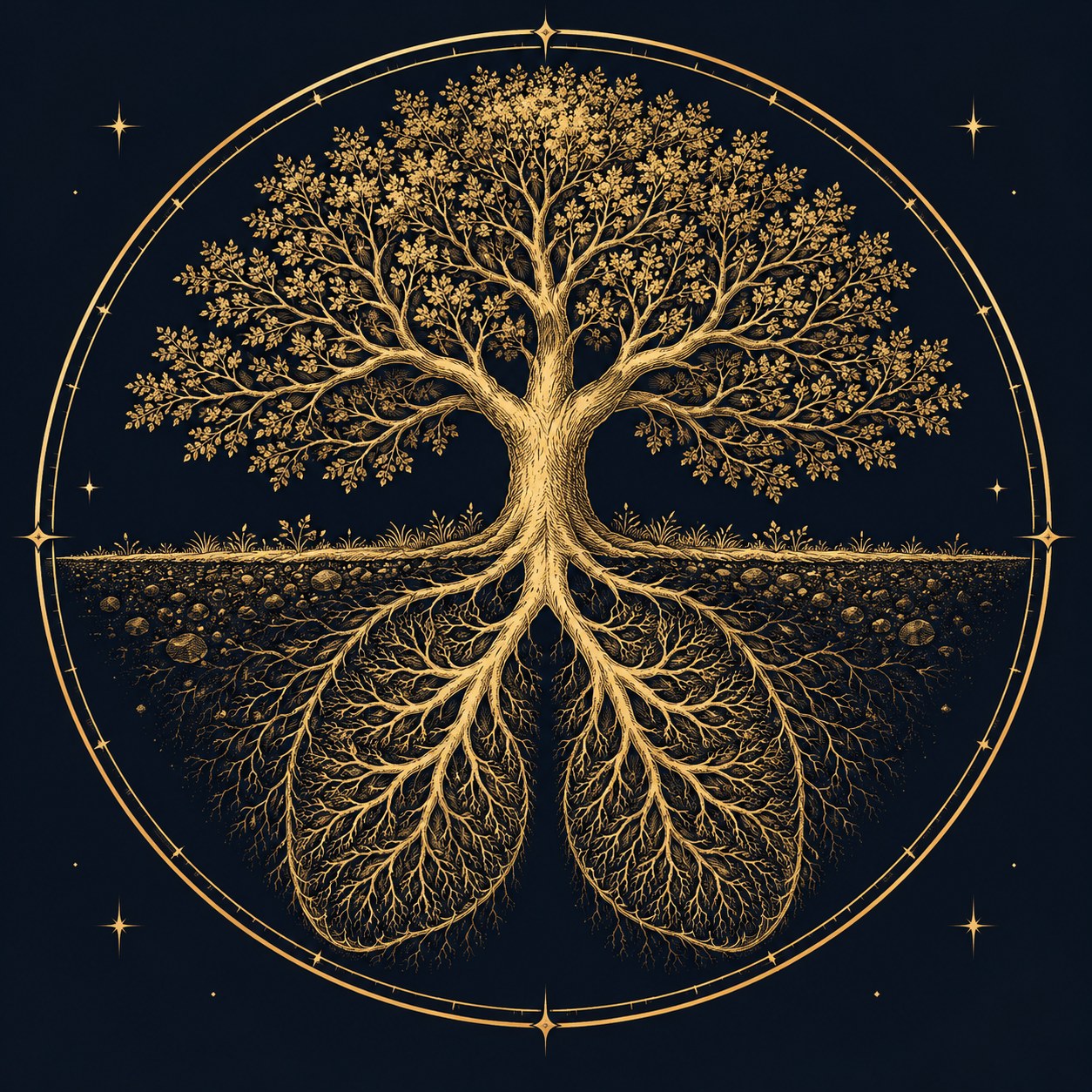
Breathe in. The air goes down one pipe, the windpipe, which splits in two, one for each lung. Each of those splits again. And again. By the time the air reaches the sacs where it crosses into your blood it has been through about twenty-three splits, and the one pipe has become a few hundred million ends, with something like seventy square meters of surface folded into a chest. Now go outside and look at the oak. It has done the same thing, twice: once into the sky and once into the ground, and the roots, if you could lift them out and turn them over, would pass for a lung at a glance.
The rule
This is not a coincidence, and it is not poetry. It is a problem with one answer. Suppose you have to carry a fluid from one point to a whole volume, and every inch of pipe costs you something: material to build it, work to push the fluid through it. What shape does the cheapest network take? In 1926 Cecil Murray, a physiologist at Bryn Mawr, worked it out for blood vessels and got a law: where a vessel splits, the cube of its radius equals the sum of the cubes of its daughters' radii. Vessels that obey it move blood for the least work. Measure a real artery tree and it obeys it, near enough. Measure the limbs of a tree and they obey it too, near enough, and Leonardo had written the tree version in a notebook four hundred years earlier: all the branches of a tree at every stage of its height, when put together, are equal in thickness to the trunk below them. He was off by a power, squares where Murray has cubes, and squares turn out to be right for trees for a different reason, which is wind. But he had seen the thing. The trunk is conserved up through the crown.
Rivers do it backward. A delta is a tree with the water running the other way: one channel arriving, splitting where it slows and drops its load, splitting again, until the river reaches the sea as a thousand mouths. Lightning does it in a thousandth of a second: a leader works its way down from the cloud, hunting for the easiest path, kinking and branching and abandoning the branches that go nowhere. Rivers, lightning, lungs, roots and the veins of a leaf are five answers to one question, and the answers look alike because the question is the same.
The instrument
The plate below grows all of them from one rule. A tip advances, and after a set distance it splits; the daughters are thinner by Murray's cube root and shorter by a fixed fraction; a little noise kinks them; and a little gravity pulls them toward the ground. Slide the dial and only the settings change: how far before a split, how wide the fork, how much noise, how hard the pull. At one end the rule packs a volume with short branches and you get a lung. At the other it sends one leader down with a few side shoots and you get lightning. Nothing in between is drawn by hand.
As above
In 2020 an astrophysicist in Bologna, Franco Vazza, and a neurosurgeon in Verona, Alberto Feletti, put a slice of human cerebellum beside a simulation of the cosmic web, the largest structure there is, the filaments of galaxies strung between the voids, and ran the same statistics on both. How matter clumps at each scale. How many connections each node has. How the network clusters. The match was closer than either of them expected, and closer than the match between the brain and several other branching things in nature. They were careful about what it means: not that the universe thinks, but that two systems made of nodes and filaments, growing under rules that reward connection and punish cost, arrive at the same architecture, across twenty-seven orders of magnitude in size.
That is the whole argument of this shelf in one paper. The Hermetic writers would have called it correspondence. Vazza and Feletti called it a power spectrum. They are describing the same observation.
The honest part
The branch rule is not a single law of nature; it is a family of answers to a family of similar problems, and the details differ. Lungs branch to fill a volume and are nearly symmetrical; rivers branch where the ground lets them and are nothing of the kind; lightning does not branch to deliver anything, it branches because the air breaks down unevenly. Murray's law fits arteries well, bronchi less well, trees only after you add the wind. And the brain and the cosmic web share statistics the way two cities with different histories can share a street plan: it tells you something about what networks do, not that one was built from the other. The resemblance is real. What it proves is that the universe has fewer good ideas than it has things, and it uses each one many times.