
360 BC to 1873, Athens, Cambridge and Ghent
Why everything is round
Plato, Isaac Newton and Joseph Plateau, with a raindrop and the Moon
The Sun, the Moon, a raindrop, a bubble, a cell, the pupil of your eye and the horizon are one figure. Nobody chose it. It is the shape left over when nothing gets to pick a direction, and here is a body you can make round or lumpy by changing only how big it is.
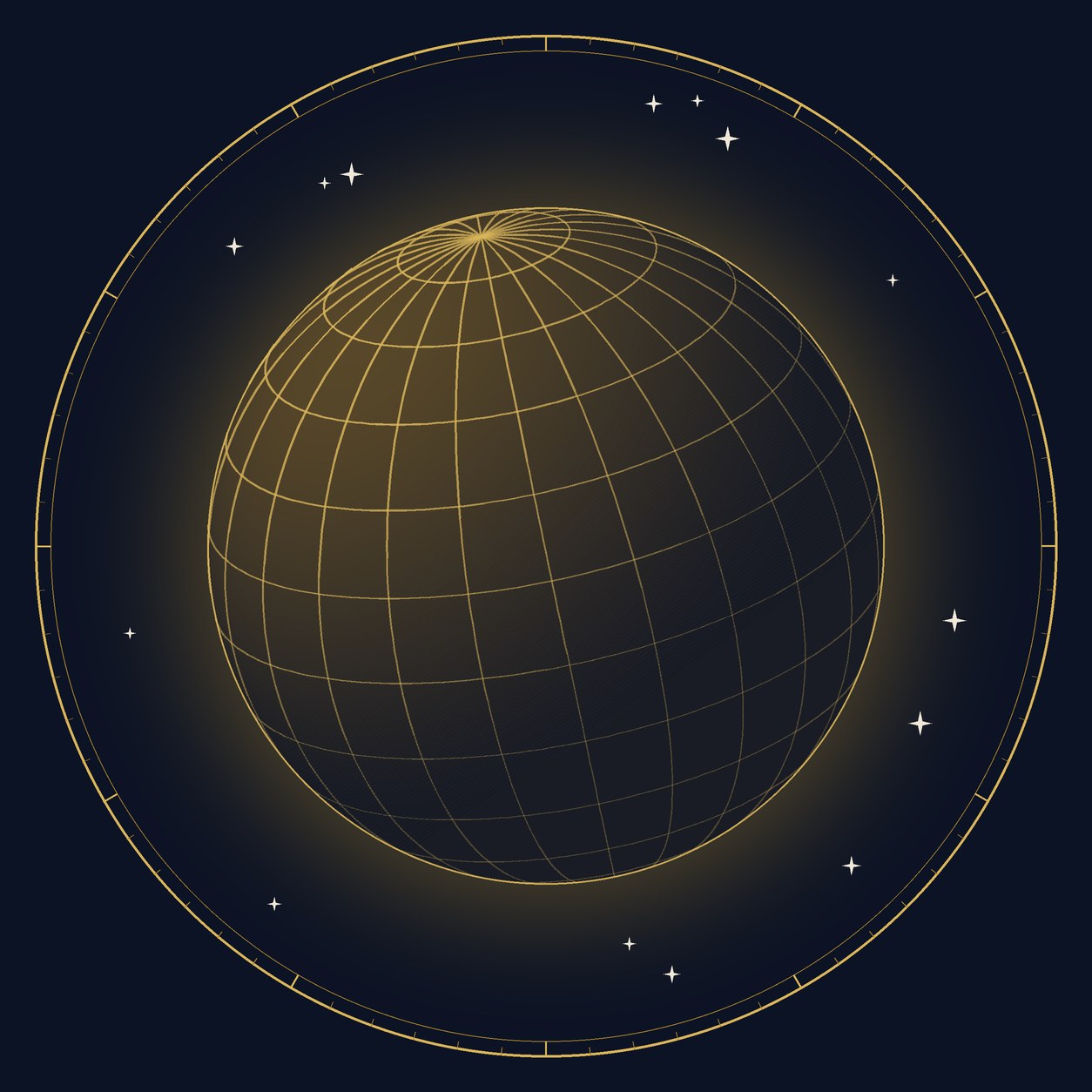
Look at anything big enough and it is round. The Sun, the Moon, every planet, every moon worth the name, every star anyone has managed to measure. Look at anything small enough and it is round again: a drop of rain, a soap bubble, a pea, a cell under the microscope, the pupil of an eye, the dew on a blade of grass. Drop a stone in a pond and the news goes out in rings. Stand on a beach and the edge of the world is a circle with you in the middle. Cut a tree across and it is a disc of discs. This shelf has spent six essays on the shapes the universe keeps drawing, and it has been walking past the plainest one.
Plato saw it and made it theology. In the Timaeus the craftsman gives the world the shape of a sphere, the most complete of all figures and the most like itself, because a thing that holds everything should have no corners and no front. Aristotle hung the stars on spheres. Ptolemy's machine, two shelves over, is nothing but circles riding circles. For two thousand years the circle was not a shape the heavens happened to have. It was the shape a heaven had to have, and when Kepler found that Mars moves on an ellipse he had spent five years and most of his strength trying to make a circle fit first. His book reads like an apology for the result.
Why the drop is round
Start at the small end, where nobody is apologising. A drop of water has a skin. Every molecule in the drop pulls on its neighbours, and the ones at the surface have fewer neighbours to pull on, so they are pulled inward, and the surface costs the drop something. Of every shape that can hold a given amount of water, the one with the least surface is the sphere. So the drop takes it. Nobody told the drop about spheres. It is the shape that is left when every other shape has been charged for its extra skin.
Joseph Plateau spent the 1860s on this in Ghent, blind. He had ruined his eyes staring into the Sun for an experiment on afterimages, and he did his best work afterward on soap films, with his family and his students describing to him what the films did. His 1873 book wrote the laws down. A film alone makes a sphere. Two bubbles meet on a flat wall. Three meet along a line at angles of a hundred and twenty degrees, never any other way, which is the honeycomb from the giraffe essay turning up again in the kitchen sink.
The skin only wins while the drop is small. For water the crossover is about three millimetres, the size at which the pull of the skin and the pull of the Earth come out even. Below it, drops are beads. Above it they sag, flatten and come apart, which is why rain falls in beads and a puddle is not a ball.
Why the Moon is round
Now the big end. A pile of rock has no skin, but it has something that does the same job: its own weight. Every piece of a large enough body is pulled toward the middle of it. Whatever sticks up is pulled down, whatever is low gets filled in, and this goes on until no piece of the thing can get any closer to the centre than it already is. That state has a name, hydrostatic equilibrium, and the only shape that satisfies it is a sphere. The Moon is round for the reason the raindrop is round. Not because anyone chose it, but because every other shape costs more.
Rock is stubborn, so it takes a lot of rock. A lump has to be somewhere around four to six hundred kilometres across, less if it is ice, before its own weight beats its own stiffness and it gives up its corners. Below that line the Solar System is full of potatoes: Hyperion, Phobos, every comet we have visited. Above it, everything is a ball. In 2006 the astronomers' union wrote roundness into the definition of a planet, so it is now literally the law.
Newton saw the next thing coming. A ball that spins is thrown outward at its waist, and in 1687 he worked out that the Earth must be flattened at the poles by its own turning, by something like one part in two hundred and thirty. Nobody could measure it. The French sent one expedition to Lapland and one to the equator, and in 1738 Maupertuis came back from the Arctic with the numbers, and Newton was right. Jupiter, which turns in ten hours, bulges so much you can see it in a small telescope. Spin is the one thing that beats roundness at every scale. Leave a cloud of gas to fall together and it makes a ball; let it turn as it falls and it makes a disc, which is where the Solar System came from, and why the planets on the front page all travel one road, and why a galaxy is a plate and not a pumpkin.
The instrument above is the whole argument with one dial. It makes a body and lets you choose how big it is, from a speck of mist to a world. At the small end its skin pulls it round. At the large end its own weight pulls it round. In the middle, where you live, nothing pulls, and the thing keeps whatever shape it was given. Spin it and it bulges at the waist, but only once something is holding it together.
Why you are not
That middle is the interesting part. Between the raindrop and the moon, round is rare, and when you find it something has worked for it. A pebble is round because a river rolled it for a thousand years. A tree trunk is round in section because it grows outward at the same rate all the way around and no direction has a reason to be different. The tree itself is not a ball, because up is different from down. A fish is not a ball, because forward is different from back. A grain of salt is a cube because sodium and chlorine stack that way and have never once been asked their opinion. Living things and crystals pick directions, and that is exactly why they are not round.
So here is the rule this shelf has been circling. Round is the shape of not caring which way. The ripple is a ring because the water carries the news outward at one speed in every direction. The horizon is a circle because your sight reaches equally far whichever way you turn. The pupil is round because light arrives from everywhere. The innermost shell of every atom is a sphere. Where nothing picks a direction, the circle is what is left, and where you see a circle you have found a place where nothing got to choose.
Plato said the sphere was chosen because it was perfect. The drop and the Moon say it was not chosen at all. Whether that is less than Plato meant, or exactly what he meant, is the question this site keeps asking.
The honest part
Nothing is a perfect sphere. The Earth is forty-three kilometres wider across the equator than through the poles. Saturn is a tenth wider than it is tall. The orbits are ellipses, as Kepler found, though the Earth's is so nearly a circle that drawn on this page it would differ from one by less than the width of the line. The roundest large thing we have measured is the Sun, which is wider across its equator by about ten kilometres on a diameter of a million four hundred thousand. The roundest thing of any size is the electron. In 2011 a group in London measured its shape and found that if it were blown up to the size of the Solar System it would still be round to the width of a hair.
And the circle Plato loved is not quite the one the drop makes. He wanted it because it was the most complete figure. The drop takes it because it is the cheapest. Those may be two names for one fact, and the Hermetic writers would have said so. The number that sets the price, the surface tension of water, is one of the plain constants the fine-tuning essay leaves alone, and the shape of every drop on every window depends on it.