
1837 to 1992, Paris
The angle the sunflower knows
The Bravais brothers, Helmut Vogel, and Stephane Douady with Yves Couder
Count the spirals on a sunflower one way and the other and you get two neighbouring Fibonacci numbers, nearly every time. The reason is one angle, the one angle that never lines up. Nudge it a fifth of a degree and the whole head falls apart.
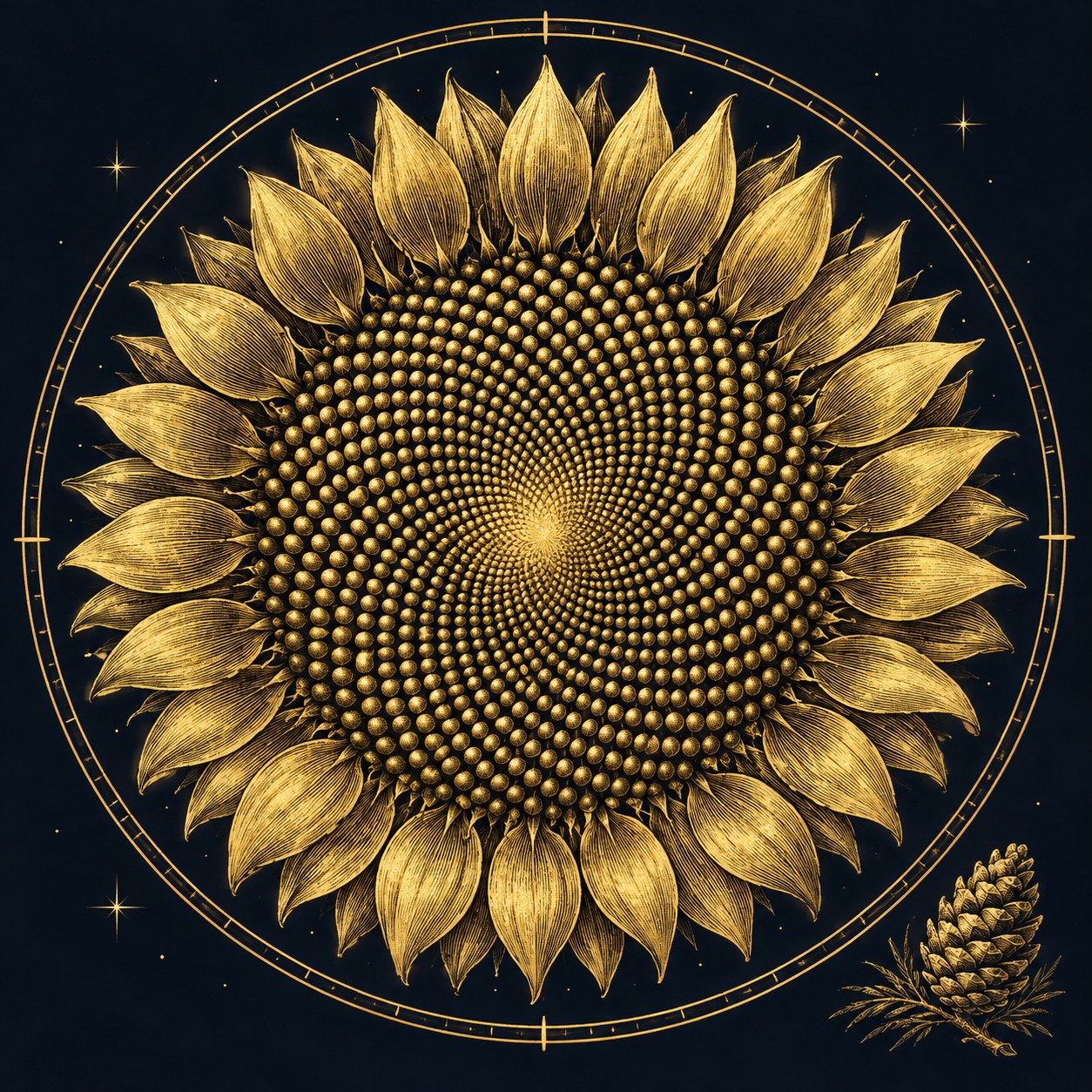
Count the spirals on a sunflower head. There are two sets, one winding left and one winding right, and if you count them you get two numbers, and the numbers are nearly always neighbours in one particular list: 21 and 34, or 34 and 55, or 55 and 89. The list is Fibonacci's, where each number is the sum of the two before it. Count a pinecone and you get 8 and 13. A pineapple, 8 and 13 again, or 13 and 21. The scales of a Romanesco, the florets of a daisy, the leaves around the stem of almost any plant. Nobody told the sunflower about Fibonacci. The question is what it does know.
One angle
The answer is an angle. A plant grows from its tip, and each new leaf or seed is laid down a fixed turn around from the last one. Two French brothers, Auguste and Louis Bravais, a crystallographer and a botanist, measured that turn in 1837 and found it was the same on almost everything: 137.5 degrees, give or take. It is the angle you get by dividing a full circle in the golden ratio, so it is called the golden angle, and it has one property no other angle has. Turn by it over and over and you never come back to where you started, and you never come close to coming back. Every other angle eventually repeats or nearly repeats, and when it does the new seeds line up behind the old ones in spokes, with wasted gaps between the spokes. The golden angle is the angle that never lines up, so every seed gets the most room, and the spirals you count are just the lines your eye draws through the seeds that happen to sit nearest each other. Which neighbours are nearest depends on how many seeds there are, which is why the numbers climb the Fibonacci list as the head gets bigger.
Watching it fail
The instrument below is Helmut Vogel's model of the sunflower from 1979: each seed is placed one angle after the last, a little farther out, so that the head stays evenly packed as it grows. At 137.5 you get a sunflower. Now nudge the dial. At 137.3, a fifth of a degree off, the head falls apart into spokes before your eyes; at 137.7 it falls apart the other way. At 120 it is three spokes and nothing else. The plant cannot afford to be off by a fifth of a degree, and it is not, and in 1992 two physicists in Paris, Stephane Douady and Yves Couder, showed why it does not have to try. They dropped drops of magnetic fluid onto a dish, one at a time, where each drop was pushed away by the ones before it and drifted outward. The drops arranged themselves at the golden angle, on their own, and formed Fibonacci spirals. The plant does the same thing with growing tips that push on each other. The angle is not knowledge. It is what pushing does.
The honest part
This is also the shelf where the most nonsense lives, so here is the sorting. The golden angle in plants is real and well measured. Fibonacci spiral counts on sunflowers are real but not universal: when the Museum of Science and Industry in Manchester got the public to count 657 heads, finishing an experiment Turing had planned before he died, about three in four were Fibonacci and the rest were other sequences or no sequence at all. The nautilus shell is not a golden spiral; it is a logarithmic spiral with a ratio of its own, and the overlay people put on it does not fit. Spiral galaxies and hurricanes are logarithmic spirals for a completely different reason, which is that their inner parts turn faster than their outer parts, and the golden rectangle drawn over the Milky Way is drawn over it afterward. The Parthenon, the pyramids and your face are not in the golden ratio either. One angle, in one family of growing things, for one good reason: that is the fact, and it does not need the rest.