
1644 to 1908, Warsaw
Why the giraffe is cracked
Georgy Voronoi, with Descartes and Dirichlet before him
A giraffe's hide, a dragonfly's wing, dried mud, beer foam and the voids between galaxies are one figure. It is what you get when things grow outward from scattered points and stop where they meet. Relax it, and it turns into honeycomb on its own.
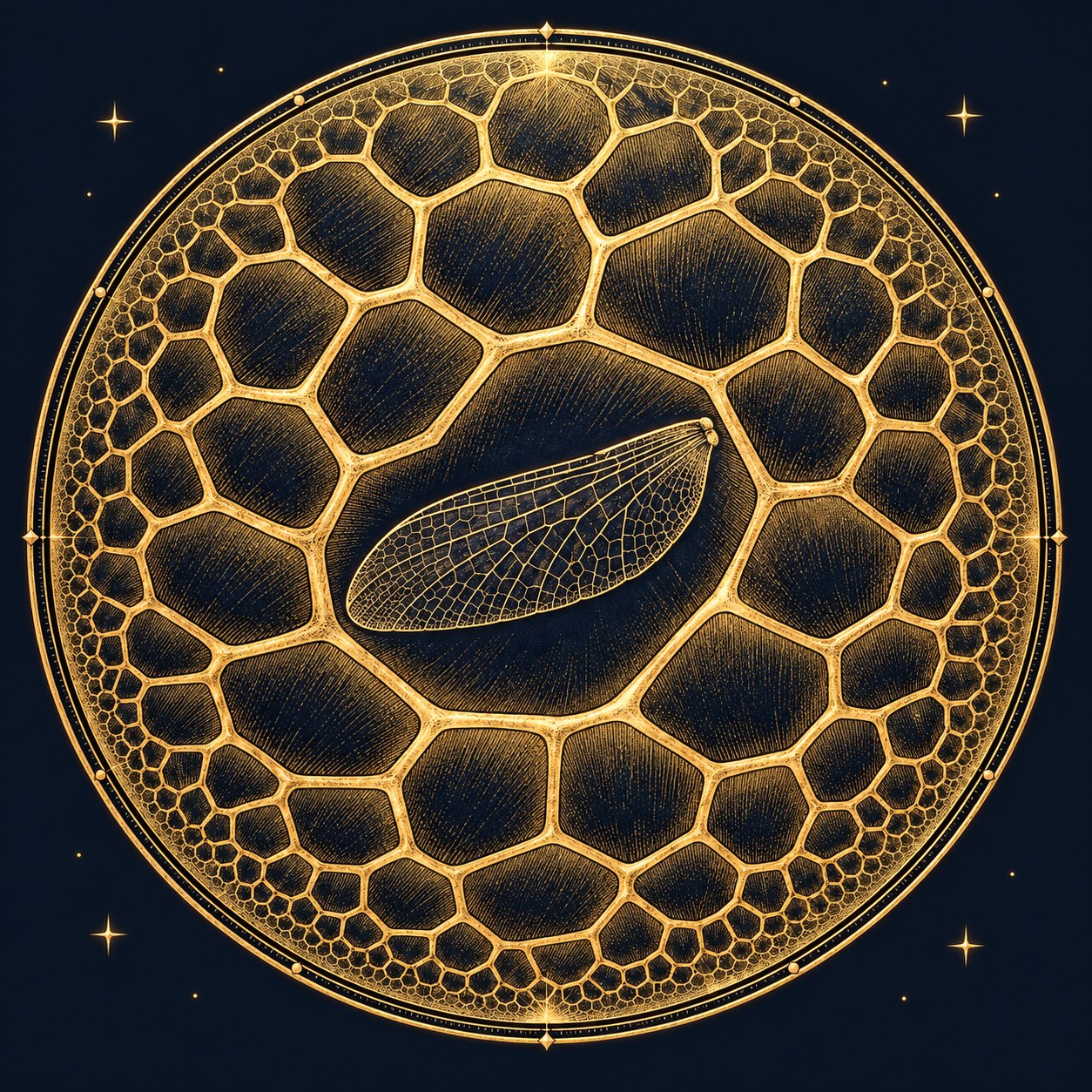
Look at a giraffe. The patches on its hide are not spots; they are tiles, irregular polygons with thin pale lines between them, and the lines meet in threes. Now look at the mud at the bottom of a dried pond, at the skin of a cantaloupe, at the wing of a dragonfly held up to the light, at the foam on a glass of beer, at a map of the voids between galaxies. The same tiles, the same thin lines, the same meetings in threes. The giraffe is drawn the way the universe is drawn at its largest scale, and nobody drew either.
Growing until you meet
The figure has a name, the Voronoi diagram, after Georgy Voronoi, a Ukrainian mathematician in Warsaw who wrote it down in 1908 in a paper about quadratic forms that has nothing to do with giraffes. Descartes had drawn something like it in 1644, trying to explain the planets with vortices. Dirichlet used it in 1850. The idea is this. Scatter some points. Give every spot on the page to whichever point it is closest to. Each point ends up owning a region, the regions tile the page, and the edges are exactly the lines that are the same distance from two points.
Nature does not measure distances. It does something that comes to the same thing: it grows. Start something at each point, a patch of pigment, a crystal, a bubble, a galaxy's pull, and let it spread outward at the same speed from all of them. Each one spreads until it runs into its neighbours. Where two meet is the same distance from both. Where three meet is a corner. The tiles are the regions that grew from each point, and the thin lines are the places the growing stopped. The giraffe's patches are patches of skin cells that spread from seed points in the embryo, and the pale lines are the frontiers. Mud cracks are the frontier the other way round: the mud shrinks away from scattered points until the cracks between them meet. Beer foam is bubbles pressing until their walls are flat and meet in threes. The voids between galaxies are regions of emptiness that grew, each from its own center, until the matter was swept into the walls between them.
The instrument
The plate below does the growing. Each point starts at a slightly different moment and spreads at the same speed, so you can watch the frontiers form and the corners click into place. Tap the plate and a new point starts growing where you touched, squeezing a new cell out of its neighbours. Then press relax. Each point slides to the middle of its own cell and the cells regrow. Do it three or four times and something happens that no one told the code to do: the cells turn into hexagons. A relaxed Voronoi foam is a honeycomb. That is why bees' cells are six-sided, why the basalt columns of the Giant's Causeway are six-sided, why there is a hexagon wider than two Earths at Saturn's north pole: not because anything aimed at six, but because six is what equal cells pressed together settle into.
The honest part
The giraffe is the least honest example here, which is why it is in the title. Its patches are close to a Voronoi tiling but not exactly one; the model that reproduces them best, from 1998, lets each patch grow at its own speed and lets the skin stretch while they grow, which bends the frontiers. The dragonfly wing is closer than the giraffe, and a 2018 paper got real wing veins out of almost nothing but growing cells and an inhibitor. Mud cracks are a sequence, not a scatter: the first crack runs, then the next one meets it at a right angle, so dried mud has more four-way corners than a true foam. And the cosmic voids are not really equal: a Voronoi foam is the standard first approximation to the cosmic web and a good one, not the thing itself. The figure survives all of this because it is not a law about giraffes. It is what happens whenever anything spreads from scattered points and stops when it meets itself, and that is a great deal of what happens.