
1952 to 1995, Manchester
Turing's leopard
Alan Turing, with Gray and Scott, and Shigeru Kondo
Alan Turing's last big paper asked how a ball of identical cells decides where the spots go. Two chemicals, one that feeds itself and one that stops it, spreading at different speeds. Nobody believed it for forty years. Then they found the chemicals.
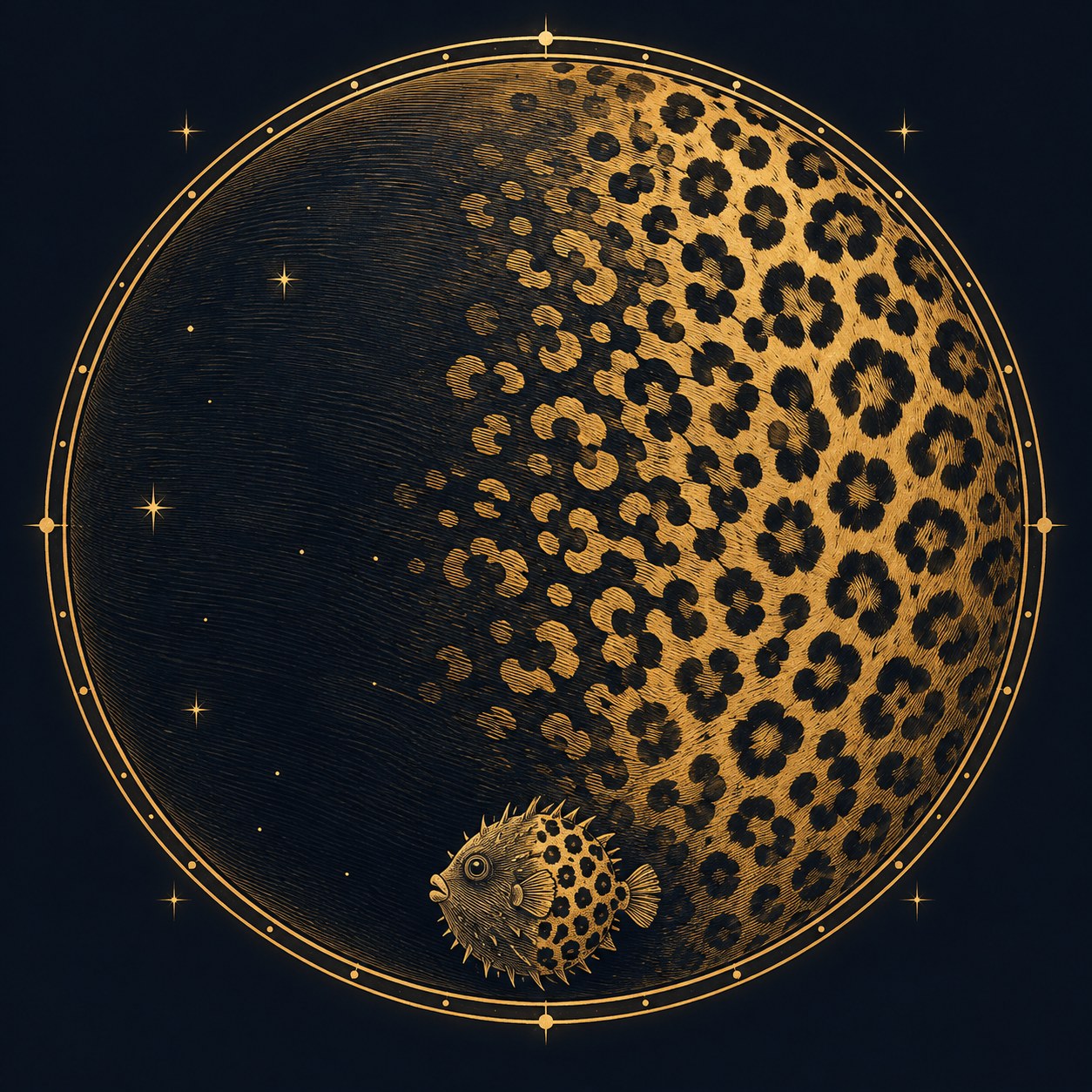
In 1952 Alan Turing, who had broken the German naval code and laid out what a computer was before one existed, published a paper about how a leopard gets its spots. It was his last big piece of work. He asked a question nobody had an answer to: an embryo starts as a ball of identical cells, every one running the same chemistry. How does it decide where the spots go? How does anything that starts the same everywhere end up different in one place than another?
Two chemicals
His answer was two chemicals and one trick. Call them the activator and the inhibitor. The activator makes more of itself, and also makes the inhibitor. The inhibitor shuts the activator off. Both spread through the tissue, but the inhibitor spreads faster. Now suppose a patch has slightly more activator than its surroundings, by chance. The patch makes more of itself and grows. But it also makes inhibitor, which runs out ahead of it and stops any activator from starting nearby. So you get a spot, and a clear ring around the spot, and beyond the ring, far enough away that the inhibitor has thinned out, another spot can start. Turn the rates a little and the spots stretch into stripes. Turn them again and the stripes break into a maze. Turing wrote the equations, ran a few of them on the Manchester computer, and said: this will paint a leopard, a zebra, the dappling on a cow, and probably a good deal else. Then he died, two years later, and almost nobody read the paper for a generation.
Finding the chemicals
It was a theory with no chemicals in it. The first time anyone made a Turing pattern in a dish was 1990, in Bordeaux, with a reaction that arranged itself into rows of yellow spots on its own. In 1995 Shigeru Kondo in Kyoto watched the stripes on a marine angelfish actually move as the fish grew, splitting and spacing themselves exactly as the equations said they should, which no other theory of pigment could explain. In 2006 a group in Freiburg found two proteins, WNT and DKK, that behave as Turing's activator and inhibitor and set the spacing of the hair follicles on a mouse. In 2012 the ridges on the roof of a mouse's mouth turned out to be a Turing pattern too, and then the fingers of a hand, which are stripes. He was right about nearly all of it, sixty years early, from an armchair.
The instrument
The plate below runs two chemicals, one that feeds itself and one that eats it, in the version of Turing's equations that Patrick Gray and Stephen Scott wrote down in 1984 and that John Pearson mapped in 1993. Two numbers set the whole character: how fast fresh chemical is fed in, and how fast the product is taken out. Leopard, zebra, pufferfish and giraffe are four pairs of numbers. Draw on the plate with your finger and the pattern heals around the mark, which is the part that convinces people: the spots are not painted on, they are being held in place by the chemistry every moment, and they come back when you disturb them.
The honest part
Not every pattern on an animal is a Turing pattern. The giraffe's patches are mostly the Voronoi figure from the plate next door, grown from seed points, and a Turing system only sharpens the edges. Zebra stripes are set at three different times for three different parts of the body, which is why the spacing differs. Many of the systems that behave like Turing's turn out to use mechanics, cells pulling on each other, as much as chemistry. And the leopard that gave the paper its name has never had its chemicals found; the proof is on fish, mice and chickens. The equations are more general than Turing knew and less universal than his fans claim. What stands is the trick: one thing that makes itself and one that stops it, spreading at different speeds, is enough to turn a blank into a pattern with nobody drawing. It is the shortest recipe on this shelf, and it is the one running in your skin.