
Always, and only for now, Everywhere you can see the Moon from
Unlikely coincidences
The sky, the calendar, and a few numbers that agree for no reason
The Sun is four hundred times wider than the Moon and four hundred times farther away, so the two look exactly the same size from here, and nothing in physics says they should. This shelf is the matches in the cosmos that mean nothing and are true anyway, with the honest note under each one.
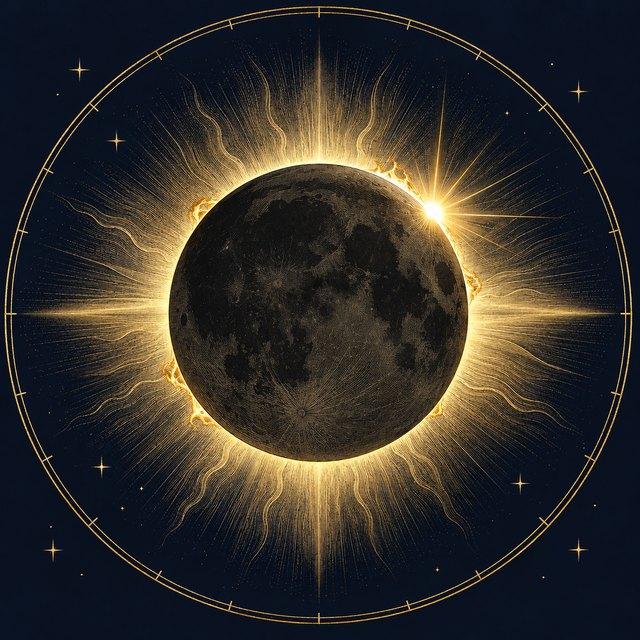
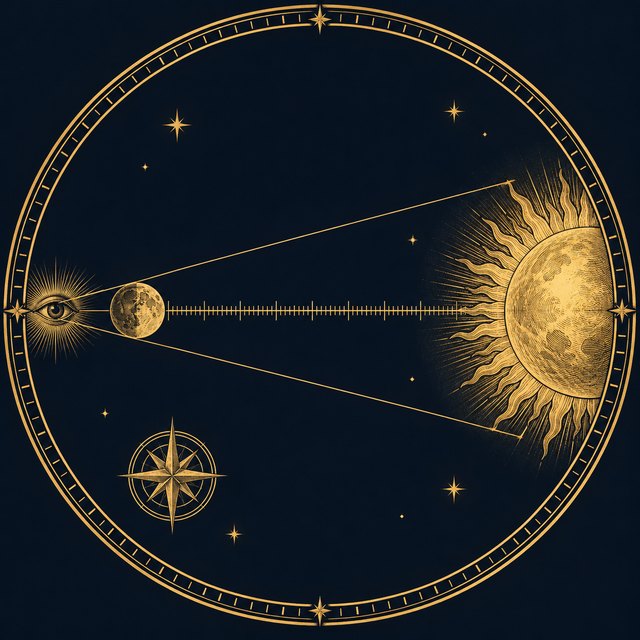
Hold a pea out at arm's length. It covers the Sun. Hold it out at night and it covers the Moon. The Sun is four hundred times wider than the Moon, and it happens to be four hundred times farther away, so from the one place we stand the two biggest things in the sky are the same size. Nobody arranged this. The Moon was knocked off the Earth by a collision, the Sun is as big as its weight makes it, and no law connects the one to the other. It is a coincidence, and it is the best one there is, because of what it lets us see.
The match in the sky
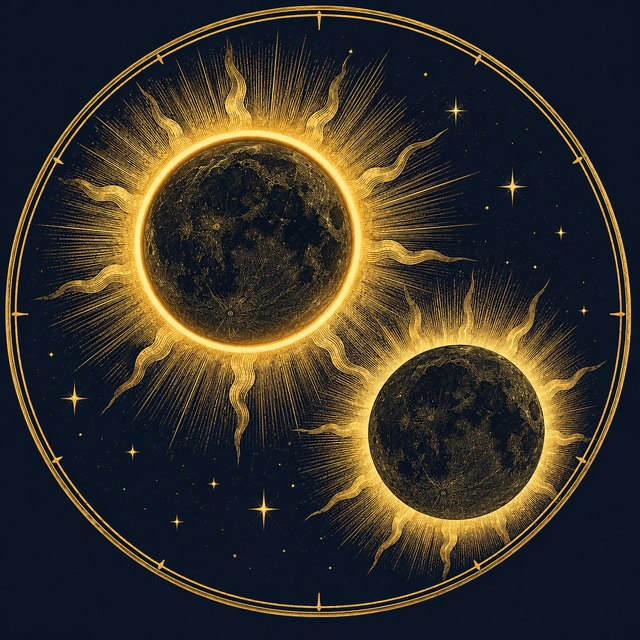
The match is close, not exact, and the slack is the whole story. The Moon's path around us is more of an oval than ours around the Sun, so the Moon swells and shrinks in the sky more than the Sun does. When the Moon is on the near side of its oval and crosses the Sun, it covers the Sun completely. The day goes to a strange blue dusk, the stars come out, and around the black disc you see the corona, the Sun's outer atmosphere, streaming out in pale rays. That is a total eclipse. When the Moon is on the far side it is a little too small, it sits inside the Sun's disc, and what is left is a ring of fire. That is an annular eclipse. Our sky can do both, and does them about equally often. No other sky in the solar system can. From Mars the moons are specks crossing the Sun. From Jupiter the moons swallow it with room to spare and there is no ring and no corona. Only here does the coin land on its edge.
That edge is where a surprising amount of science came from. In 1868 astronomers watching an eclipse in India saw a line in the Sun's light that matched no element known on Earth. They named it helium, for the Sun, and found it in the ground twenty-seven years later. The corona itself could not be studied at all except in those few minutes of totality until someone built an instrument to fake an eclipse in 1930. And in 1919 Arthur Eddington took a telescope to an island off Africa, photographed stars beside the eclipsed Sun, and measured how far the Sun's gravity had bent their light. The numbers matched Einstein's and not Newton's, and the next morning Einstein was famous. Every one of those discoveries needed a Moon that fits the Sun exactly.
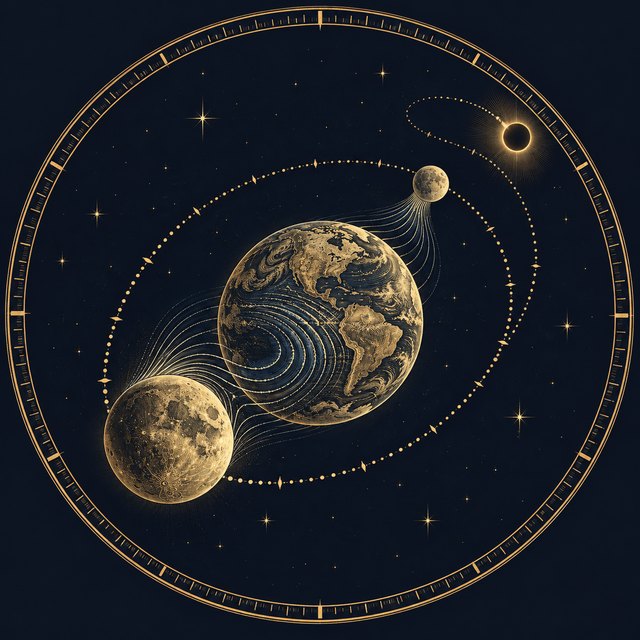
It will not last. The Moon is moving away from us at about an inch and a half a year. We know because the Apollo crews left mirrors on it and we have been bouncing lasers off them for fifty years. When the Moon was young it was far closer and looked enormous, and every eclipse was total and black. It has been easing out ever since, and the ring of fire is a fairly recent addition to the sky. In six hundred million years or so it will have backed off far enough that it can no longer cover the Sun at all, and the last total eclipse, by the most careful count, comes in about a billion years. The window in which a sky can do both tricks is a few billion years wide. We showed up inside it. Slide the Moon through that time below and watch the eclipse change.
The shelf
The Sun and Moon are the first entry. Here are the rest, each with the match, and under it the honest note: how much of the match is real and how much is us. A shelf that only showed the matches that mean something would be selling you something, and two of these are pure accidents, included on purpose.
The saros
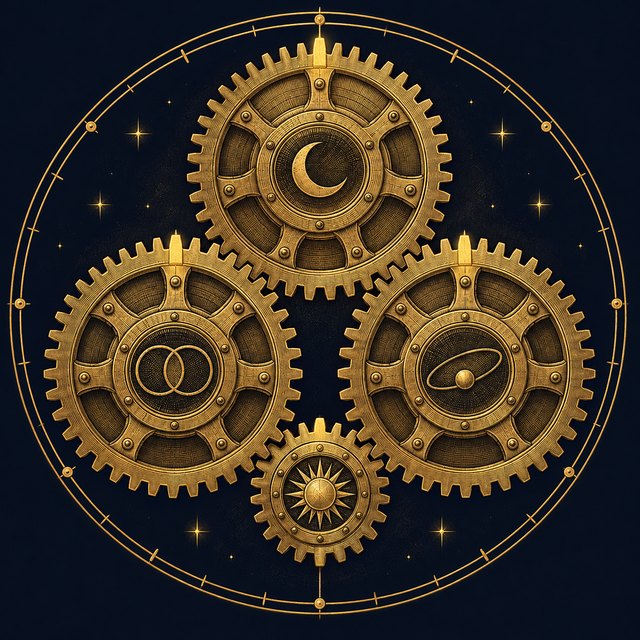
Three different lunar clocks, the one that counts new Moons, the one that counts the Moon's crossings of the Sun's path, and the one that counts its closest approaches, all come back into step after 18 years, 11 days and 8 hours. So an eclipse repeats, nearly the same, one saros later, and the extra eight hours carry it a third of the way round the world. The Babylonians found this by writing down eclipses for centuries, and Edmond Halley used it to tell London the exact minute its sky would go dark in 1715. He was four minutes off.
This is arithmetic, not mystery, but nothing makes three lunar periods line up, and they only nearly do. A saros series runs for about thirteen centuries and then quietly dies.
Nineteen years
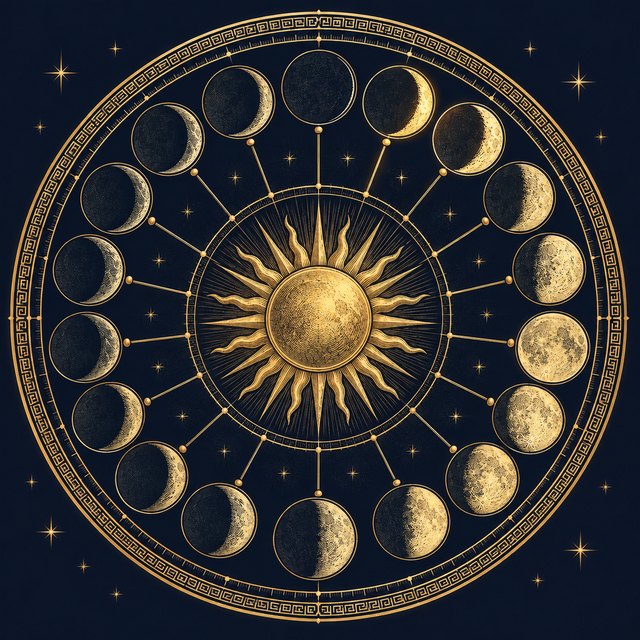
Two hundred and thirty-five months of the Moon and nineteen years of the Sun differ by two hours. So the phases of the Moon come back to the same dates every nineteen years. Meton announced it in Athens in 432 BC. The Jewish calendar runs on it, and so does the date of Easter, which is still fixed by a number called the golden number, a year's place in the nineteen.
A plain coincidence between two periods that have nothing to do with each other. The two hours add up, which is why the calendar had to be fixed in 1582.
The Sun turns while the Moon goes round
Watch a sunspot: it comes back to the same place every 27.3 days. Watch the Moon against the stars: it comes back to the same place every 27.3 days.
The Sun is not solid and turns faster at its middle than at its poles, and the 27.3 is one chosen latitude. This is a soft match, and the kind that gets found because somebody went looking.
The Moon moves its own width in an hour
It is half a degree wide and it slides east through the stars at half a degree an hour. When it covers a star, the star is gone for about an hour; when it covers the Sun, the whole show takes about two.
This one follows from the match above and the length of the month, so it is a consequence, not a third coincidence. It stays on the shelf because astronomers use it every night.
The Moon is three elevenths of the Earth
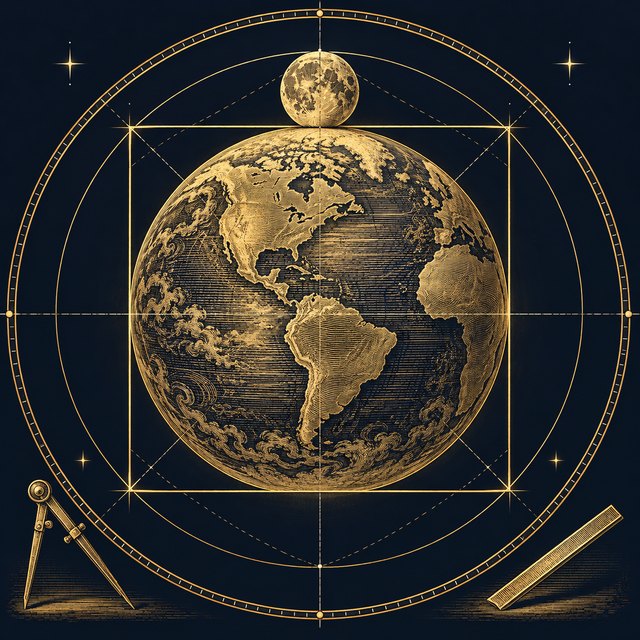
The Earth is 7,920 miles across and the Moon is 2,160, and that is 11 to 3, almost exactly. Add them and halve them and you get 5,040, which is 7 times 6 times 5 times 4 times 3 times 2 times 1, and is the number of households Plato gave the ideal city in the Laws. Draw a square tight around the Earth and its edge measures 31,680 miles. Set the Moon on top of the Earth, draw a circle through the Moon's centre, and with pi taken the old way as 22 over 7 that circle also measures 31,680. The square and the circle agree, which is the thing the Greeks spent two thousand years failing to do with a compass.
A big one. The mile is a unit people made up, 22 over 7 is not pi, and the rounding is doing the work. It is still the prettiest accident on the shelf.
The rose of Venus
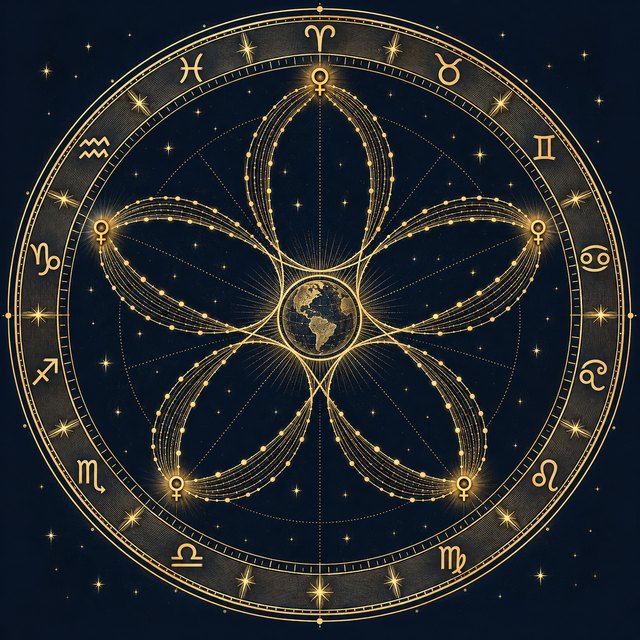
Every eight years Venus comes back to almost the same spot in our sky, and in those eight years it has swung close to the Sun five times. Mark the five spots on the zodiac and you have drawn a near perfect five pointed star. Trace the whole path and it is a rose with five petals. In those same eight Earth years Venus goes round the Sun thirteen times, and eight and thirteen sit next to each other in the Fibonacci sequence.
The star turns a couple of degrees each time, so it never closes, and nobody has shown a reason for it. The Fibonacci pair is luck.
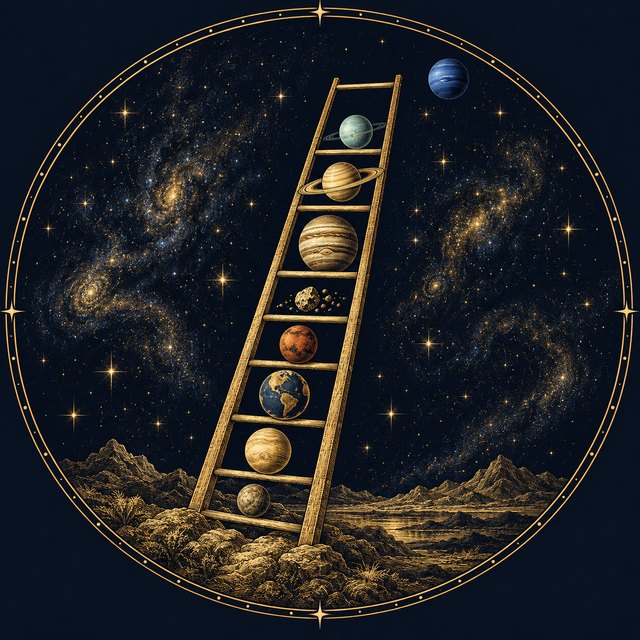
The ladder of planets
Take 0, 3, 6, 12, 24, 48, 96, add four to each and divide by ten. You get the distances of the planets from the Sun, in Earth distances, to a decimal place or so, Mercury through Saturn, with one empty rung between Mars and Jupiter. The rule put Uranus on the next rung before Uranus was found in 1781, and sent astronomers to the empty rung, where they found Ceres on the first night of 1801. Then Neptune turned up well short of its rung and the rule has been an orphan ever since.
Most people who study orbits call it a coincidence with a grain of truth in it, since planets cannot sit too close together. It found two worlds anyway.
Ten to the fortieth
The electric pull between a proton and an electron is about ten thousand trillion trillion trillion times stronger than the gravity between them. The age of the universe, counted in the time light takes to cross an atom, is about the same number. So is the square root of the number of particles in everything we can see. Paul Dirac, who had already predicted antimatter, could not accept three numbers that size agreeing by chance and proposed in 1937 that gravity is slowly weakening. It is not, as far as anyone can measure.
In 1961 Robert Dicke gave the answer that stuck: the universe is this old because it had to be, to make the carbon that makes the astronomer. That reply is the seed of the argument on the fine tuning shelf, so it is told there and not here.
Twenty-seven words
In 1951 a physicist named Friedrich Lenz published what may be the shortest paper in the history of the Physical Review. It said that the mass of the proton divided by the mass of the electron, then measured as 1836.12, is six times pi to the fifth power, which is 1836.118. Seventy years of better measurement moved the ratio to 1836.153.
Still within two parts in a hundred thousand, now outside the error bars, and generally filed under coincidence. It is on this shelf for the twenty-seven words.
The coincidence problem
This one has its name in the textbooks. About sixty-nine percent of the universe is dark energy and about thirty-one percent is matter. Matter thins out as the universe grows and dark energy does not, so in the past the two were wildly unequal and in the future they will be again. The only era in which they are within shouting distance of each other is this one, the era with astronomers in it.
Nobody knows whether this is the anthropic answer again or a clue about what dark energy is. It is the one entry on the shelf where the people who know the most are the least sure.
What Jung would say
The arithmetic is honest and it says coincidence, every time. Put twenty-three strangers in a room and two of them share a birthday half the time; count the thousands of matches that could have happened and the one that did stops being special. Jung, who has his own essay on the lineage, did not argue with any of that. He asked a different question. Granted the match had to happen somewhere, why did it happen where you could see it. The Moon fits the Sun. It did not have to, it will not always, and it does now, over the only planet with anyone on it to look up. Make of that what you like. This shelf will only insist on the numbers.