
This minute, every cycle the cosmos runs on
The clocks
Where we are in every cycle this minute, and what a minute is
Ten dials, one for every cycle the cosmos runs on, from the day to the Sun's lap round the galaxy, each one live and reading where we are this minute, with a counter under it for how far its hand has turned since you opened the page. Then the harder half of the question, what a second is, why a clock on a mountain runs fast, why there is no now, which way time points, and the one question Augustine could not answer.
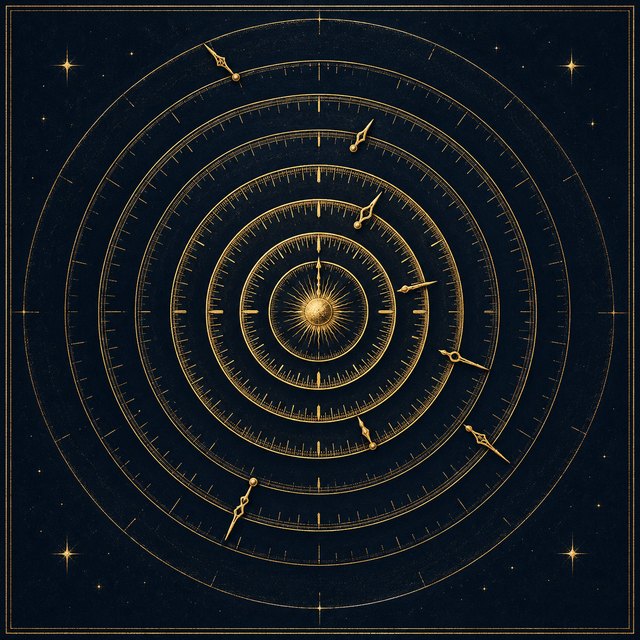
The sky page is where everything is. This page is when. Every cycle the cosmos runs on is a dial here, from the one you can see move to the one that has not visibly moved since the first dinosaurs, and every hand is driven by the same ephemeris and the same clock, yours, so that what the dials read is where we are at this minute. Under each hand is a counter for how far it has turned since you opened the page. Some of those numbers are small. All of them are true.
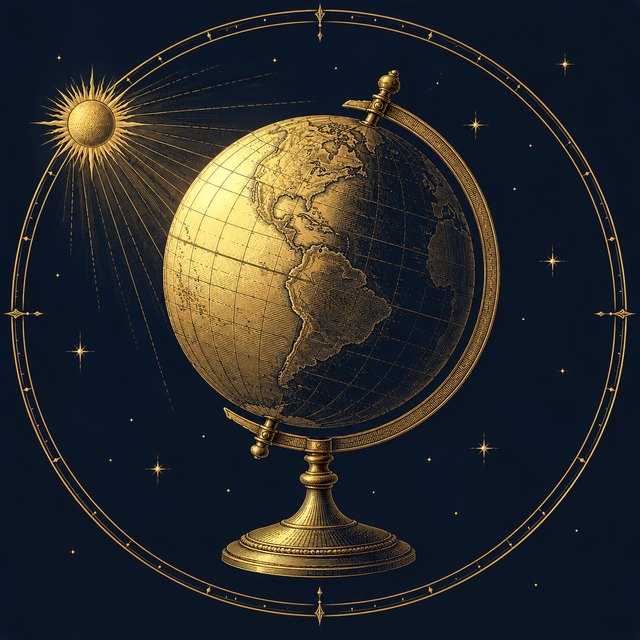
Once round in 24 hours
The day
One turn of the Earth, midnight at the top and noon at the bottom.
The hand goes once round in a day of your clock, midnight at the top and noon at the bottom. It is the only hand on this page you will see move, and even it is slow: a quarter of a degree a minute. The Earth turns once against the stars in 23 hours, 56 minutes and 4 seconds; the four minutes left over are the Earth catching up with a Sun that moved on while it turned. And the day is getting longer, which has its own entry further down.
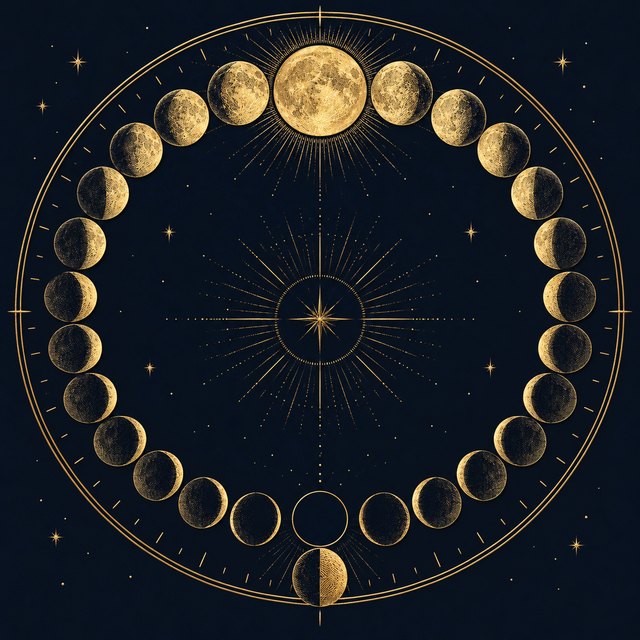
Once round in 29 days 12 hours 44 minutes
The month
One month of the Moon, new at the top and full at the bottom.
One turn is one month of the Moon, new Moon at the top and full at the bottom. The Moon goes round the Earth in 27 days and 8 hours, but the Earth has moved along its own road meanwhile and the Moon needs two more days to catch the Sun up again, which is why the month is longer than the orbit. The phase and the age are computed from the same ephemeris that draws the sky.
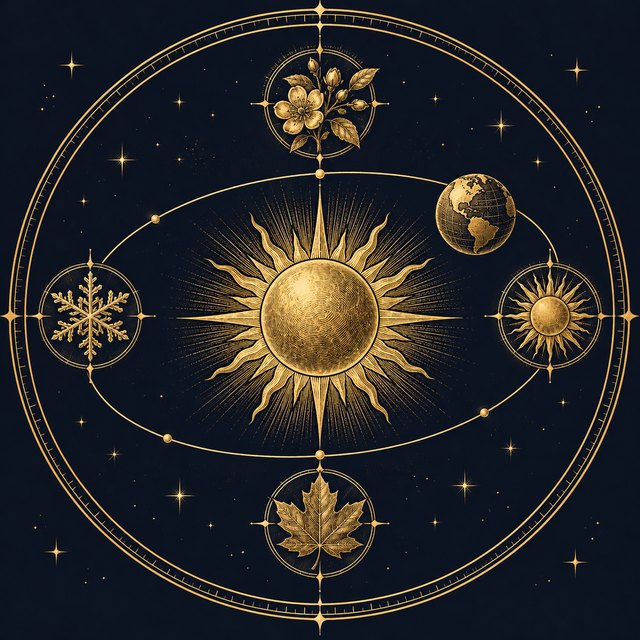
Once round in 365 days 5 hours 49 minutes
The year
One year, counted from the March equinox at the top.
One turn is one year, counted from the March equinox at the top, with the solstices and the September equinox at the quarters. The year is 365 days, 5 hours, 48 minutes and 45 seconds long, which is why there is a leap day, and why 1900 was not a leap year and 2000 was.
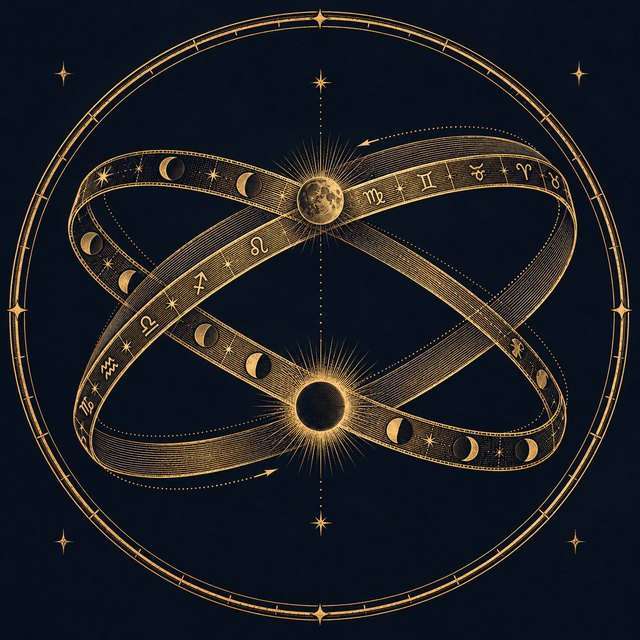
Once round, backward, in 18.6 years
The Moon's wobble
The two crossings of the Moon's path and the Sun's slide backward round the sky.
The Moon's path is tilted five degrees to the Sun's, and the two places where they cross, the nodes, slide backward round the sky once every 18.6 years. An eclipse can only happen when the Sun is near a node, which is why eclipses come in seasons about six months apart. The long hand is the ascending node, the short one the descending node, and the small sun on the ring is the Sun; when it comes within about eighteen degrees of either hand, it is eclipse season. The eclipse itself, at its true size, is on the coincidences shelf.
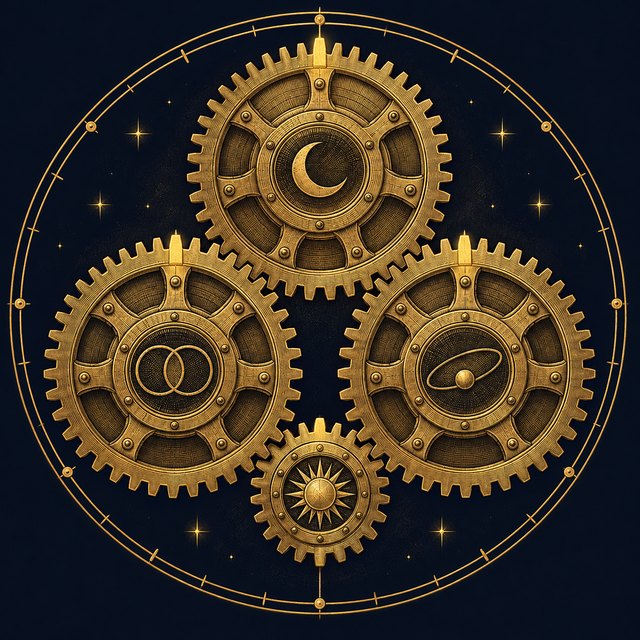
Once round in 18 years 11 days 8 hours
The saros
Counted from the eclipse of April 8, 2024.
Three lunar clocks, the one that counts new Moons, the one that counts the Moon's crossings of the nodes above, and the one that counts its closest approaches to the Earth, come back into step after 18 years, 11 days and 8 hours. So an eclipse repeats, nearly the same, one saros later, and the extra eight hours carry it a third of the way round the world. This dial counts from the total eclipse that crossed America on April 8, 2024. The hand comes back to the top on April 20, 2042, when that eclipse's sibling falls over Indonesia.
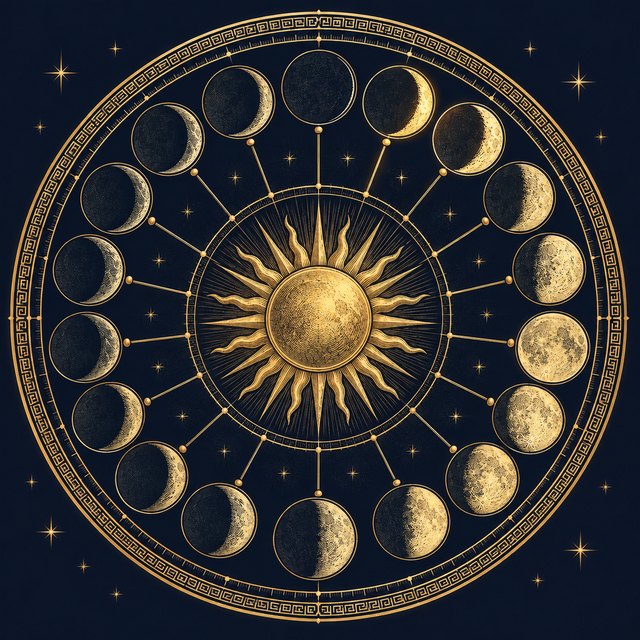
Once round in 19 years, 235 months
Nineteen years
The Moon's phases come back to the same dates every nineteen years.
Nineteen years of the Sun and 235 months of the Moon differ by two hours, so the phases of the Moon come back to the same calendar dates every nineteen years. The church counts a year's place in the nineteen as its golden number and still fixes Easter by it; the hand reads this year's golden number and when these dates come round again. Why the two periods agree at all is on the coincidences shelf: they do not have to.
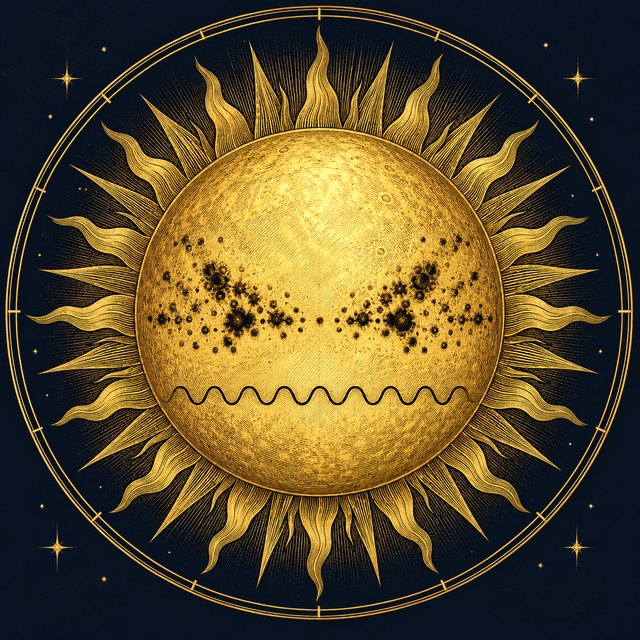
Once round in about 11 years
The Sun's cycle
Counted from the maximum of Cycle 25 in October 2024.
The Sun's spots come and go on a cycle of about eleven years, found by Heinrich Schwabe in 1843 after seventeen years of drawing the Sun every clear day. Cycle 25 reached its maximum in October 2024, and the hand is counted from there. The honest note: the cycle runs anywhere from nine to fourteen years, nobody predicts the next one well, and this dial turns at the average.
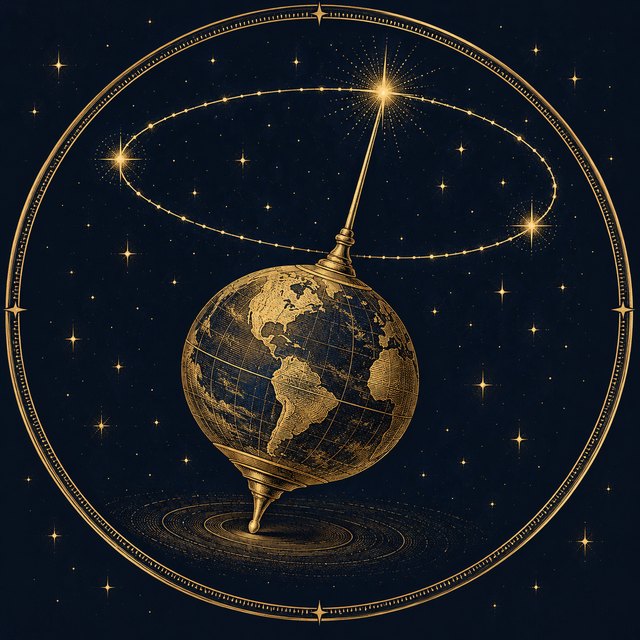
Once round in 25,772 years
The slow turn
The pole wanders round a circle in the stars and the pole star changes.
The Earth's axis wobbles like a slowing top, once round in 25,772 years, so the pole star changes. Thuban in Draco had the job when the pyramids went up, Polaris has it now and is closest in the year 2100, and Vega takes it around AD 13,700. The hand started at Thuban. The counter under it is true; it is just small.
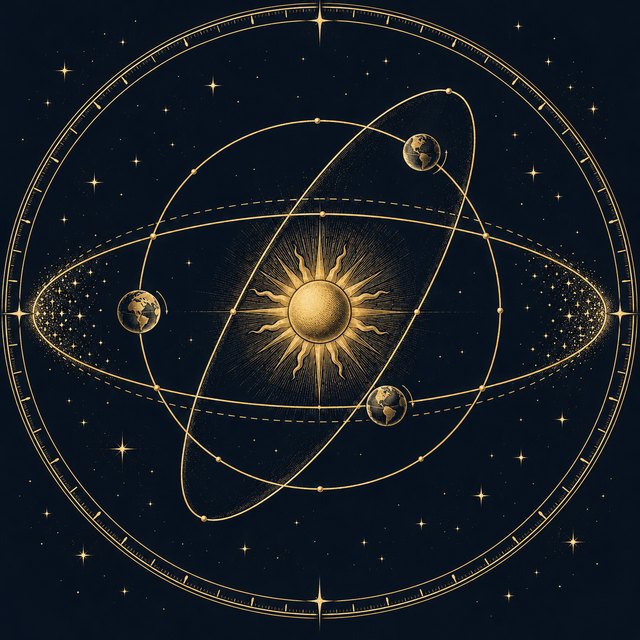
Three hands, 41,000, 100,000 and 21,000 years
The ice-age wobbles
The tilt, the stretch of the orbit, and the season the Earth is nearest the Sun.
Three hands. The long one is the tilt of the Earth's axis, which rocks between 22.1 and 24.5 degrees every 41,000 years and is 23.44 degrees and falling. The middle one is the stretch of the orbit, which goes from nearly round to a visible ellipse and back on about 100,000 years and is at 0.0167 and falling. The short one is which season the Earth is nearest the Sun, which comes round every 21,000 years or so and is January now. Milutin Milanković worked out in the 1920s that these three together set when the ice comes, and the deep-sea cores proved him right in 1976. The long and middle hands are placed roughly; the record is not exact enough to do better.
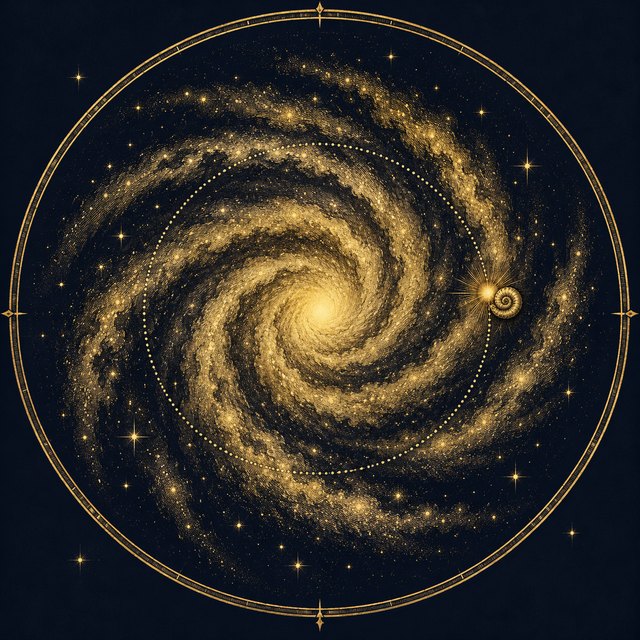
Once round in about 230 million years
The galactic year
One lap of the Sun around the Milky Way.
The Sun goes round the Milky Way once in about 230 million years, at about 230 kilometres a second, 26,000 light years from the centre. Last time it was here the first dinosaurs had just appeared. The hand is drawn where the Sun is now and will not visibly move in the life of anyone who reads this. The counter under it does.
Time itself
That is where we are. The rest of this page is about what the hands are made of. A second is an atom's habit. A clock on a mountain runs fast, and so does your head. There is no moment that is now for everyone. The day is getting longer, the candle will not unburn, and sixty and seven and twenty-four are an old empire's arithmetic. Each entry below ends with the honest note, which says how much of it is settled.
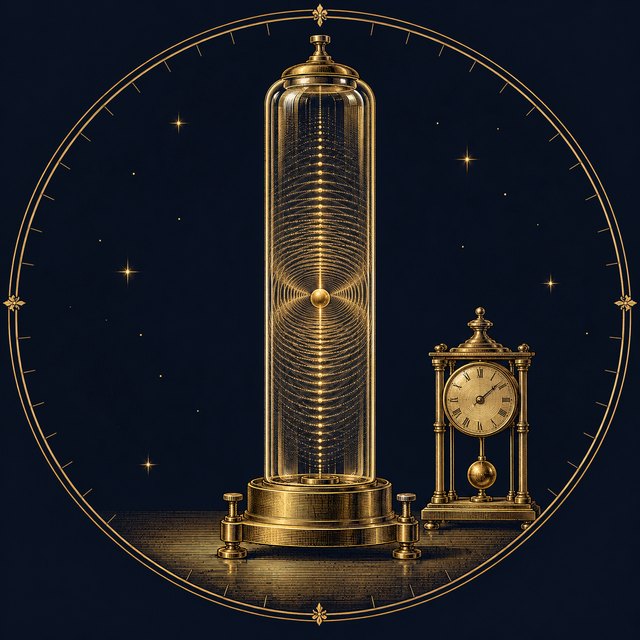
What a second is
Since 1967 the second has been 9,192,631,770 swings of the radiation a cesium-133 atom gives off as it flips between its two lowest states. Before that it was a fraction of the year, and before that a fraction of the day, and the day turned out not to be steady, which is the entry two below. The cesium second is kept by fountain clocks, in which a cloud of atoms is tossed up through a microwave cavity and falls back through it, and it is good to about one second in a hundred million years. The newest optical clocks, which count the far faster swings of a strontium or ytterbium atom, would lose less than a second over the age of the universe, which makes them the first things people have built that are more regular than the sky.
The second is the only unit defined by an atom and then handed down to everything else: the metre is now the distance light goes in a certain fraction of it. The next step, moving the definition to an optical atom, is expected in the 2030s and is not yet decided.
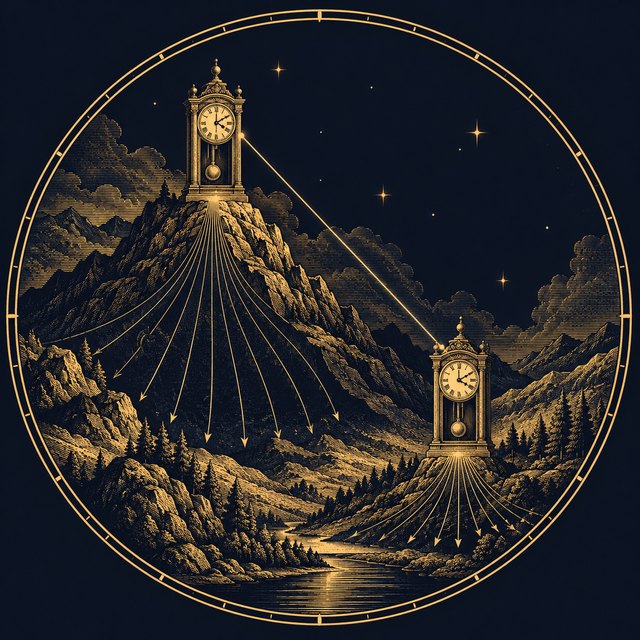
The high clock
A clock higher in the Earth's gravity runs faster than one lower down, by about one part in ten thousand trillion for every metre. In 2010 a team at the National Institute of Standards and Technology in Boulder, Chou, Hume, Rosenband and Wineland, compared two aluminium-ion clocks and watched one gain on the other when it was lifted thirty-three centimetres. The satellites that find your phone are twenty thousand kilometres up and run about 38 microseconds a day fast, 45 from being high and 7 slow from moving quickly, and the system corrects for it or every position on the map would drift ten kilometres a day. The four clocks that flew round the world in 1971 are under the twins on the paradoxes shelf.
Since you opened this page your head has been gaining on your feet.
Your head is about 1.7 metres above your feet, so it is higher in the field too, and it also runs fast. The counter above is live, from g times h over c squared, and the number it reads is real.
There is no now
Two events that happen at the same moment for one observer do not for another who is moving past, and there is no fact about which of them is right. Einstein removed the universal present in 1905 and it has not come back. What you see instead is a sky of pasts: the Sun as it was eight minutes and twenty seconds ago, the Moon a second and a quarter ago, Andromeda as it was two and a half million years ago, before there were people to look. The sky page draws all of it as it is now, which, on this page, means as its light left.
The philosophy of this, the view that past, present and future are all equally there and now is only where you happen to be standing, has its own essay in the lineage.
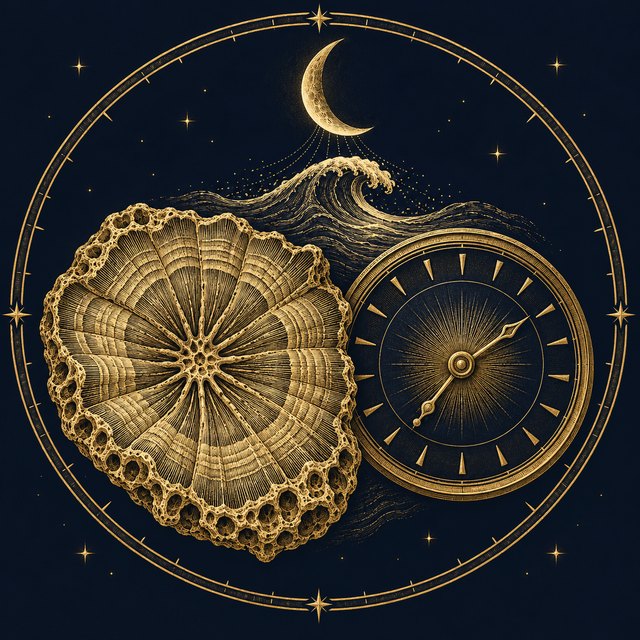
The longer day
The Moon's tides are a brake, and the day is getting longer by about 1.7 milliseconds a century. The proof is in corals. In 1963 John Wells counted the daily growth lines in Devonian corals and found about four hundred to a yearly band, so four hundred million years ago the year had four hundred days of twenty-two hours. The leap second was the patch: twenty-seven of them since 1972, the last on the last day of 2016, each one holding the atomic clocks back a second so that noon stayed noon. In 2022 the General Conference on Weights and Measures voted to stop adding them from 2035.
The day dial at the top of this page carries this quietly. Its hand is a hair slower than it was when the corals grew, and a hair faster than it will be.
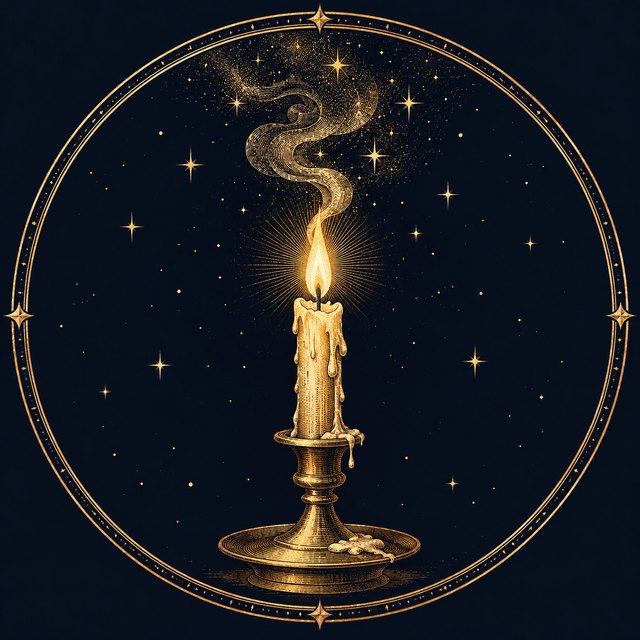
The arrow
Every law of motion runs the same backward as forward; a film of two billiard balls colliding looks right in reverse. The candle does not unburn. The direction comes from counting: there are vastly more ways for the wax to be smoke than for the smoke to be wax, so smoke is where things go, and that is the whole of the arrow. Ludwig Boltzmann saw it in the 1870s. The catch, which he also saw, is that counting only gives a direction if the universe started in a very unlikely tidy state, and nobody knows why it did.
The strange cousin of this entry, the brain that condenses out of the void with false memories, is on the paradoxes shelf. Whether the arrow is a law or only a fact about how things began is open, and this page says so.
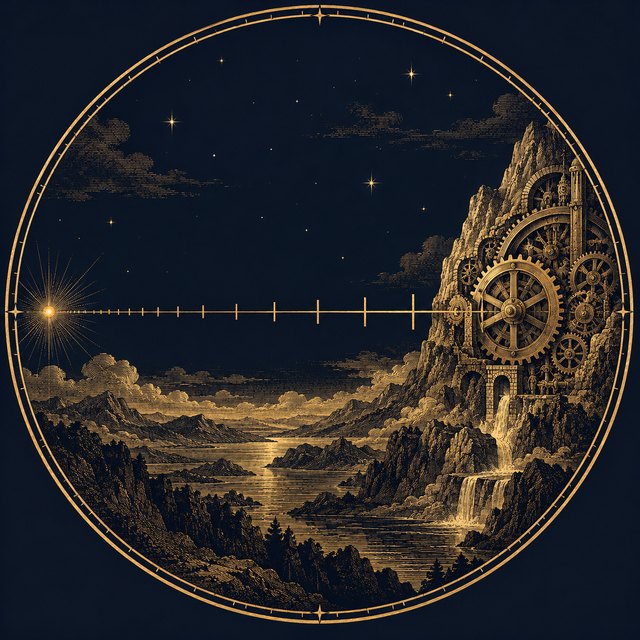
The smallest and the largest tick
At one end, the Planck time, five point four times ten to the minus forty-four seconds, the scale at which our two best theories stop agreeing about what time is. It is not a proven smallest tick; it is the edge of what the theories can say. At the other end, a clock is being built inside a mountain in west Texas by the Long Now Foundation, meant to run for ten thousand years, wound by the visitors who climb to it, with a chime that never plays the same sequence twice. Every dial on this page sits between those two bookends.
Ten thousand years is about the age of farming, and the clock is a bet that there will be someone to hear the chime. The Planck time is a number from a formula; nobody has measured anything near it.
Sixty, seven, twenty-four
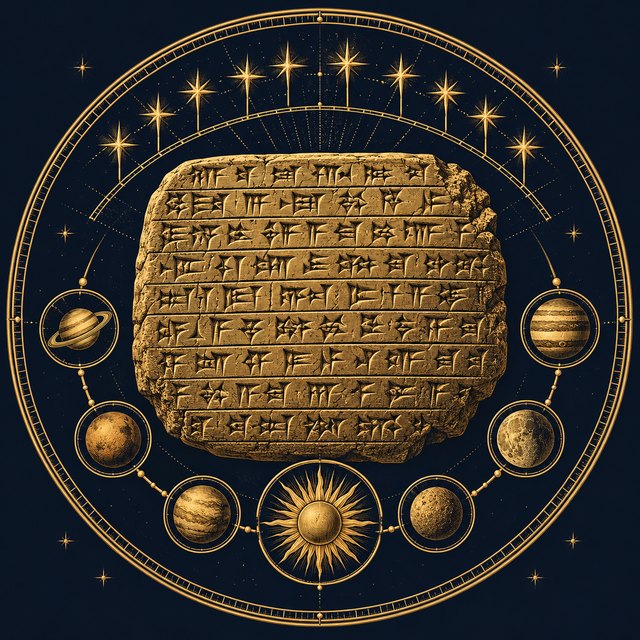
Sixty is from Babylon, which counted in sixties because sixty divides cleanly by two, three, four, five, six, ten, twelve, fifteen, twenty and thirty, and the minutes and seconds on your wrist are Babylonian arithmetic four thousand years on. Twenty-four is from Egypt, which marked the night by the rising of twelve stars in turn, the decans, and gave the day twelve hours to match. Seven is the seven wandering lights, the Sun, the Moon and five planets, each ruling an hour in turn, which is why the days of the week fall in the order they do and are still named for the planets across most of Europe.
The planetary hours are still kept next door on Harmony of the World, which is the one place on this page where the Cast your chart button has a reason to exist.
What then is time
We are the only species in the universe that measures something that does not exist.
Dolores Cannon said that, in a recording playing in the next room on the night this page was planned, while the page was in the middle of asking what a second is. She was a hypnotist in Arkansas who spent forty years writing down what her clients said in deep trance, and the line is their verdict on Earth, as her books report it: that time is a local habit of this planet, and that we are the odd ones in the universe for measuring it. The page keeps it as what it is, trance testimony, and sets it beside physics' own verdict from 1905, that there is no universal now, and lets the two rhyme without arguing with either. The coincidence of the timing is logged on the coincidences shelf, where it qualifies.
The honest aside, in this site's voice: we are not the only species on this planet that keeps time. Bees return to a flower at the hour it opens. Periodical cicadas count thirteen and seventeen years underground and come up together. Every cell you have carries a clock that runs a little over a day. But we are the only ones who asked what a second is, and then built one.
Augustine asked the question in about the year 400, in the eleventh book of the Confessions, and gave the only answer anyone has improved on since: What then is time? If no one asks me, I know; if I wish to explain it to one who asks, I do not know. The dials above are still turning. That is the whole of the answer this page has.