
1998 and 2026, Cerro Tololo, Kitt Peak and Brisbane
Is one of the dials turning?
Riess, Schmidt and Perlmutter, then a ruler in Arizona and 2,884 exploding stars
The sky is emptying. Since 1998 we have known that something is pushing the galaxies apart faster every year, and that if it keeps on, the far future is one island of stars in a black sky with the evidence for everything else gone. For a quarter of a century the push looked like a constant of nature. Two instruments now say it may be fading, at three sigma, which in physics means interesting and not yet true.
In the first week of January 1998 a young astronomer named Adam Riess sat at a computer in Berkeley and fitted a curve to the faintness of some exploding stars, and the fit told him how much matter the universe contained. The number came out negative. There is no such thing as a negative amount of matter, so he assumed he had made a mistake, and spent days looking for it. He had not made a mistake. The stars were too faint because they were farther away than anything allowed, and the only way to get them that far was for the expansion of the universe to be speeding up. His team leader, Brian Schmidt, said his own reaction was somewhere between amazement and horror. Up the hill at the Lawrence Berkeley lab, a rival team under Saul Perlmutter, which did not much like Schmidt's team and was not much liked back, had the same impossible curve. Both announced within weeks of each other. Science magazine put Einstein on its cover, looking startled, and named it the discovery of the year. In 2011 Riess, Schmidt and Perlmutter shared the Nobel Prize.
Everyone had expected the opposite. Gravity pulls. A universe thrown outward by the Big Bang should have been slowing, the way a ball slows on the way up, and the only question the two teams had set out to answer was by how much. Instead something was pushing, and pushing harder as the universe grew. Nobody had a name for it, so one was invented: dark energy, which is a name for not knowing.
The candle
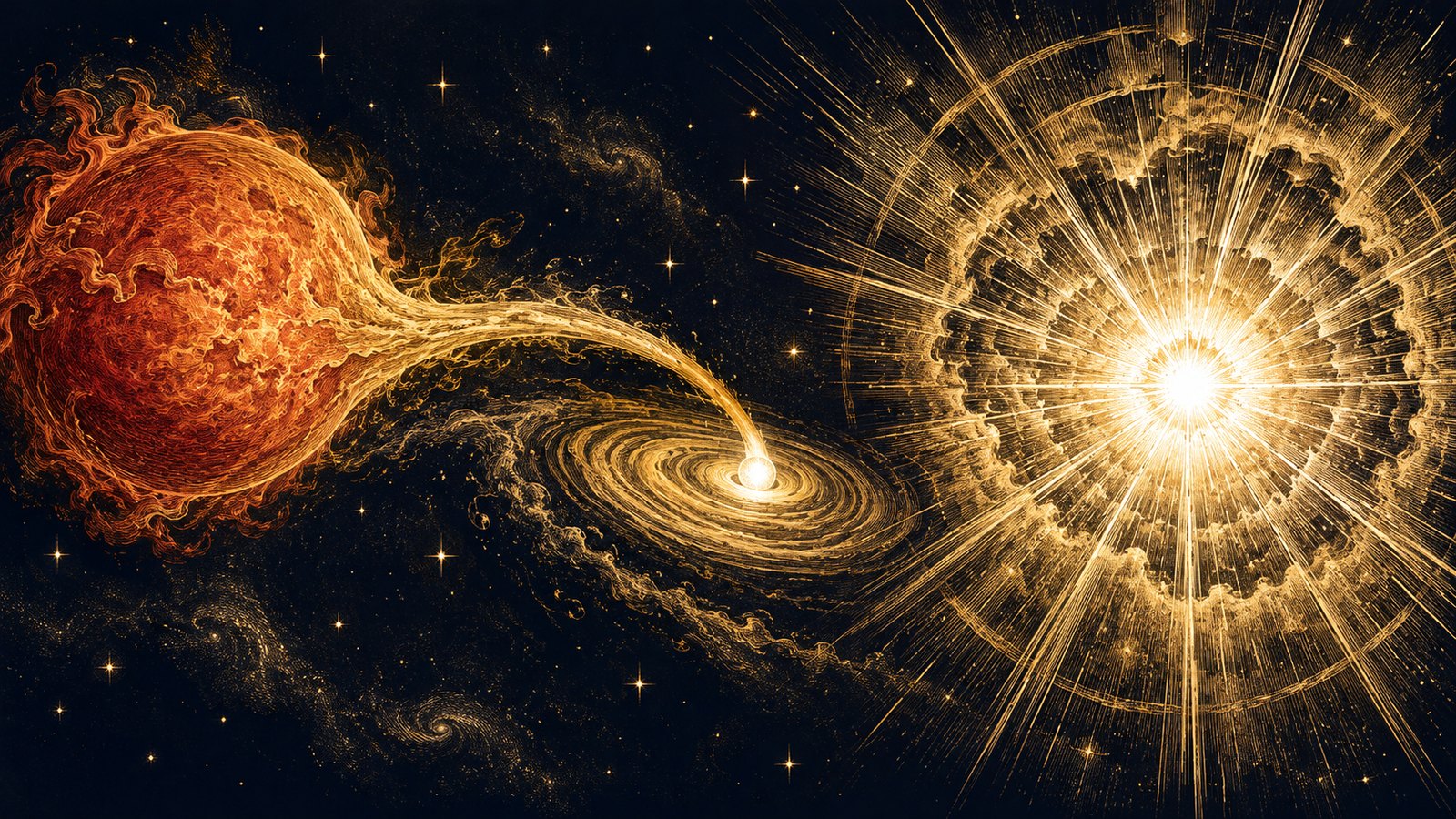
The exploding stars are the trick, so here they are. A white dwarf, the cinder of a dead star, pulls gas off a companion until it tips over a fixed weight, about one and four tenths of the Sun, and detonates. Because the weight is always the same, the explosion is always nearly the same, and for a few weeks it shines with the light of five billion suns. That makes it a candle of known brightness, and a candle of known brightness is a ruler: how faint it looks tells you how far away it is. Both teams had spent years finding these in galaxies billions of light-years off, photographing the same patches of sky weeks apart and looking for the new point of light. The far ones were, every one of them, a little fainter than a slowing universe allowed.
Einstein's leftover
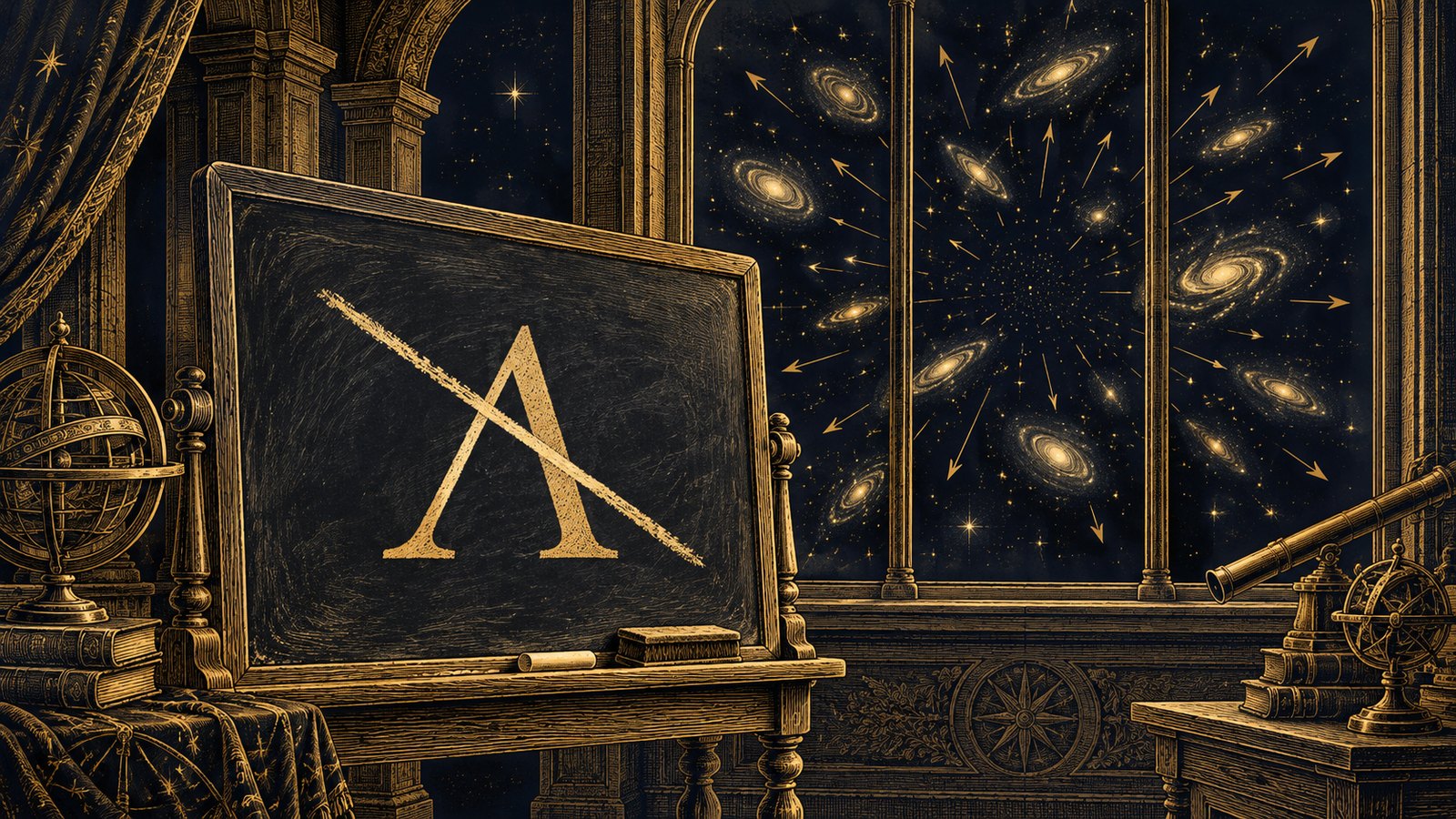
The push had a name already, as it turned out, and an owner. In 1917 Einstein had added a term to his equations because without it the universe would not sit still, and he believed the universe sat still. Twelve years later Hubble showed it was expanding and the term was no longer needed. George Gamow later claimed Einstein called it the biggest blunder of his life; nobody else heard him say it. The term is a constant: an energy that belongs to empty space itself, so that every new cubic meter of space arrives with the same dose of push as the old ones. Matter thins as space grows, and the push does not, which is why it wins in the end.
Physicists compress all of that into one letter, w, the pressure of a thing divided by its energy. Matter has w of zero. Einstein's constant has w of exactly minus one, at every moment, forever, and the minus sign is the push. For twenty-five years every measurement landed on minus one, give or take the error bars, and the universe got a standard model with the constant built in: about sixty-nine percent of everything is the push, thirty-one percent is matter, and the push wins a little more every year.
How the story ends
Run the constant forward and the sky empties. Galaxies beyond our own small group are carried off faster and faster until their light can no longer cross the growing distance, and they slip over the horizon one by one, the last of them in about a hundred billion years. The far future is a single island of stars in a dark that keeps getting bigger.
Two physicists, Lawrence Krauss and Robert Scherrer, worked out in 2007 what astronomers of that era would conclude. They would see one galaxy and a black sky. The microwave glow of the Big Bang would have stretched past detecting. Every other galaxy, and with it every trace that space was ever expanding, would be gone. They would decide, from excellent evidence, that the universe was a single eternal island that had always been there, which is exactly what Einstein believed in 1917. The sky deletes its own history, and we happen to be reading it before the deletion. That is the coincidence problem from the coincidences shelf wearing different clothes: the only era in which the push and the matter are within shouting distance of each other is this one, the era with astronomers in it.
The window is the sky and you are the small island of galaxies in the middle. Drag across it to scrub time, or run the clock and watch. On Einstein's constant the needle on the gauge never moves, and the galaxies slide out past the rim one by one until your own group is the only thing left. The other two buttons set the dial to what the two instruments below measured, and on those the needle drifts, the push fades, and more of the sky stays. The sliders set it anywhere, and some settings tear the sky apart. Notice where the settings part: not in the past, where the data is, but in the future, where every fit is a guess carried forward. Whether the real sky holds on, nobody has measured.
Two instruments
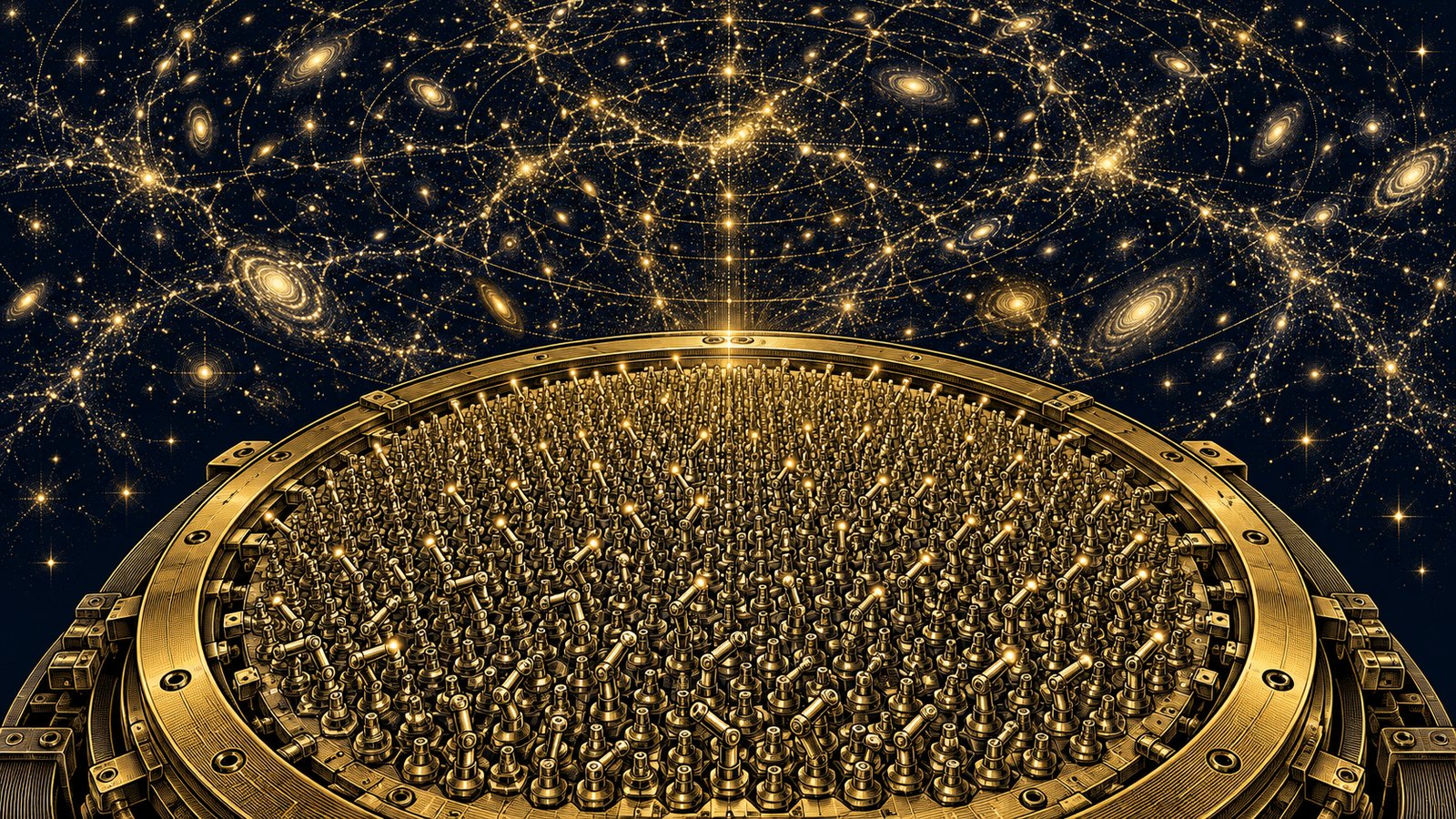
The Dark Energy Spectroscopic Instrument sits on a telescope on Kitt Peak in Arizona. Five thousand robotic fibers each swing to a galaxy and take its spectrum, five thousand galaxies at a time, then all swing to the next field. By March 2025 it had placed more than fourteen million galaxies and quasars in three dimensions and found, in their spacing, the ripple that sound waves left in the early universe: a preferred distance between galaxies of about five hundred million light-years, laid down when the universe was 380,000 years old and stretched with it ever since. That ripple is a ruler the same size at every epoch, and a ruler of known size is the other way to measure a distance. The ruler did not quite fit a constant push. It fit better if the push had been stronger in the past and was weakening now.
The second instrument was not a telescope. In September 2026 a team led from the University of Queensland published Unite, a single catalog of 2,884 of the exploding stars from seven surveys across thirty years, including the two biggest, which had never before been made to agree with each other. Ryan Camilleri, who led it, put it plainly: three decades of observations rebuilt into one consistent framework. Read together with the ripple and the microwave glow, the candles give w today of minus 0.86, drifting, so that it sat below minus one a few billion years ago. In the language of the page before this one: not minus one, and moving.
A candle and a ruler, built by different people on different continents, disagreeing with Einstein's constant in the same direction. That is why the question has a page.
Three sigma
Now the honest part, which the people who did the work say first and loudest.
Physics has a bar for a discovery, and it is five sigma: the chance that the pattern is a fluke of the noise has to be under one in three and a half million. The DESI result sits between 2.8 and 4.2 sigma depending on which supernova catalog it is paired with. The Unite fit stands at 3.3 sigma on its best reading, about a one in a thousand fluke, and the same paper says that the Bayesian way of weighing evidence calls the preference weak. Three sigma results have a long history of going away.
There is also a specific objection. In late 2025 three physicists at Cambridge reweighed the DESI result and found that most of the preference for a changing push came from one place: a disagreement between DESI's ruler and one of the supernova catalogs, which a moving w was good at papering over. Swap in a recalibrated version of that catalog and the preference vanished. Unite was built to make the catalogs consistent with each other, and still lands on the same side of minus one; Tamara Davis, one of its authors, has said its deviation points in a slightly different direction from the 2024 result that started the argument. That is either two instruments converging or two instruments wobbling. More candles are being gathered now, including a dedicated survey of nearby ones to anchor the bottom of the ladder. The question will be settled by light, not by argument.
What it would mean here
If the dial is turning, dark energy is not a constant of nature but a thing with a history: a field stretched through space the way the Stoics said the pneuma was, a tension running through everything, slackening a little. It would be the first ingredient of the universe found since 1998 to show any character at all. And it would change the ending. A push that fades does not necessarily clear the sky. The island might keep its neighbors.
It leans on two other pages. The coincidence problem asks why the push and the matter are within a factor of two of each other right now. A push with a schedule of its own is exactly the kind of thing that was invented to answer that question, and so far no version of it answers without a new coincidence of its own. And on the fine-tuning page Weinberg's 1987 anthropic argument predicted the size of the constant ten years before anyone measured it. His argument was about a constant. If the number moves, the cleanest anthropic prediction on this shelf was right about the size of something that is not what he thought it was.
Pythagoras would want the number fixed. The Stoics would want it to breathe. Both of them are in the room, and for the first time the room has an instrument that could tell them apart. Until it does, the sky is still full, and you are reading this in the one era when it could be read at all.