
1678 to 2019, The Hague, London, Paris, Cambridge, Tokyo and Vienna
The wave
Huygens, Young, Fresnel, Maxwell, de Broglie, Tonomura and a stone in a pond
Drop two stones in still water and the rings cross without touching, and where they cross they make lanes of calm fanning out between lanes of double waves. Thomas Young drew that picture in 1807 and used it to show that light was a wave. It has since been drawn by X-rays, by radio, by electrons one at a time, by whole molecules, and by two black holes a billion light years off. This page is a ripple tank you can tap, and the story of the one picture that keeps coming back.
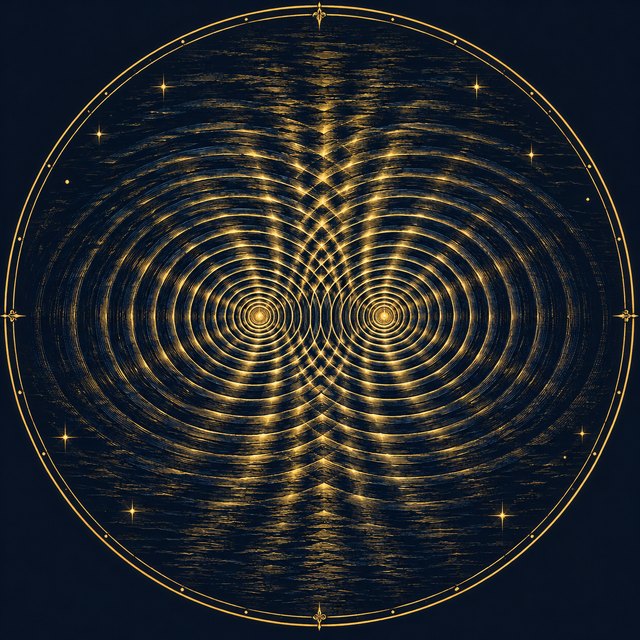
Stand at the edge of still water and drop in two stones a little apart. Each makes a ring, and the rings widen, and when they meet they pass through one another as if the other were not there. That is the first strange thing, and it is so familiar that nobody sees it: two waves can occupy the same water at the same moment, each going about its business, and the water simply adds them up. The second strange thing is what the adding makes. Where a crest of one ring meets a crest of the other the water stands twice as high; where a crest meets a trough it stands still. Since the two rings are spreading from two different points, the places where they arrive in step and the places where they arrive out of step lie along fixed lines, and those lines fan out from between the stones like the spokes of a wheel, lanes of calm water between lanes of doubled waves. The pattern is not in either stone. It is in the difference between them, and it is the same for any two things that wave, which is why it has been drawn, over three centuries, by nearly everything.
Young's card
Newton thought light was a stream of small bodies, and for a hundred years, in England at least, that settled it. In 1678 Christiaan Huygens had argued the other way, that light was a disturbance passing through something, and had given the rule that is still used: every point a wave reaches becomes a little source of its own, and the new wave is the sum of all of them. The rule explained reflection and refraction and nothing else that corpuscles could not, so it waited. In 1801 Thomas Young, a London physician who had learned to read by two and had a dozen languages by twenty, told the Royal Society that light was a wave after all, and over the next two years did the experiment that is still in every textbook. He let a sunbeam through a pinhole into a dark room and split it with the edge of a card about a thirtieth of an inch wide, so that the light passing one side of the card met the light passing the other. On the wall the beam was not a smooth patch. It was striped, light and dark, with colours at the edges of the stripes, and when he blocked the light on one side of the card the stripes vanished. Two beams of light added together had made darkness. No stream of particles can do that. Only waves can cancel. In his lectures of 1807 he printed a plate of two sets of ripples spreading from two points in a tank, crossing, and fanning into the lanes, and said that this was what the light was doing on his wall.
He was abused for it, mostly by people defending Newton, and the argument was ended in Paris rather than London. In 1818 the Academy of Sciences offered a prize for the best account of the fringes at the edge of a shadow, hoping to see the wave theory beaten, and a young engineer named Augustin Fresnel submitted a full mathematics of Huygens's rule. One of the judges, Simeon Poisson, who held with corpuscles, showed that Fresnel's equations predicted an absurdity: in the middle of the shadow of a small round disc there should be a bright spot, as bright as if the disc were not there. Another judge, Francois Arago, set up the disc and looked. The spot was there. Fresnel took the prize, and after that the only question was what was waving. In 1865 Maxwell found that the equations of electricity and magnetism had a wave in them, that its speed came out as the speed of light, and that light was therefore a ripple in the electric and magnetic fields themselves, and in 1887 Hertz made such ripples from a spark across a lecture room and caught them in a wire. The lanes in the ripple tank became radio, and X-rays, and the whole of the spectrum the window page is about.
The same picture, smaller
Then it turned round. In 1905 Einstein showed that light also arrives in lumps, and the lumps came to be called photons, which was awkward for a theory of waves. In 1924 a French prince named Louis de Broglie, in his doctoral thesis, proposed that if waves came in lumps then lumps might come in waves, and that an electron, which everyone agreed was a particle, should have a wavelength that depended on its speed. Three years later two physicists at Bell Laboratories in New York, who had been bouncing electrons off a nickel target for reasons of their own, found that the electrons came off in the pattern of lanes a crystal makes when it scatters a wave, and the wavelength was de Broglie's. In 1961 a student at Tubingen cut slits half a thousandth of a millimetre wide in copper and sent electrons through them, and Young's stripes appeared. In 1989 a team at Hitachi in Tokyo sent electrons through one at a time, so slowly that each had struck the screen and gone before the next was fired, and filmed the result. Each electron landed as a single dot, at a place nobody could predict. After ten the dots looked random. After a few thousand they lay in Young's stripes. Each electron, alone in the apparatus, had gone through as a wave and arrived as a particle, and the pattern was in the places it was allowed to arrive. In 1999 a group in Vienna did it with fullerene, a ball of sixty carbon atoms, and in 2019 with molecules of two thousand atoms, each one heavier than some viruses, each of them a wave while it was travelling and a dot when it landed.
The largest version came in on the morning of September 14, 2015, when two sets of mirrors four kilometres apart, one in Louisiana and one in Washington, shivered by less than the width of a proton at the same moment. The ripple had come from two black holes that fell into each other a billion and a quarter years ago, and it was found by the same trick as Young's: a beam of light split in two, sent down the two arms, and recombined so that the two halves cancelled exactly unless something had changed the length of one arm. Something had. The pattern that Young drew with a card and a sunbeam was, two hundred years later, the thing that let people hear space itself move.
The instrument
The disc below is a ripple tank. One stone: tap the water and a ring spreads, tap again and the rings cross without touching. Two stones: place two steady sources and the lanes fan out between them; the wavelength dial opens and closes the fan. Young's slits: a flat wave meets a wall with two gaps, the gaps become two stones, and the right edge reads the lanes as bright and dark bands, with a dial for how far apart the gaps are.
The honest part
The ripple tank is an analogy, and it is one of the few analogies in physics that goes exactly as far as the mathematics and no further. Light does not ripple in water, or in anything, since the ether that was supposed to carry it was looked for and not found. An electron is not a small wave of stuff. What the tank shows truthfully is the rule of adding, that two waves in the same place sum, and that the sum can be zero, and that rule is the same whether the thing waving is water, the electric field, or the quantity in the equation that gives the odds of where an electron will land. The lanes are real in all three. The water is only real in one.
What is not settled is what the electron is doing between the slits and the screen. Every account agrees on the pattern and disagrees on the story, and the disagreement is a century old and has not narrowed. Feynman, in 1965, said the double slit holds the only mystery, and that nobody could explain it, by which he meant that the mathematics is complete and the picture is not. This shelf is about patterns that show up where nothing aimed at them, and the wave is the purest case, because it shows up in everything that can be added, and the question of why the smallest things can be added that way, the way water can, is one of the open questions on the other shelf.