
1800 to 1974, Slough, Jena, Hamburg and Princeton
How much of it do we get?
Herschel's thermometer, Galton's whistle, von Uexkull's tick and Nagel's bat
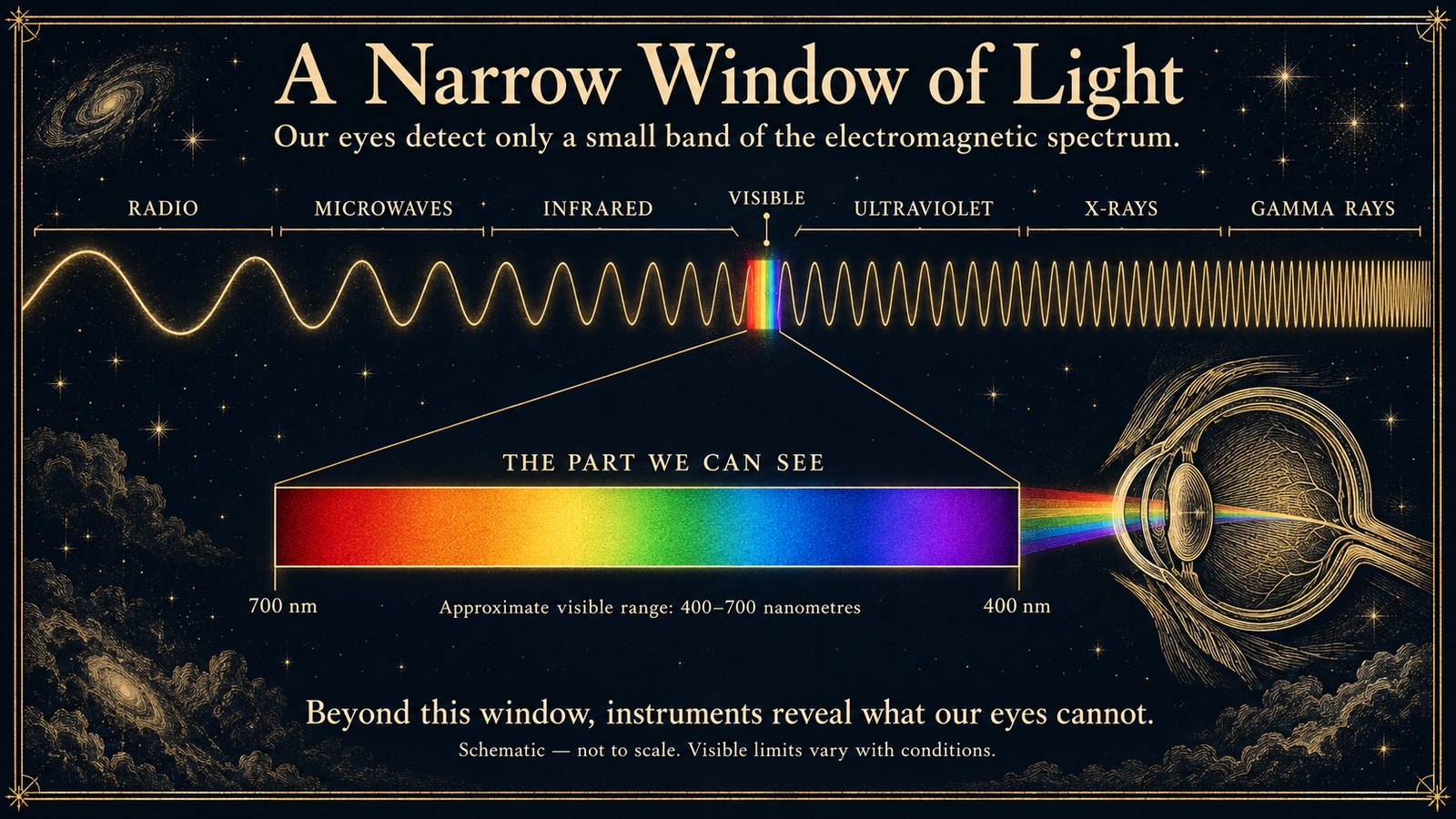
The eye is given one octave of light out of about a hundred. The ear does better, ten octaves of sound in thirty-seven. The skin reports a true temperature across a band so thin it has to be drawn with a glow. And there are whole senses, magnetism, electric fields, polarised light, that the body has no organ for at all. This page is a ring you can turn through each of them, with the lit part being what you get, and the story of how everything outside it was found.
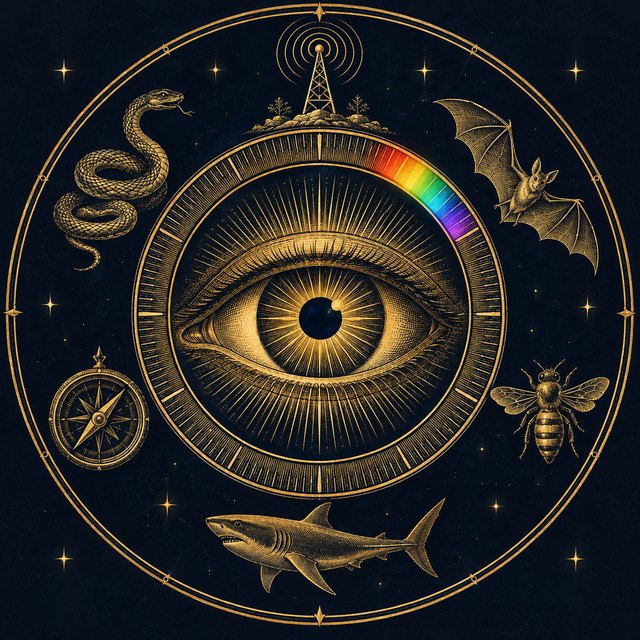
In February 1800 William Herschel, who had found Uranus from his back garden nineteen years before, was trying to answer a small practical question: which colour of sunlight carries the heat? He set a prism in a window at Slough, let the spectrum fall across a table, and laid thermometers with blackened bulbs in the bands, one in the violet, one in the green, one in the red. The red ran warmest. Then, as a control, he put a thermometer just past the red, in what looked like plain shadow on the table, and it rose higher than any of them. There was light there, with nothing to see it by. He called the rays invisible, and spent the spring showing that they reflected and refracted like the visible kind. A year later in Jena, a young chemist named Johann Ritter, who had read Herschel and reasoned that nature liked symmetry, put paper soaked in silver chloride just past the violet end, where there was also nothing to see, and watched it blacken faster than it did in any colour. Within twelve months the spectrum had grown on both sides, and the part of it the eye is given had become, for the first time, a part.
It has not stopped shrinking. Hertz made radio waves in a Karlsruhe lecture room in 1887, from a spark, and caught them across the room with a loop of wire. Rontgen found X-rays in 1895 and photographed his wife's hand; she said she had seen her own death. Villard found gamma rays in 1900. By the time the twentieth century was properly under way the eye's share, laid against everything that had been measured, was already a sliver, and the instruments have been pushing both ends out since. The hardest photon ever caught arrived over Tibet in 2021 carrying more than a thousand million million electron volts. The slowest electromagnetic wave anyone has recorded takes about a second to pass. Between those ends lie about a hundred octaves. The eye has one.
Why there
The window is not placed at random. Sunlight, by energy, peaks in the green, and the sea, where eyes were invented, is clear in exactly the same band and nearly opaque a little way to either side of it. An animal in the Cambrian sea that grew a patch of cells sensitive to light had one usable range to be sensitive in, and that range has been inherited up every line since. There are reasons the window could not have been much wider. In the infrared every warm thing glows, including the eye itself, so an eye open there would be dazzled by its own heat. In the ultraviolet the lens yellows and burns, and the light scatters so badly in air that distant things blur. The eye sits in the one place where the light is bright, the water is clear, and the body does not get in the way. It is a good window. It is still one octave.
The other windows
Hearing is the generous sense, and the one where the first measurements were made. In the 1870s Francis Galton had a whistle built whose pitch he could raise with a screw until he could no longer hear it, and carried it round the London zoo hidden in a walking stick. Cats turned at notes he could not hear; the big animals did not. The ear gets about ten octaves, from twenty cycles a second to twenty thousand, with the top octave fading through middle age. The span of sound that exists runs some thirty-seven. Elephants rumble to each other below the window, at fourteen cycles a second, and keep in touch across miles of forest by it; the calls were only discovered in 1984, when a researcher standing by the elephant house in Portland felt a throbbing in the air she could not hear. Bats hunt above it. The greater wax moth, which the bats hunt, hears to three hundred thousand cycles a second, the highest ear known, so that it hears the bat before the bat has found it.
Then there are the senses that are not narrow for us but absent. A robin carries a compass, probably in its eye, and reads the Earth's field well enough to find Africa; the first proof was a cage in Frankfurt in 1966, where the birds turned to face a magnet. A shark feels the heartbeat of a flounder buried in sand, through pores in its snout that sense the flicker of a nerve. A bee sees, in ultraviolet, a landing strip painted on the flower; a reindeer sees lichen on snow by the same light; a mantis shrimp has twelve kinds of colour receptor to our three and still, oddly, tells colours apart worse than we do. A pit viper has a second pair of eyes for heat and strikes a mouse in the dark by its warmth. None of these is a wider window. They are windows in walls we do not have.
The Hamburg biologist Jakob von Uexkull, who spent his life on this, asked what the world is to a tick. A tick has three senses: it smells butyric acid, which is what skin gives off; it feels warmth; and it feels hair. It climbs a grass stalk and waits, for years if it must, with no sight and no hearing, and when the acid arrives it lets go, and when the warmth arrives it drinks. Von Uexkull's point was that the tick's world is not a poor version of ours. It is complete. Nothing is missing from it, because missing is a word that only makes sense from outside. In 1974 the philosopher Thomas Nagel asked what it is like to be a bat, and answered that we will never know, not because bats are stupid but because echolocation is a way of having a world, and we are not inside it. The honest version of that question points back at us. Something is finding its way through a universe of radio, magnetism and gamma rays using one octave of light and ten of sound, and is sure it has the picture.
Time and size
The same thing is true of the two senses nobody lists. The eye blurs anything faster than about a sixtieth of a second, which is why film works; the ear does better and keeps two clicks apart down to about three thousandths. At the other end the longest duration anyone experiences from the inside is one life. The present itself, the slice of time that feels like now, is about three seconds wide, which is the length of a line of verse and the time a handshake lasts, and this is probably not a coincidence. Durations in nature run from the shortest tick physics admits to the age of everything, some sixty-one powers of ten, and the window is twelve of them. In size the eye does better than it is given credit for. It resolves a hair at arm's length, and on a dark night the smudge of the Andromeda galaxy, which is a real shape two million light years away, so the window is nearly half the span. Below a hair, though, the world went entirely unseen until 1674, when a draper in Delft ground a bead of glass into a lens and found a drop of lake water full of animals.
The instrument
The ring below is the whole span of one quantity, laid once around the disc on a scale where each tick is a power of ten, and the lit part is what the unaided body is given. Turn it through light, sound, size, time and heat, and then through the six senses with no arc at all. Hover the ring to read what lives there.
The honest part
The ends of each ring are where the instruments stop, not where the quantity does. Nobody knows that light stops at the hardest photon yet caught or that the smallest length is the Planck length, and a wider choice of ends would make every window look narrower, a tighter one wider. The size window is read generously: you see Andromeda as a shape, but you see no detail in it, and by the stricter rule of things you could measure with your eye alone the arc would be far shorter. The heat window is read strictly: the skin's true thermometer runs from about five degrees to forty-five, and beyond those it reports pain, which is a different sense and a refusal to measure. Reasonable people would draw each arc a little differently. None of them would draw it wide.
Two things on the other side. The window may be narrow but the eye is astonishing inside it: in 1942 three physiologists at Columbia showed that a dark-adapted eye will register somewhere between five and fourteen photons, which is close to the physical floor for any detector, and the ear can hear a motion of the eardrum smaller than the width of an atom. And the shelf you are standing in is itself the answer to the question in the title. Everything on this site that is not in the window, the infrared glow of a dead star, the microwave hum left over from the start, the ruler of fourteen million galaxies, the ring at Saturn's pole, was brought inside it by an instrument, and then painted in a colour the eye could take. Plato said the senses were not the measure of what is. The thermometers, plates, aerials and detectors have been proving him right for two hundred and twenty-six years, in a way he did not expect, by finding more.