
About 2000 BC to the first Easter, Uruk, Nineveh, Ugarit, Newgrange and Jerusalem
Why three days?
Inanna, Dumuzi, Jonah, a Ugaritic storm god and the Sun at midwinter
Four thousand years ago a Sumerian poem hung the goddess Inanna dead on a hook in the underworld for three days and three nights before she was brought back. Jonah spent three days in the fish, Hosea promised a raising on the third day, and the oldest line in the New Testament says Jesus rose on the third. Several religions have a god who goes under and comes back, and the count is often three. This page asks where the number came from, and points the instrument at the three lights in the sky that go dark and return: the Sun at the solstice, the Moon at the new, and Venus, who was Inanna.
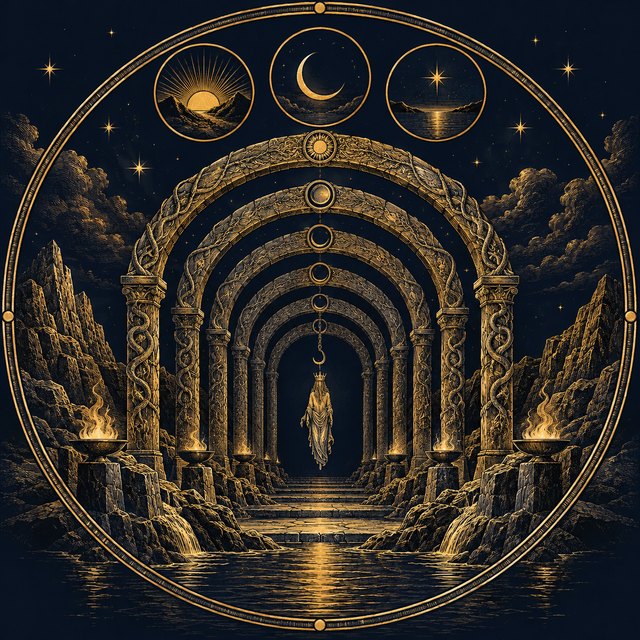
The oldest version we have is on clay. Somewhere around 2000 BC, in the cities of the lower Euphrates, scribes copied out a poem about the goddess Inanna, Queen of Heaven, who decided to go down to the underworld, which belonged to her sister. She dressed in her seven powers, a crown, a lapis necklace, a breastplate, a gold ring, a measuring rod, and told her minister that if she did not come back he was to go and beg the great gods for her life. At each of the seven gates of the underworld the gatekeeper took one of the seven things from her, so that she came before her sister naked and bowed. The judges of the dead looked at her with the look of death. She was struck down, and her corpse was hung on a hook. The poem then says, in the Sumerian, that three days and three nights passed. Her minister wept at the gates of the gods. Two of them refused him. The third, Enki, the god of fresh water and cleverness, made two small creatures out of the dirt under his fingernails, gave them the food of life and the water of life, and sent them down. They sprinkled it on the corpse and Inanna rose. She could not simply leave, because nobody leaves the underworld without sending someone in their place, and the one she chose was her husband Dumuzi, the shepherd, who had not mourned her. He went down, and his sister took half of each year in his stead, and that is why he returns and goes again.
So the shape is already there four thousand years ago, complete: a descent, a death, three days, a return, and a lover or a season who pays for it. The Akkadians kept it as Ishtar; the Hebrew prophet Ezekiel saw the women of Jerusalem weeping for Tammuz, who is Dumuzi, at the north gate of the Temple. At Ugarit on the Syrian coast, in a cycle of poems from the fourteenth century BC, the storm god Baal goes down into the mouth of Death and the land dries until his sister Anat finds the body and splits Death with a sword, and when Baal is back the heavens rain oil. The prophet Hosea, in the eighth century BC, wrote that the Lord would revive his people after two days and raise them on the third. Jonah spent three days and three nights in the belly of the fish, and the Gospel of Matthew has Jesus cite the fish as the sign of his own three days in the earth. The oldest written line in the New Testament, a formula Paul says he received from others, is that Christ died, was buried, and was raised on the third day. In the fourth century a Christian writer named Firmicus Maternus described, with distaste, the rites of a Roman mystery cult, most likely that of Attis: a tree carried into the sanctuary, a day of mourning, a night in which a light was brought and a priest anointed the throats of the mourners and whispered, take courage, initiates, the god is saved, and there will be salvation for you from your troubles.
As above
The question on this shelf is always the same one: is the pattern in the world, or in us? For this story there is a third possibility, and it is the one the Sumerians would have given, because Inanna was not only a goddess. She was the planet Venus. Her names and her star appear together in the oldest god lists, and a whole literature of her poems reads straight once you know that the Queen of Heaven is the brightest thing in the evening sky. Venus does the thing the poem describes. For months it hangs in the west after sunset, the evening star, climbing a little higher each night and then sinking, night by night, back into the glare of the setting Sun until it cannot be seen at all. Then, after some days gone, it appears on the far side of the Sun, low in the east before dawn, as the morning star, and it climbs again. It has passed between us and the Sun, which is to say it went down, and under, and came up on the other side. Nobody in Uruk would have needed a poet to tell them that the Queen of Heaven dies and returns. They would have watched it.
The Moon does it monthly. It thins to a hair in the dawn, vanishes, and about two nights later, sometimes three, shows as a hair in the dusk, lit from the other side. Every calendar of that world began its month at that first crescent, and the dark nights before it were the nights the Moon was dead. The Sun does it once a year, and more slowly. Through the autumn its rising point walks south along the skyline each morning, and as midwinter comes the walk slows, and at the solstice it stops. For several mornings together the Sun comes up in the same notch of the hills, and anyone with a fixed place to stand and a marker to stand it against can see that it has stopped. Then it turns and begins to come back. The Latin word for the day is solstitium, the Sun standing still. At Newgrange in Ireland, built about 3200 BC, a stone box over the entrance lets the midwinter sunrise down a passage to the back of the tomb for a few minutes each morning around the standstill, and on no other mornings of the year. Whoever built it had counted the days the Sun stood still in the dark, and built a house for the dead that the light would enter on exactly those.
The instrument
Below are the three lights, one at a time. Drag through the year and watch the sunrise stop in its notch; the dial moves you north or south, because the standstill is longer the nearer the pole you stand. Drag through a month and count the nights the Moon is gone. Drag through the 584 days of Venus and watch Inanna go under and come up on the far side of the Sun.
The honest part
The pattern is real and the number is softer than it looks. Inanna's three days and three nights are in the text, and so are Jonah's and Hosea's and Paul's, but the Sun's standstill lasts anything from a few days to a couple of weeks depending on how sharp your skyline is, the Moon is usually gone for two nights rather than three, and Venus is lost for about a week when it passes in front of the Sun and for two months when it passes behind. If the sky taught the count it taught it loosely, and three is also the smallest number of days that is plainly more than a day, which is reason enough for a storyteller. The Friday to Sunday of Easter is three days only by the old habit of counting the day you start on.
Nor is every god on the list really a dying and rising one. The Victorian anthropologist who built the category, in The Golden Bough, stretched it over Osiris, Adonis, Attis and the rest, and in 1987 a historian of religion went back through the sources and found that most of them die and stay dead, or return in some sense that was read into them later, sometimes by Christians and sometimes by anthropologists who wanted the parallel. A Swedish scholar answered in 2001 that Dumuzi, Baal, Melqart and a few others really do die and come back in texts that predate Christianity by centuries, and that is now roughly where the argument sits: fewer than the list, more than none. The things that circulate online about a dozen gods born on the twenty-fifth of December to virgins are nearly all false and should be dropped before the argument that does hold.
Last, the Venus reading of Inanna is a serious scholarly position, not a settled one. The texts call her the star and sing her as the evening and morning light, and the descent fits the planet's behaviour well enough that several Assyriologists read the poem as astronomy. Others read it as politics or as a story about the two sisters. Both can be true of a poem. What is not in doubt is that the people who wrote it watched the same three lights go dark and come back that you can watch tonight, and that somebody, very early, decided that this was the shape of what happens to us.