
1950 to 2018, Los Alamos, Green Bank, Delaware in Ohio, and State College
Where is everybody?
Enrico Fermi, Frank Drake, Michael Hart, Jerry Ehman and Jason Wright
In the summer of 1950, over lunch at Los Alamos, Enrico Fermi asked where everybody is. The galaxy is thirteen billion years old and has a few hundred billion stars, most of them older than the Sun, and a people who could travel at all would have had time to reach every one of them many times over. Nobody has. This page is the arithmetic of that silence: Drake's chain of factors, which you can set yourself; how much of the sky has actually been listened to, which is almost none of it; and how fast one people would cross the galaxy, which is no time at all.
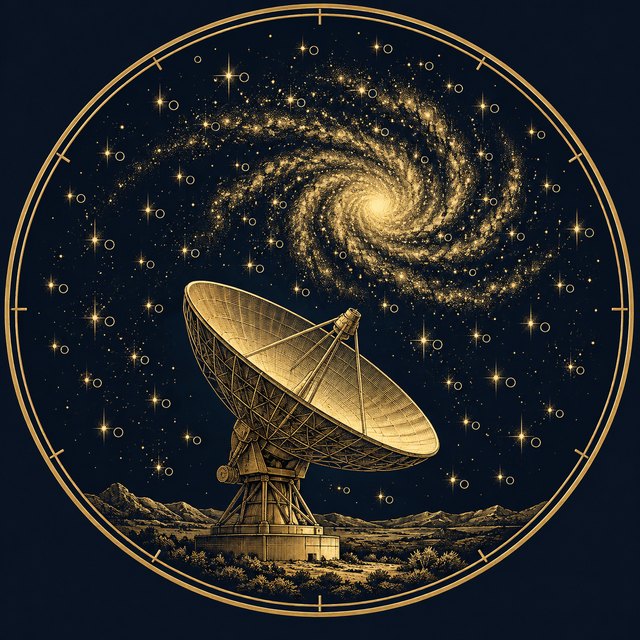
The question was asked at lunch. In the summer of 1950 Enrico Fermi was at Los Alamos for a few weeks, and on the walk to the dining hall with Edward Teller, Emil Konopinski and Herbert York the talk turned to flying saucers, which were in the papers that year, and to a cartoon in the New Yorker that showed small cheerful aliens unloading New York's missing trash cans from a saucer. The subject changed, as it does. Some time into the meal Fermi said, out of nowhere, where is everybody? Teller remembered that everyone laughed, because they all knew at once what he meant. York remembered that Fermi then did what Fermi always did, which was arithmetic, on the odds that a planet has life, that the life gets clever, that it builds ships, and how long a ship takes to cross from one star to the next, and that he concluded we ought to have been visited long ago and many times over. The galaxy is thirteen billion years old. The Sun is four and a half. Most of the stars that could have planets have had billions of years more than we have had. A people who could cross between stars at all, at any speed, would have had time to be everywhere. The sky is quiet, and nobody has landed. Either they are not there, or something is wrong with the reasoning, and it has not been settled which.
The arithmetic
Nobody had looked yet. In 1959 two physicists at Cornell worked out that if anyone was calling across the galaxy they would most likely do it at the frequency hydrogen hums at, 1,420 million cycles a second, because every astronomer anywhere would be listening there already, and the next spring a young radio astronomer named Frank Drake pointed an eighty-five foot dish at Green Bank, West Virginia at two nearby stars for six weeks and heard nothing. The year after, he was asked to organise a small meeting on the subject and, needing an agenda, wrote the question on the blackboard as a product. The number of civilisations we could hear from, he said, is the rate at which stars are born, times the fraction with planets, times the number of those planets fit for life, times the chance life starts, times the chance it gets clever, times the chance it builds a transmitter, times the number of years it keeps transmitting. The ten people in the room, who included a young Carl Sagan, put in their guesses and got answers from a thousand to a hundred million. The equation has never produced a number. It was never meant to. It is a list of what you would have to know.
Two of the factors have since been measured. Nearly every star has planets; that was settled in the 1990s and 2000s as the count of known planets went from none to, by the autumn of 2025, more than six thousand. And the Kepler telescope, staring at one patch of sky for four years to catch the dimming of stars as planets crossed them, gave the answer for the next factor: about one Sun-like star in five has a planet of roughly Earth's size at roughly Earth's distance. The galaxy has somewhere between a hundred and four hundred billion stars. The number of Earth-sized worlds in a warm orbit is in the billions, whatever else is true. The factors after that are where the arguing starts, because there is one example of life beginning, one of intelligence, one of radio, and no example yet of how long a radio civilisation lasts, since the only one known is seventy years in and still going.
The silence
In 1975 an astrophysicist named Michael Hart took Fermi's lunch remark and made it a paper. He called it Fact A: there are no aliens on Earth now. Then he worked through the ways out. Perhaps travel is impossible; but ships at a tenth of the speed of light break no law, and at that speed a people who stopped at each star to settle and build before moving on would still fill the galaxy in a few million years, which is to a galaxy what an afternoon is to a life. Perhaps nobody wants to; but it only takes one, ever, in thirteen billion years. Perhaps they are here and hiding; Hart thought that was not science. His answer was that we are the first, or alone. Frank Tipler sharpened it in 1980 with self-copying probes that would do the job without anyone aboard. The third mode of the instrument below is Hart's arithmetic drawn on the galaxy.
Then there is what has actually been heard. On August 15, 1977 the Big Ear radio telescope at Ohio State, listening on the hydrogen line, recorded a signal thirty times stronger than the background that rose and fell over seventy-two seconds exactly as a point in the sky would as the Earth turned the telescope past it. The astronomer who found it on the printout a few days later circled it and wrote Wow! in the margin. It has never been heard again, from that spot or any other, and the hundred or so explanations include a comet, a reflection, a satellite and someone calling once. In 2015 a Russian investor put a hundred million dollars into ten years of listening with the largest dishes in the world, and the first big result, in 2020, was that 1,327 of the nearest stars show no sign of anything on any of the frequencies searched. People have treated that as an answer. In 2018 three astronomers at Penn State decided to measure how much of an answer it was. They described the search as a haystack with nine dimensions, every direction a signal could come from, every frequency it could use, every strength, every moment it could be on, every way it could be coded, and then added up every search ever made, from Ozma to Breakthrough, as a share of the whole. The share was six parts in a million million million. They put it in water: all the searching so far is a hot tub, or a small swimming pool, out of all of the oceans of the Earth. The silence is real, and nobody has listened yet.
So the arguments have multiplied. Perhaps something stops nearly everyone, and the question is only whether the stopping is behind us, at the start of life or the start of brains, or ahead, which was Robin Hanson's Great Filter, written as a web essay in 1998 and now a standard worry. Perhaps Earths are common and Earth is not: a big moon, a planet like Jupiter to sweep the comets, a steady star, plate tectonics, an atmosphere that did not boil, each of them needed and each of them rare, which was the argument of a book called Rare Earth in 2000. Perhaps they are all quiet on purpose, because loud is dangerous, which is a fear old enough to be in the Chinese novel that made it famous. And perhaps, said three philosophers at Oxford in 2018, the paradox was never one. Multiply seven guesses together and you get a number, but multiply seven ranges of guesses and you get a spread, and when they did it properly, with the honest width of what is not known about the start of life, a large part of the spread put us alone in the galaxy, and a fair part alone in everything we can see. Fermi's surprise, they argued, came from taking the middle of every guess and forgetting how wide the guesses were.
The instrument
The disc is the galaxy, a hundred thousand light years across, with where we are marked. The equation lights the civilisations talking at once on your settings, and reads off how far the nearest one probably is and how long a hello and its answer take. The haystack lays all the searching so far over the galaxy as a share of its area, smaller than a pixel, and lets you multiply it until it shows. The sweep is Hart's arithmetic: tap to set where one people start, choose a speed, run, and count the years against the galaxy's age.
The honest part
The instrument is honest about the parts that are measured and makes no secret of the parts that are not. The number of stars and the share with warm Earth-sized worlds are known to within a factor of two or three. The chance that one of them gets life that talks is not known to within a factor of a billion, which is why that dial runs so far, and any number you get from the equation is a number you put in. The nearest-neighbour distance is the average for civilisations scattered evenly over the disc, and real ones would not be. The haystack figure is for radio, through 2018, and it is a fraction of a space the authors defined; a different choice of edges gives a different fraction, though no sensible choice gives a large one. And the sweep assumes somebody wants to go and keeps going, which is the assumption the whole paradox rests on, and which nothing in the one example we have, ourselves, has yet confirmed either way.
What is not in doubt is the quiet. The galaxy has had the time. We have not. The whole of the human search is sixty-five years long and has looked at a hot tub's worth of the ocean, with equipment that could not pick up our own television from the nearest star. Whether the answer is that we are early, or alone, or being left alone, or simply that no one has turned the dish the right way at the right moment, is open, and this is one of the few questions on this site where the next sixty-five years could close it. The shelf already has a page where people say they were told who else is here, which is the other side, as reported. This page is the arithmetic. The two do not yet agree, and neither of them has the last word.