
1619 to 2011, Linz, Oxford, Gaithersburg and the Koryak mountains
Five
Kepler, Penrose, Shechtman, a starfish and an apple
Six tiles a floor and five does not. Pentagons will not meet at a corner, which is why no crystal was supposed to have fivefold symmetry, and for a hundred and forty years none did. Then Roger Penrose found two tiles that cover a floor with fivefold stars everywhere and never repeat, and in 1982 an alloy did the same thing in an electron microscope, and the definition of a crystal had to be rewritten. Starfish, apples, roses and the pentagram had been doing five all along.
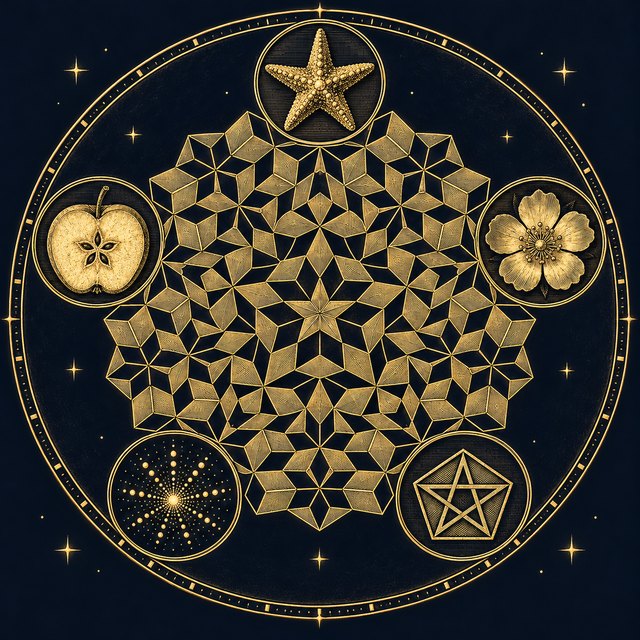
On the morning of April 8, 1982, in a government laboratory outside Washington, a visiting Israeli metallurgist named Dan Shechtman put a flake of aluminium and manganese alloy into an electron microscope. The alloy had been cooled so fast that it had no business being orderly at all. He turned the beam on it and the screen filled with sharp bright spots, which meant the atoms were in rows, and the spots sat in rings of ten, which meant they could not be. He counted them twice. In his notebook he wrote 10 Fold, and after it three question marks. Every crystallographer alive knew that a crystal could turn on itself two, three, four or six times and come back to where it started, and never five or ten, for the same reason you cannot tile a bathroom floor with pentagons. The proof fits on a napkin and had been accepted since the 1840s. Shechtman spent the next two years being told he was looking at an artefact, and the head of his group asked him to leave because he was embarrassing the laboratory. When the paper came out in 1984, Linus Pauling, who had two Nobel prizes, said there was no such thing as quasicrystals, only quasi-scientists. Shechtman got his own Nobel in 2011, and by then the International Union of Crystallography had quietly rewritten the definition of a crystal to be anything that gives sharp spots, however many.
The corner
The napkin proof is in the first mode of the instrument below. Regular shapes meeting at a point have to use up the full 360 degrees between them. A triangle's corner is 60, so six fit. A square's is 90, so four. A hexagon's is 120, so three. A pentagon's is 108, and 108 goes into 360 three times with 36 left over, which is a gap the shape of a thin sliver, and no amount of rearranging gets rid of it, because the shortfall is in the arithmetic and not in the arrangement. Kepler drew the gaps in 1619 in the Harmonices Mundi, filling a page with pentagons, pentagrams and decagons and the irregular shapes he called monsters that were needed to patch between them, and he noticed, without being able to go further, that the pattern looked as if it could spread for ever without settling down. Durer had drawn pentagons packed with rhomb-shaped gaps a century before him. For the next three hundred years the matter rested there: five could not fill a plane, so five could not make a crystal, and the regular things in the world came in sixes and fours.
The tiling
In 1961 a logician asked whether there could be a set of tiles that covers the plane but only ever without repeating, and in 1966 one of his students found such a set. It had twenty thousand four hundred and twenty-six tiles in it. By 1971 that was down to six. In 1974 Roger Penrose, an Oxford mathematician who did it for pleasure, got it down to two. A fat rhomb with corners of 72 and 108 degrees and a thin one with corners of 36 and 144, marked so that they could only be fitted one way, cover the plane completely, never repeat, and are full of fivefold stars. Martin Gardner put them in Scientific American in 1977 and people have been making floors out of them since. The number that keeps the pattern from repeating is the golden ratio. In any large patch there are about 1.618 fat tiles for every thin one, and a repeating pattern would have a whole number of each in every repeat, which is to say a fraction, and the golden ratio is the most stubbornly unfractional number there is. The same number is the reason a pentagon's diagonals cut each other where they do, and the reason the Pythagoreans, who used the pentagram as a password, are supposed to have discovered through it the first quantity that could not be written as a ratio at all.
What makes this a pattern page and not a mathematics page is what happened next. In 1982, the same year as Shechtman's morning, the crystallographer Alan Mackay built a Penrose tiling out of dots, shone a laser through it, and photographed the pattern of spots it made. They were sharp, and they were tenfold. He published it two years before the alloy paper, and when the two met, the forbidden spots had a shape to go with them: the atoms in Shechtman's flake were laid out like a three-dimensional Penrose tiling, ordered through and through and never repeating. There have been two more turns since. In 2007 two physicists went through the tile patterns on the walls of medieval Islamic buildings and found, on a shrine in Isfahan finished in 1453, a decagonal pattern laid out with a set of five tiles that is a near-perfect quasicrystal, five centuries before the mathematics. And in 2009 a grain from a meteorite that had fallen in the Koryak mountains of eastern Siberia turned out to contain the first natural quasicrystal, an alloy of aluminium, copper and iron that nobody had thought could form outside a furnace, and which had done so somewhere in the asteroid belt four and a half thousand million years ago. The last word, for now, came from a retired printing technician in Yorkshire, who in 2022 found a single tile, the hat, that covers the plane and can never repeat.
The living five
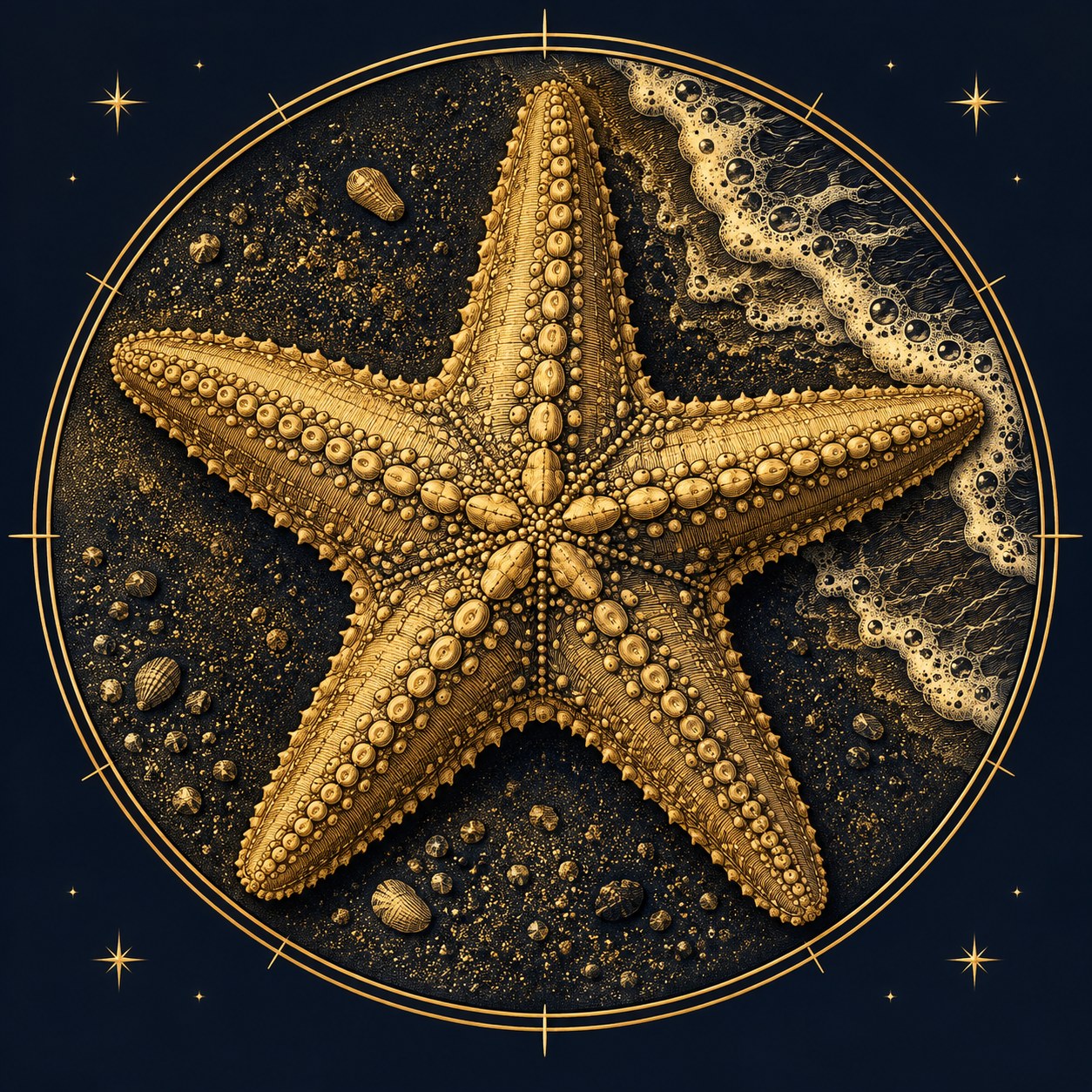
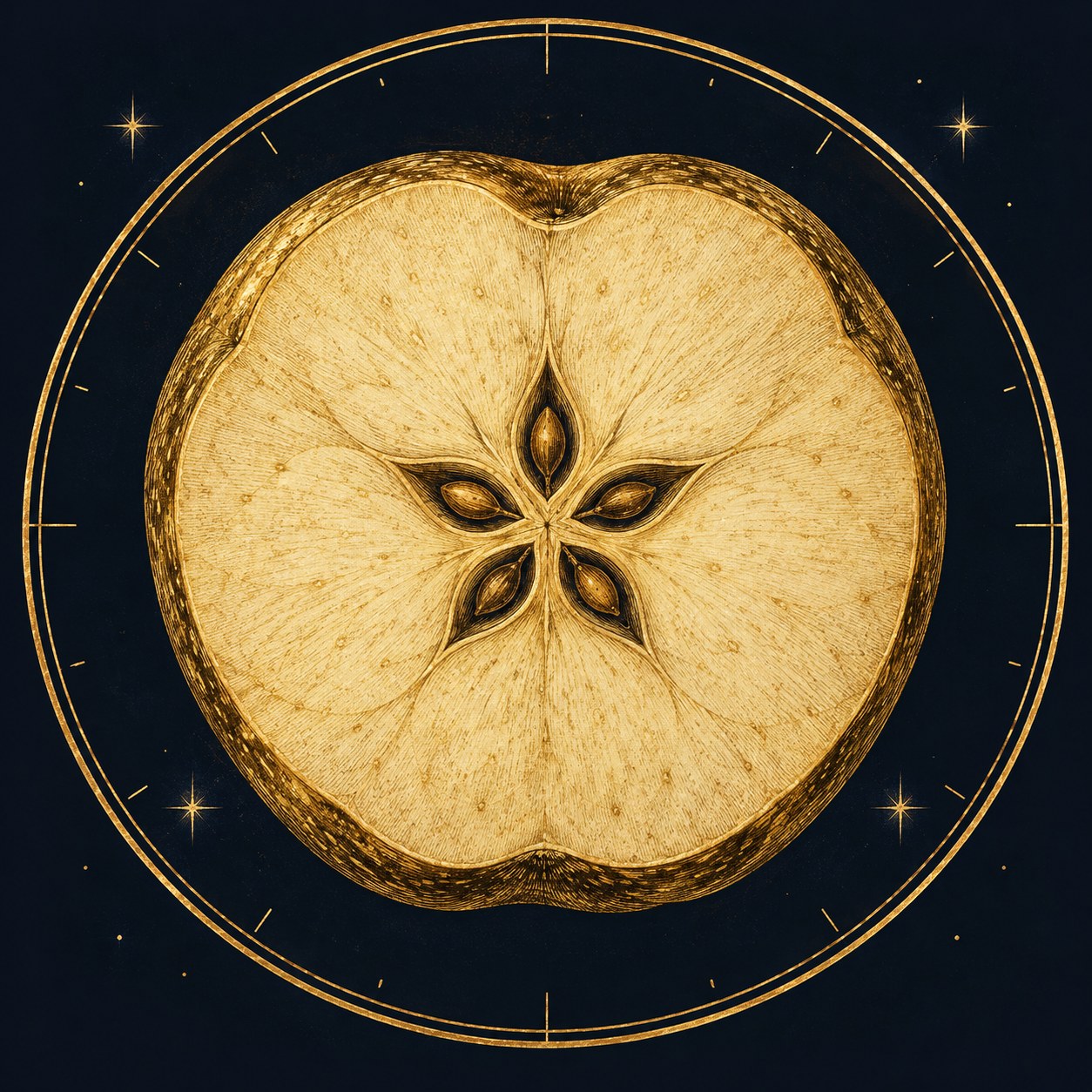
The ring of five below is the other half of the story, and it has nothing to do with crystals. A starfish begins as a larva with a left and a right, like you, and then rebuilds itself around a mouth into five arms, and has done so since the early Cambrian; nobody has a settled answer for why five. An apple is a rose. The rose family builds its flowers in fives, five sepals, five petals, and the apple's five seed chambers are the pentagon of five carpels at the bottom of the flower, which is why an apple cut across its equator shows a star. Most of the flowering plants you know are fives. A virus is a fivefold thing too: the shell of a polio or a herpes virus is an icosahedron, twenty triangles meeting at twelve corners, and through every corner runs a fivefold axis, which was the whole point, because the icosahedron is the way to build the biggest closed box from the smallest number of identical parts, and a virus has very little genome to spend on parts. And then there is the hand. Five fingers is not geometry. The first animals that walked out of the water had eight fingers, and seven, and six, and the five we have is the count that happened to be left when the others went, three hundred and sixty million years ago, and has been inherited by every frog, bat, whale and horse since, whether or not it uses them.
The instrument
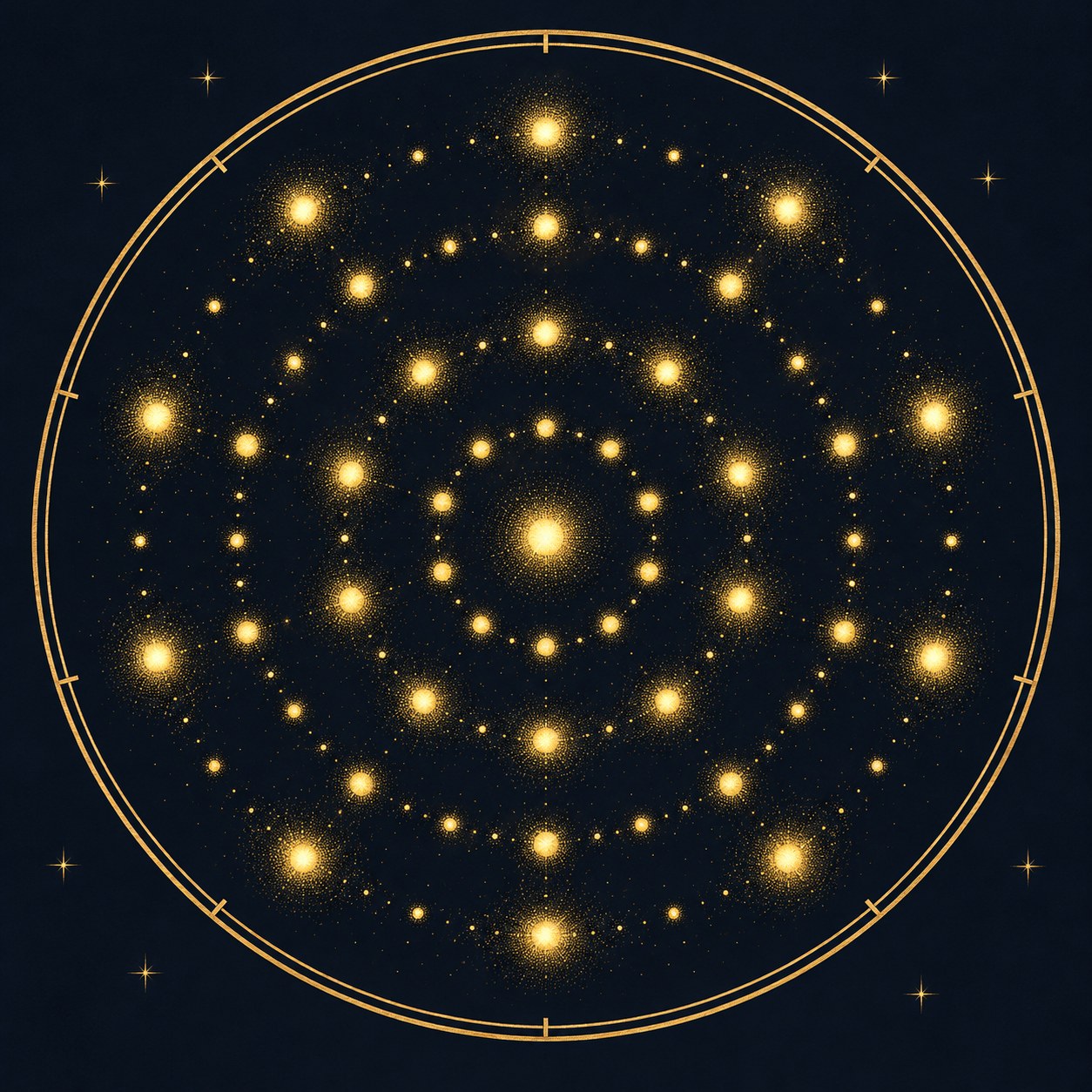
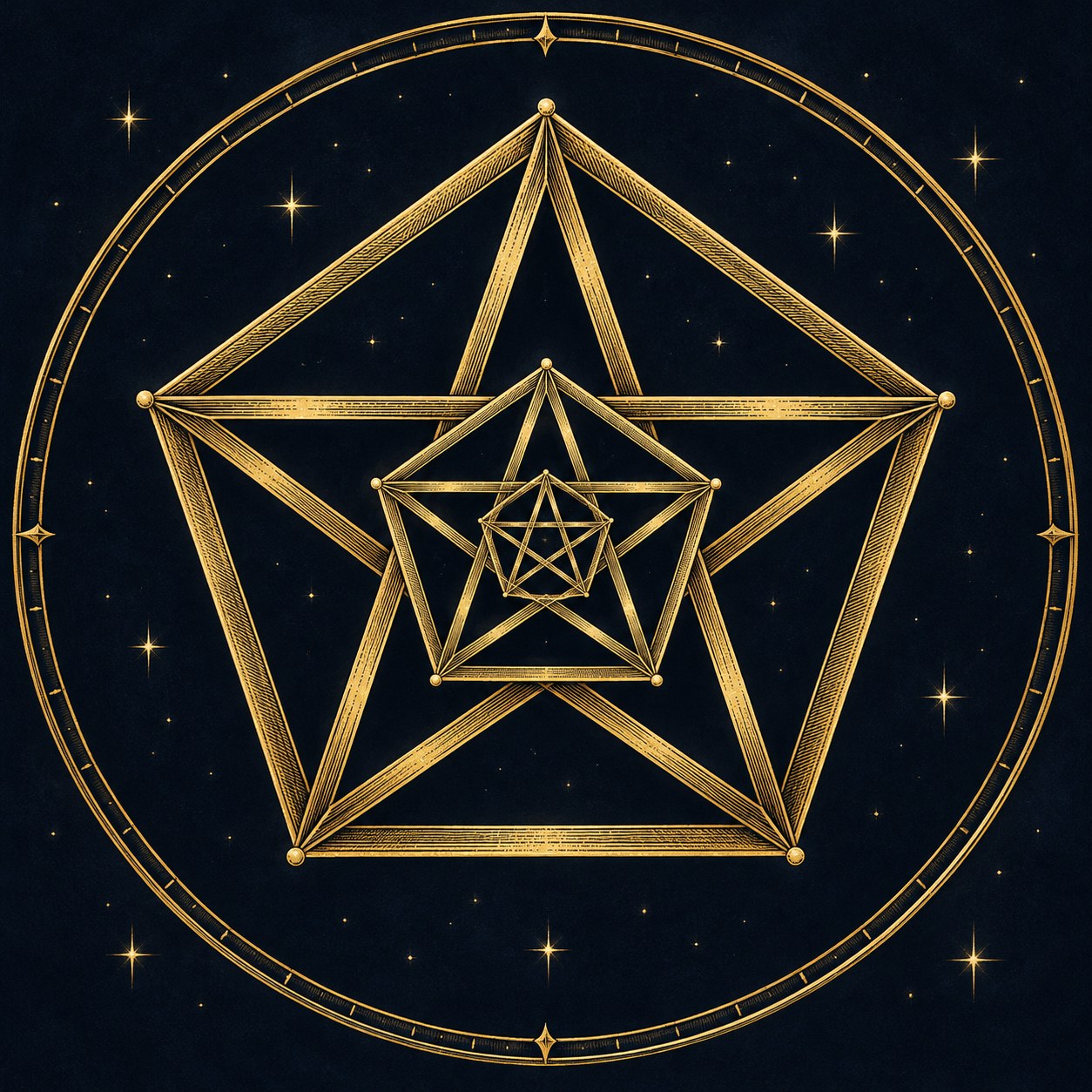
Three modes. The corner is the napkin proof: turn the dial through the regular shapes and watch which ones close round a point and which leave a gap. The tiling is Penrose's two rhombs, and every tap cuts every tile into the next generation; read the tally of fat to thin as it walks toward 1.618. The dots are what the electron beam saw: five waves crossing at 72 degrees to each other, and the tenfold spots they make.

The honest part
The five in the alloy and the five in the starfish are not the same five. The tiling and the quasicrystal are one story, and it is a true one: fivefold order was forbidden by a theorem, the theorem assumed repetition, and the world found the loophole. The starfish, the apple and the hand are a different story each, and in none of them is the number forced by geometry. Echinoderms chose five for reasons that are still argued over. The rose family's five is inherited, and plenty of families build in fours or threes or sixes. Five fingers is the leftover of a count that started higher. What the three have in common is only that they are fives, and a pattern that is only a number is the kind this shelf is most careful with.
The alloy itself was a metastable thing, a freak of fast cooling, and stable quasicrystals that can be grown slowly in a crucible were not found until 1987. The natural one is still known from a single meteorite. And the golden ratio, which is exact in the pentagram and in the tally of Penrose's tiles, is not in the nautilus shell, the Parthenon, the human face or most of the other places it is said to be; those are measurements rounded until they fit. Where five is real, it is very real. Shechtman's spots are the only case on this site where a pattern in the world was ruled out in advance by a proof, and the proof was right, and the pattern was there anyway.