
From this second back to the first one
How old it is
One year that holds all of it, a letter from an Irish bishop, a rock from Arizona, and two answers that still disagree
The universe is 13.8 billion years old, the Earth 4.54 billion, and both numbers slide off the mind the way the big distances do. This page squeezes all of it into one year, Carl Sagan's way, so you can see where everything falls, then tells how anyone knows, from a bishop's arithmetic to a rock older than the Sun, with the arguments about it left in.
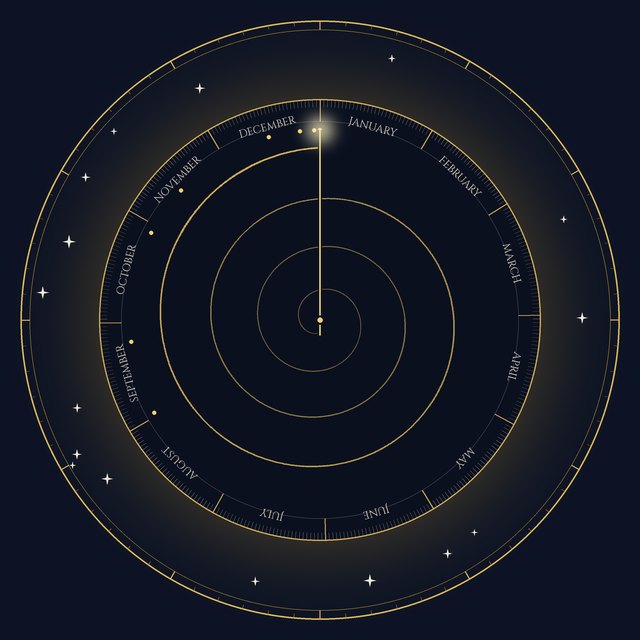
The cosmic calendar: 13.8 billion years as one yearIt is midnight on December 31. You were born a fifth of a second ago.Since you opened this page the calendar has run 0 years
The universe is thirteen point eight billion years old. The Earth is four and a half billion. Those numbers do what the big distances do on the page before this one: they slide off. Nobody can picture a billion of anything, and a billion years is worse, because a year is already longer than most things you can hold in mind at once.
So in 1977 Carl Sagan squeezed the whole of it into one calendar year, and the trick has not been improved on since. The Big Bang is the first instant of January 1. This second, the one you are reading in, is the last instant of December 31. Everything that has ever happened falls somewhere in between, and the arithmetic that places it is simple: a month is a little over a billion years, a day is thirty-eight million, an hour is one and a half million, a minute is twenty-six thousand, and one second of the calendar is four hundred and thirty-seven years. The whole history of the United States is half a second. Your life, if you get eighty years, is the last fifth of a second of the year.
Where everything falls
Here is the year. The first thing to feel is how late we are. The second is how long the Earth went without anyone on it.
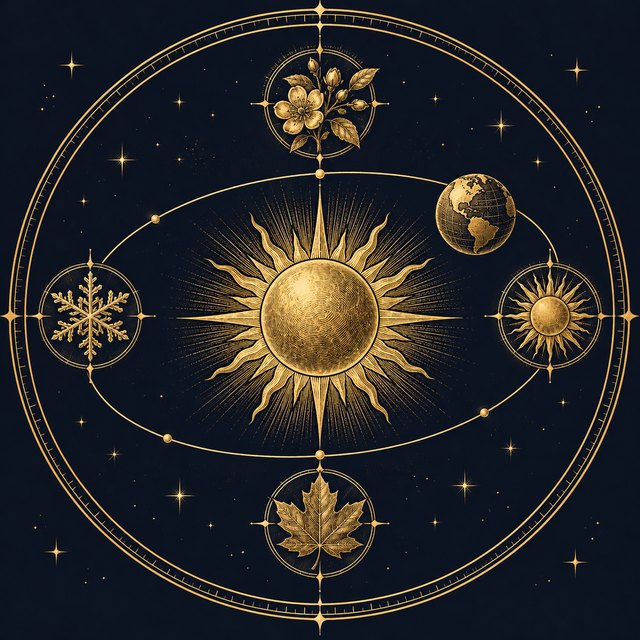
- January 1, midnight. The Big Bang. Fourteen minutes later the universe is cool enough to go clear, and the light released then is the hiss two radio astronomers could not get rid of in 1964.
- January 6. The first stars. January 8. The most distant galaxy anyone has photographed, as it was.
- March 15. The Milky Way takes shape.
- September 2. The Sun lights in the small hours, and the Earth has gathered itself by evening. The Moon follows on the 3rd.
- September 25. The oldest traces of life. October 29. The air begins to hold oxygen. November 14. The first cells with a nucleus.
- December 16. The first animals. December 19. Plants come ashore. December 25. The first dinosaurs. December 30, six in the morning. The last of them, under the asteroid.
- December 31, 10:13 pm. The first humans of any kind. 11:48 pm. Our own species. 11:59:34. Farming. 11:59:48. Writing. 11:59:55. The year 1.
- 11:59:59.8. You.
Every date above is also a place on the dial further down, where you can turn the year by hand and zoom the last day, the last hour, the last minute and the last second until the whole of recorded history is a readable stretch of the ring instead of a hair's breadth at the top.
A nail file
There is an older way to hold it, and it does not need a calendar. John McPhee, writing about geologists, borrowed the old English yard: the distance from the king's nose to the tip of his outstretched hand. Let that be the age of the Earth. One stroke of a nail file across the king's middle fingernail erases human history.
That is the Earth's four and a half billion, not the universe's thirteen point eight. Put the universe on the king's arm and the Earth's whole history is the forearm, life is the hand, the dinosaurs are the last joint of the finger, and the nail file does not need to stroke; it only has to touch.
How anyone knows
For most of history nobody did, and the serious answers were short. Ussher's six thousand years was good scholarship on the records he had. Kelvin's forty million was good physics with one wrong assumption in it. Both of them are on the shelf below, with the honest note under each, because they were not foolish and the way they were wrong is instructive.
The answer for the Earth came from rocks, and it came from radioactivity. Some atoms are unstable: left alone, each one eventually breaks into something lighter, and while no one can say when a particular atom will go, the rate for a crowd of them is as fixed as anything in nature. Uranium turns to lead with a half-life of four and a half billion years, meaning half of any batch has gone in that time, half of what is left in the next, and so on. A crystal that locked uranium inside itself when it formed, and kept lead out, is a clock wound at that moment, and reading it is a matter of counting what has turned into what. Zircon does exactly this, which is why a sand grain of zircon from the Jack Hills in Western Australia, dated to 4.4 billion years, is the oldest piece of the Earth there is, and why the oldest solids in the whole solar system, little white flecks inside a meteorite that fell on Mexico in 1969, come out at 4,567 million years. That is the Sun's birthday, and the Earth's is a few tens of millions of years after.
Counting one year a second since you opened this page.
The answer for the universe came from the sky, three different ways, and the ways agree, mostly. The first is the expansion: the galaxies are moving apart, so once they were together, and the rate tells you when. The second is the oldest light, the glow left over from the universe's hot beginning, now cooled to a whisper in the microwave; its fine ripples, mapped across the whole sky, fit a model of the universe that gives its age as 13.787 billion years, plus or minus twenty million. The third is the oldest stars, which can be aged by their chemistry the way a tree can by its rings, and which come out at twelve to thirteen billion: younger than the universe, as they have to be, and not by much.
Mostly. The honest note on this page is that the expansion, measured in the nearby universe with the best telescopes there are, comes out about nine percent faster than the microwave sky says it should, and the two camps have been checking each other's work for a decade without either one giving way. If the nearby number is right, the universe is about a billion years younger than the number above. The dial below uses the microwave figure, because it is the more precise one, and the ring does not look any different at the other.
The year that holds everything
Here is the whole year on one dial, with the hand at midnight on December 31, which is now. Turn it and read the date and the real years back at every point. Then zoom: the last day, when the dinosaurs go; the last hour, when there are humans; the last minute, when there is farming; the last second, which holds everything since the printing press.
The strange thing about the calendar is not how late we are. It is that we had to be. A planet with people on it needs a star that has burned steadily for billions of years, and that star needs to be made from the ashes of earlier stars, which took billions of years of their own to live and die and scatter their iron and carbon. The calendar could not have had anyone reading it in June. Run the same calendar forward and the Sun burns out next April; the last stars in the universe go dark in a year about seven thousand calendar years long, and the universe spends almost all of its life cold and dark and empty. Of all the time there is, the stretch in which someone can sit on a porch and wonder how long it has been is a thin band near the start, and we are in it.
The deep past
The age of the world was found out by people, most of whom were wrong in interesting ways before anyone was right. Here they are, each with the honest note.
The night before October 23
In 1650 James Ussher, the Archbishop of Armagh, published a history of the world that began at a definite moment: the night before Sunday, October 23, 4004 BC. He got there by adding up the lifespans in Genesis, matching the kings of Judah to the Babylonian and Persian records he could find, and fixing the end of the chain to a date he could trust, the death of Nebuchadnezzar. The result was printed in the margins of English Bibles for two hundred and fifty years, so that for generations of readers the age of the world was not a question but a footnote.
The nine o'clock in the morning that gets attached to the story was never Ussher's; it comes from a different scholar, John Lightfoot, writing about a different event, and the two got stitched together later. Ussher's method was careful scholarship on the only records he had, and the figure of about six thousand years was the serious answer of serious people until the rocks started talking back. Stephen Jay Gould, who did not share a single premise with him, wrote an essay defending the man's craft.
No vestige of a beginning
In June 1788 James Hutton, an Edinburgh doctor turned farmer turned geologist, took a boat along the coast east of the city with two friends and landed at a point called Siccar. There the rock stands in two sets of layers, one nearly vertical, the other lying flat across the broken tops of the first. Hutton read it aloud: the lower beds were laid down as sediment, hardened, tilted upright, worn flat by the sea over an age nobody could count, and then buried under new sediment that hardened in its turn. One of the friends, John Playfair, wrote afterward that the mind seemed to grow giddy by looking so far into the abyss of time. Hutton's own verdict, published that year, was that he found no vestige of a beginning, no prospect of an end.
He was right about the depth and wrong about the edges. The Earth does have a beginning, 4.54 billion years back, and the Sun will see to the end. But the picture he read at Siccar Point, the land worn down, laid in the sea, lifted and worn again, in cycle after cycle, is the picture geologists still use, and it is why Darwin, seventy years later, felt entitled to as much time as he needed.
Kelvin's sum
William Thomson, Lord Kelvin, the greatest physicist in Britain, did the arithmetic in 1862. A ball of molten rock the size of the Earth, left to cool, would be as cool as it is now in somewhere between twenty and four hundred million years. By 1897 he had narrowed it to twenty or forty. The Sun, by the same kind of sum, could not have shone for more than a few tens of millions of years either. This was a disaster for Darwin, who had written three hundred million years into the first edition of the Origin for the wearing away of one English valley, and quietly took the figure out of the later ones. Mark Twain, reading Kelvin's hundred million, worked out that if the Eiffel Tower stood for the age of the world, the skin of paint on the knob at its very top would stand for our share of it, and that anybody would think the tower was built for the paint.
The usual story says Kelvin's mistake was radioactivity, which he could not have known about, and there is a nice scene in 1904 of the young Ernest Rutherford announcing it at the Royal Institution with Kelvin in the audience, and the old boy, in Rutherford's words, beaming at him. The nicer truth is that an engineer named John Perry had already shown in 1895 that Kelvin's sum assumed a solid Earth that could only conduct its heat; if the inside flows, which it does, the sum comes out thousands of millions of years. Kelvin ignored him. The physics was not missing. It was in the room, and it was not listened to.
The lead in the air
By the 1950s the clocks in rocks were understood: uranium turns into lead at a fixed, slow rate, and a crystal that trapped uranium when it formed and kept lead out is a clock that was wound at that moment. The trouble was finding a piece of the original Earth, because the Earth has melted and recycled its own crust ever since. Clair Patterson, a young chemist at Caltech, used the leftovers instead: meteorites, which froze out of the same cloud as the Earth and have sat untouched. In 1956 he measured the lead in a fragment of the iron that made Meteor Crater in Arizona, and in others, and got 4.55 billion years, give or take seventy million. The number has moved less than its own error bar since.
Patterson could only do it after building the first clean room in the world, because every sample he touched came up full of lead from the air, the dust and his own skin. He spent the next thirty years proving where that lead came from, which was gasoline, and the long fight to get it taken out of petrol, which he won, is the same man and the same instrument. The Earth's accepted age today is 4.54 billion years, plus or minus fifty million.
Older than the Sun
In 1969 a meteorite fell near the town of Murchison in Australia and was gathered up within days, which is why it is the most studied rock from space there is. Dissolve most of it in acid and what is left includes tiny grains of silicon carbide, each one smaller than a speck of dust, that formed not in our solar system but in the outflow of other, older stars, and drifted in the cloud the Sun later condensed from. In 2020 a team at the University of Chicago measured how long some of those grains had been hit by cosmic rays and found ages of five to seven billion years. They are the oldest solid things anyone has ever held: older than the Earth, older than the Sun, stardust in the literal sense.
The ages come from the neon that cosmic rays make inside the grain over time, and they depend on how hard the rays were hitting, which is modelled rather than measured; the oldest grains carry the widest error bars. What is not in doubt is that every one of them formed before the Sun did, because the Sun did not exist to form them in.
Younger than its rocks
When Edwin Hubble showed in 1929 that the galaxies are all moving apart, the arithmetic was obvious: run the film backward and they were all in one place at some moment in the past. His measure of the expansion gave that moment about two billion years ago. By then the geologists had rocks three billion years old. For two decades the universe was officially younger than the Earth, and nobody could say why. The answer, in 1952, was that Hubble's measuring sticks were wrong. Walter Baade found there are two kinds of the variable star Hubble had used to find distances, and once they were told apart every galaxy moved twice as far off and the universe doubled in age. Allan Sandage, Hubble's student, kept pushing the figure for another forty years.
The age depends on the expansion rate and on what the universe is made of, and the rate is still argued about: the microwave sky says one number, the nearby galaxies say one about nine percent higher, and the two measurements have not come together as this page is written. The difference is worth about a billion years of age. The rocks are not younger than the universe any more, but the universe's own birthday still has an argument around it.
The pigeons
In 1964 two radio astronomers at Bell Labs in New Jersey, Arno Penzias and Robert Wilson, were trying to get a big horn antenna quiet enough to use, and could not get rid of a faint hiss that came from every direction at every hour. They checked the wiring. They evicted a pair of pigeons roosting in the horn and scrubbed out what their paper called white dielectric material. The hiss stayed. Forty miles away a group at Princeton was building a receiver to look for exactly that hiss: the glow left over from when the universe was young and hot, cooled by the expansion to a few degrees above absolute zero. When the Princeton group heard, their leader said, boys, we've been scooped. The hiss is the oldest light there is. It set out when the universe was 380,000 years old, and it is still arriving.
That light is the reason the age is known to the precision it is. The European Planck satellite mapped its small ripples across the whole sky and the fit to them gives 13.787 billion years, plus or minus about twenty million, which is an uncertainty of a tenth of one percent. The caveat is the one under the entry above: the fit assumes a model of what the universe is made of, and the nearby galaxies do not quite agree with it.
The star older than the universe
There is a faint star in the constellation Libra, catalogued as HD 140283 and nicknamed Methuselah, that is one of the oldest stars known: almost no iron in it, which means it formed before many generations of stars had made any. In 2013 a team using the Hubble telescope measured its distance precisely enough to work out its age, and got 14.5 billion years, which is older than the universe. The headlines wrote themselves.
The same paper gave an uncertainty of 800 million years either way, which put 13.8 comfortably inside the range, and later work with better physics for a star that poor in metals has brought the central figure down to about twelve billion. The lesson is not that the universe is older than it says. It is that an error bar is part of the number, and a headline that leaves it off is reporting a different measurement.
The reactor
In 1972 a French plant that enriched uranium found a shipment from the Oklo mine in Gabon that had slightly too little of the kind of uranium that splits. The missing amount had already been split, by nature, about two billion years ago, when the ore was rich enough and the groundwater right that it ran as a nuclear reactor on its own, on and off, for a few hundred thousand years. The waste is still in the rock. And the waste is a measurement: the exact mixture of what a reactor leaves behind depends on the strengths of the forces inside the atom, and the Oklo mixture matches a reactor built today to within a part in ten million.
The bound depends on how hot the reactor ran, which has to be modelled, so the figure moves a little from paper to paper; what does not move is that the physics of two billion years ago is the physics of now to as many decimal places as anyone can read. There have been claims, from the light of very distant quasars, that one of the constants was slightly different in the early universe; the most careful recent look, in 2020, found no change at all.
The same rules all the way back
The question this site keeps asking is whether the universe is ordered and whether we are inside the order. The calendar is the second half of the answer, the half that the page on size could not give. Size says the same rules hold everywhere. Time says they hold always.
The evidence is in the shelf above. The waste from a natural reactor that ran in Africa on about November 16 of the calendar matches the waste from a reactor built this year. The light from the farthest galaxies, which set out on January 8, carries the same hydrogen lines as a lamp. The uranium in a zircon from September 6 has been turning into lead at the same rate ever since, which is the only reason the clock can be read. Every measurement anyone has made of whether the constants of physics drift has come back the same: not to the limit of the instrument, but to the limit of the instrument and then some.
Hutton found no vestige of a beginning. He was wrong about that; there is one, and it is at the top of the dial. But what he found at Siccar Point was true, and it is the thing this page is for. The rock that was laid down, tilted, worn and buried was obeying, the whole time, the rules it obeys now. Darwin, who needed the time more than anyone, wrote that a reader who could not admit how incomprehensibly vast the past has been might as well close his book. This page would put it the other way round. The past is incomprehensibly vast, and it has been one thing, running one way, by one set of rules, the entire time. That is the order. The year is just a way of seeing it whole.