
1935 to 2022, Princeton, CERN, Berkeley, Orsay, Delft, La Palma, Stockholm and Zurich
Does the Moon exist when nobody looks?
Einstein, Schrödinger, John Bell, John Clauser, Alain Aspect, Anton Zeilinger, and Wolfgang Pauli writing to Jung
Einstein asked Abraham Pais on a walk whether he really believed the Moon exists only when he looks at it. He thought the answer was obviously yes, and that the quantum theory was therefore missing something, a card of instructions each particle carries. In 1964 John Bell showed that any such card leaves a fingerprint, a number that can never pass two, and that the theory predicts nearly three. Every experiment since has found nearly three. The instrument below lets you fire the pairs and set the dials and watch the limit break.

In 1950 Albert Einstein was seventy-one and walking home from the Institute in Princeton with a physicist thirty years younger named Abraham Pais. They often talked about what Einstein called objective reality. Pais wrote down what happened on one of those walks. Einstein suddenly stopped, turned to him, and asked whether he really believed that the Moon exists only when he looks at it.
Einstein thought the answer was obviously yes, the Moon is there, and that this settled something. The quantum theory he had helped to start said that a particle has no definite position, or spin, or polarisation, until it is measured, and that the measurement does not reveal the value but produces it. Einstein never accepted this. He thought the theory was true as far as it went and that it stopped short. Somewhere underneath, each particle must carry its answers already, the way the Moon carries its craters whether or not a telescope is pointed at it. The theory was incomplete, and one day someone would find the missing part.
He was wrong, and the way he was shown to be wrong is one of the few arguments in physics that can be laid out in full on one page, with the experiment at the end of it run by you.
The argument
In May 1935 Einstein, with two younger colleagues, Boris Podolsky and Nathan Rosen, published four pages in the Physical Review under a title that was a question: can the quantum description of reality be considered complete. The argument used a trick that was new. Take two particles that have interacted and flown apart. The theory describes them with one expression, not two, and that one expression ties them together: measure the first and you know at once what the second will give, however far away it is. Einstein's point was that the second particle cannot have been changed by a measurement on the first, since nothing can reach it faster than light, so it must have had its answer all along. The theory does not contain that answer. Therefore the theory is incomplete.
Bohr answered within months and most physicists took his side without, it is fair to say, quite following him. The one who saw clearly what Einstein had found was Erwin Schrodinger, who wrote the same year that this tying together of two distant particles was not one feature of the quantum theory among others but the characteristic feature, the thing that marks it off from every theory before it. He gave it a name, in German Verschrankung and in his own English, entanglement. It was also the year of his cat, which was built to make the same complaint as Einstein's: if the theory is taken literally, a cat is neither alive nor dead until someone opens the box, and that is absurd. For Einstein and Schrodinger the absurdity was the proof. For nearly thirty years there was no way to test which side was right, because both sides predicted the same results for every experiment anyone could think of. It was philosophy, and physicists had work to do.
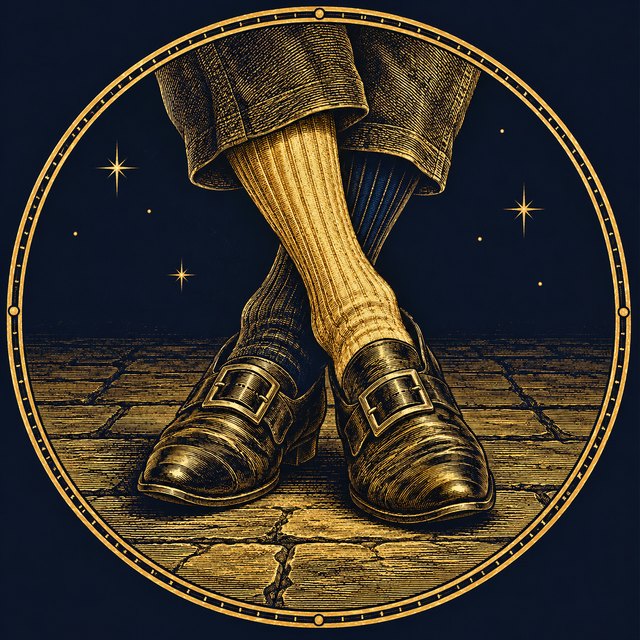
Einstein's idea, put plainly, is the instruction card. Each particle leaves the source carrying a card that says what it will answer to every question a detector might ask. The cards of a pair are written together, so the answers match, and that is the whole of the mystery. John Bell, who did more than anyone to take Einstein's side seriously, had a joke for it. His colleague at CERN, Reinhold Bertlmann, never wore matching socks. If you saw that the sock on his left foot was pink you knew at once that the sock on his right foot was not, and no one thought the left sock had sent a signal to the right. Bertlmann's socks carry instruction cards. The question was whether particles do.
The number
John Bell was an Irish physicist from Belfast who designed accelerators at CERN for a living and thought about the foundations of the quantum theory on his own time, because, he said, it was not a respectable thing to be paid for. In 1964, on a year's leave in America, he wrote a paper of six pages that did what nobody had thought possible. It found a difference between Einstein's instruction cards and the quantum theory that an experiment could see.
The idea is this. A detector can ask its particle one of several questions, by being turned to one of several angles. If the particle carries a card, the card has an answer for every angle written on it in advance. Bell showed that any set of cards whatever, written by any rule whatever, obeys an arithmetic limit on how well the answers of two distant detectors can agree and disagree across a chosen set of angles. The limit, in the form the experimenters use, is the number two. Add up the agreements the right way and no cards can push the total past two. The quantum theory, with no cards at all, predicts two times the square root of two, which is two point eight three. Between two and two point eight three there is a gap, and an experiment could look into it.
Bell's paper appeared in a new journal that folded after a few issues, and for five years almost nobody read it. In 1969 four physicists, John Clauser, Michael Horne, Abner Shimony and Richard Holt, rewrote the inequality in a form that real detectors with real inefficiencies could test, and that version, named CHSH for the four of them, is the one the instrument below counts.
The basement
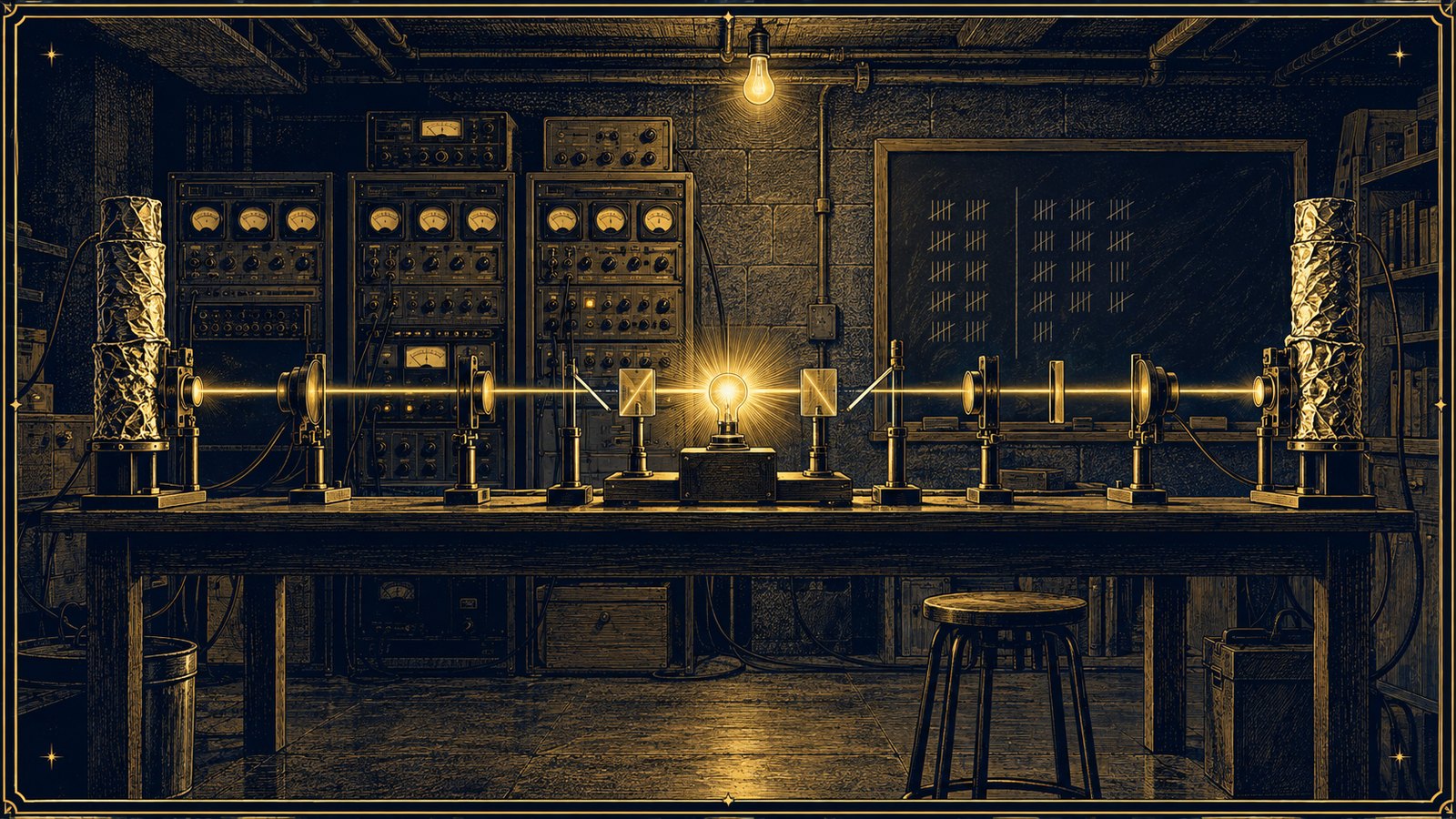
John Clauser was a graduate student at Columbia when he found Bell's paper, and his advisor told him to leave it alone, since the question was settled and the experiment would end his career. He did it anyway, at Berkeley, with Stuart Freedman, in 1972. They heated calcium atoms until the atoms gave off pairs of photons, sent each photon of a pair through a polariser to a detector, and counted, at nine different angles between the polarisers, for about two hundred hours, because the signal was so weak. Clauser has said since that he had hoped the result would go the other way and that Einstein would turn out to be right. The count came out on the quantum side, well past two. A rival experiment at Harvard the same year came out on Einstein's side, and Clauser repeated it and found that it had not.
The switches
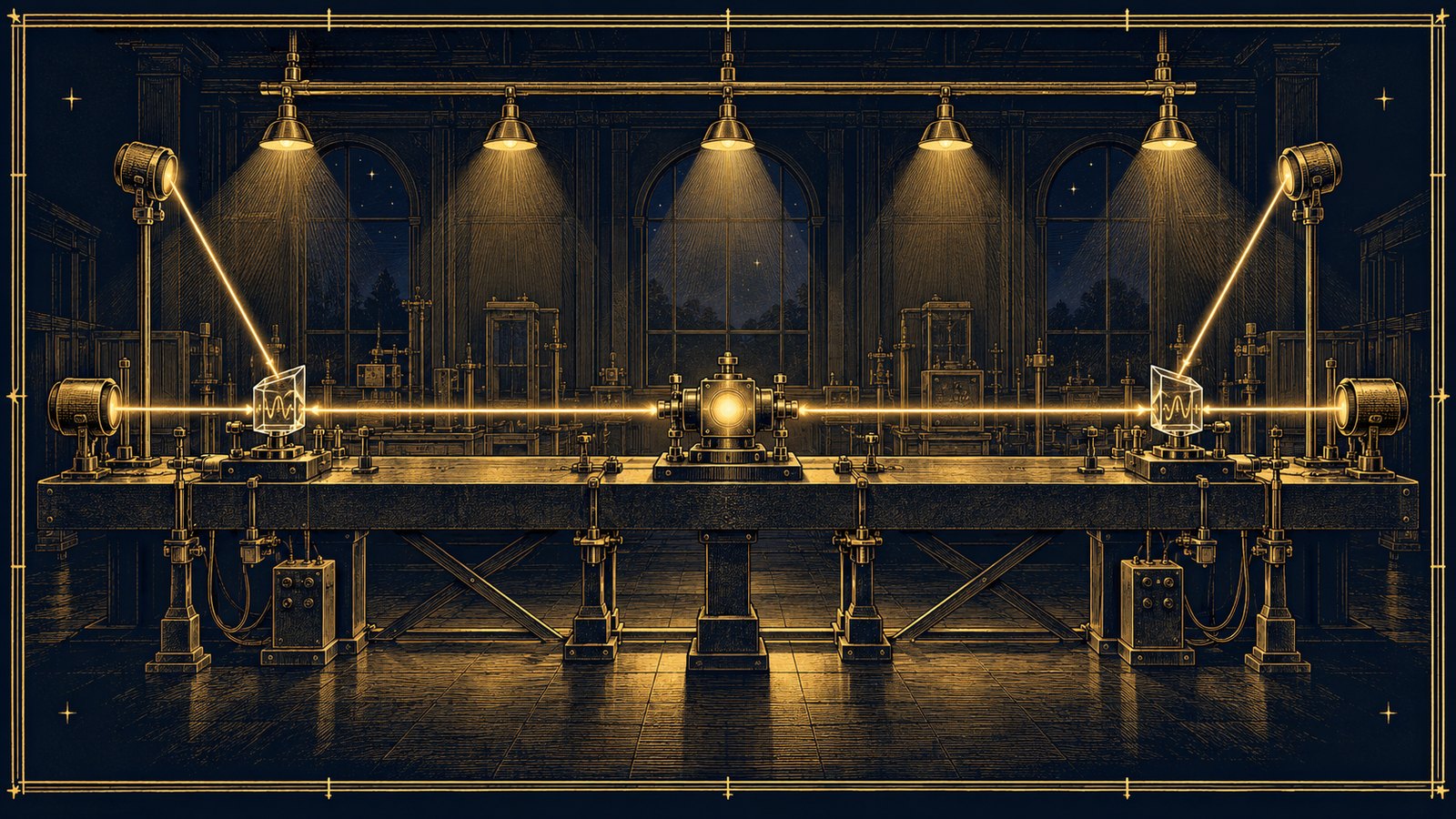
There was a loophole, and Bell had pointed to it himself. If the detectors are set to their angles before the pair leaves the source, the source could in principle know the settings and write the cards accordingly. The settings have to be chosen after the photons are in flight, so late that no signal, even at the speed of light, could carry the choice from one side to the other in time. In 1982 Alain Aspect at Orsay, south of Paris, built that. His two detectors stood about twelve metres apart, and on each side a switch, driven by sound waves in a small block of glass, threw the photon toward one of two polarisers every ten nanoseconds, faster than light could cross the bench. The count came out at the quantum value again. Einstein's cards, if they existed, would have to be written with knowledge of a choice that had not yet been made.
The diamonds and the quasars
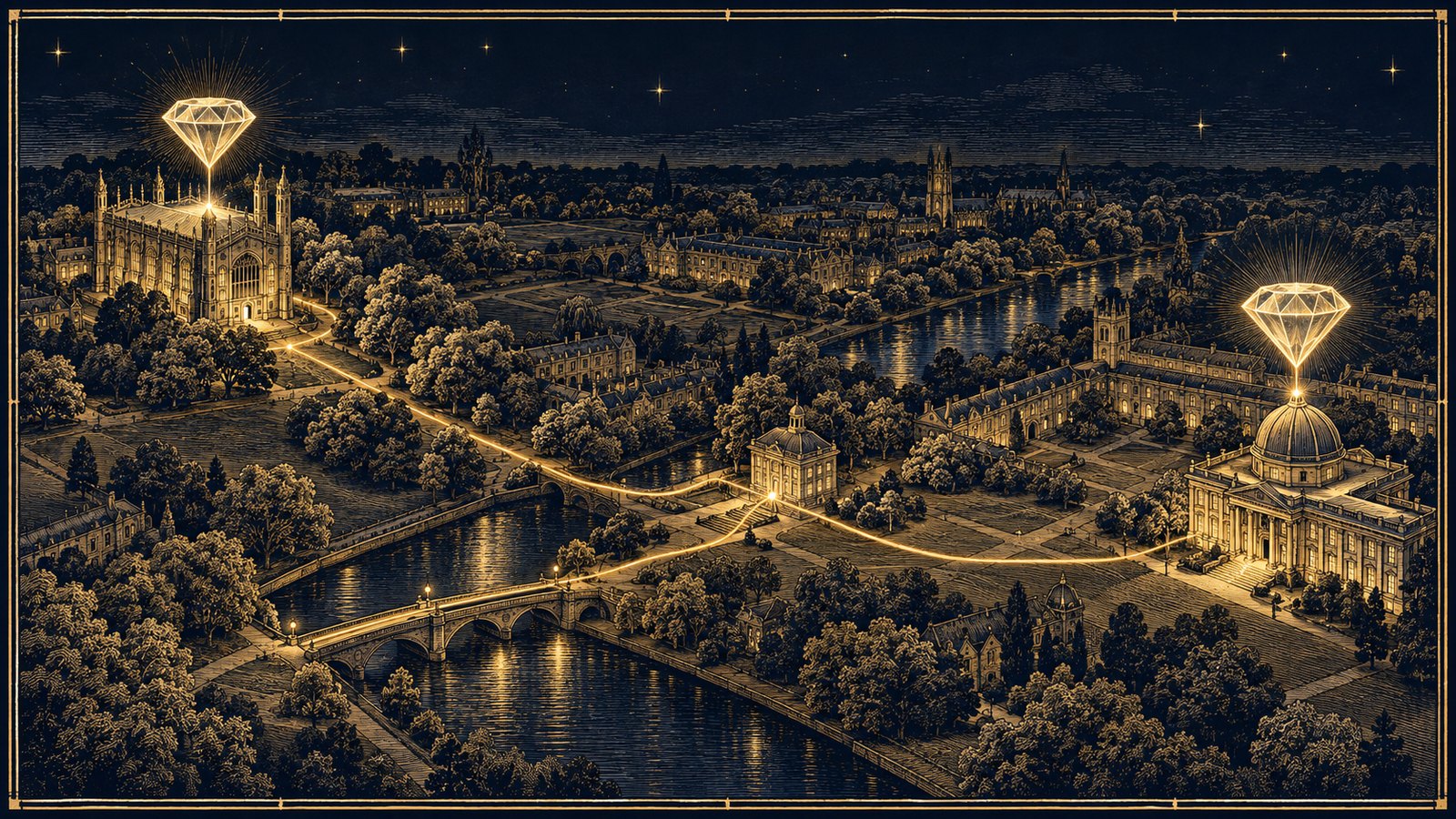
Two loopholes stayed open for another thirty years. Detectors miss most photons, so a sceptic could say the ones that were counted were an unrepresentative sample. And in Aspect's experiment the switches were fast but not random. Both were closed in 2015, in three experiments within a few months of each other. At Delft, Ronald Hanson's group put an electron inside a diamond in one building and another inside a diamond in a second building 1.3 kilometres across the campus, entangled them through photons meeting in a third building between, and read the electrons out directly, missing none. They ran 245 trials and got 2.42. Vienna and the American standards laboratory in Colorado did it with photons the same year, with new detectors that caught nearly all of them, and got the same answer with far more trials.
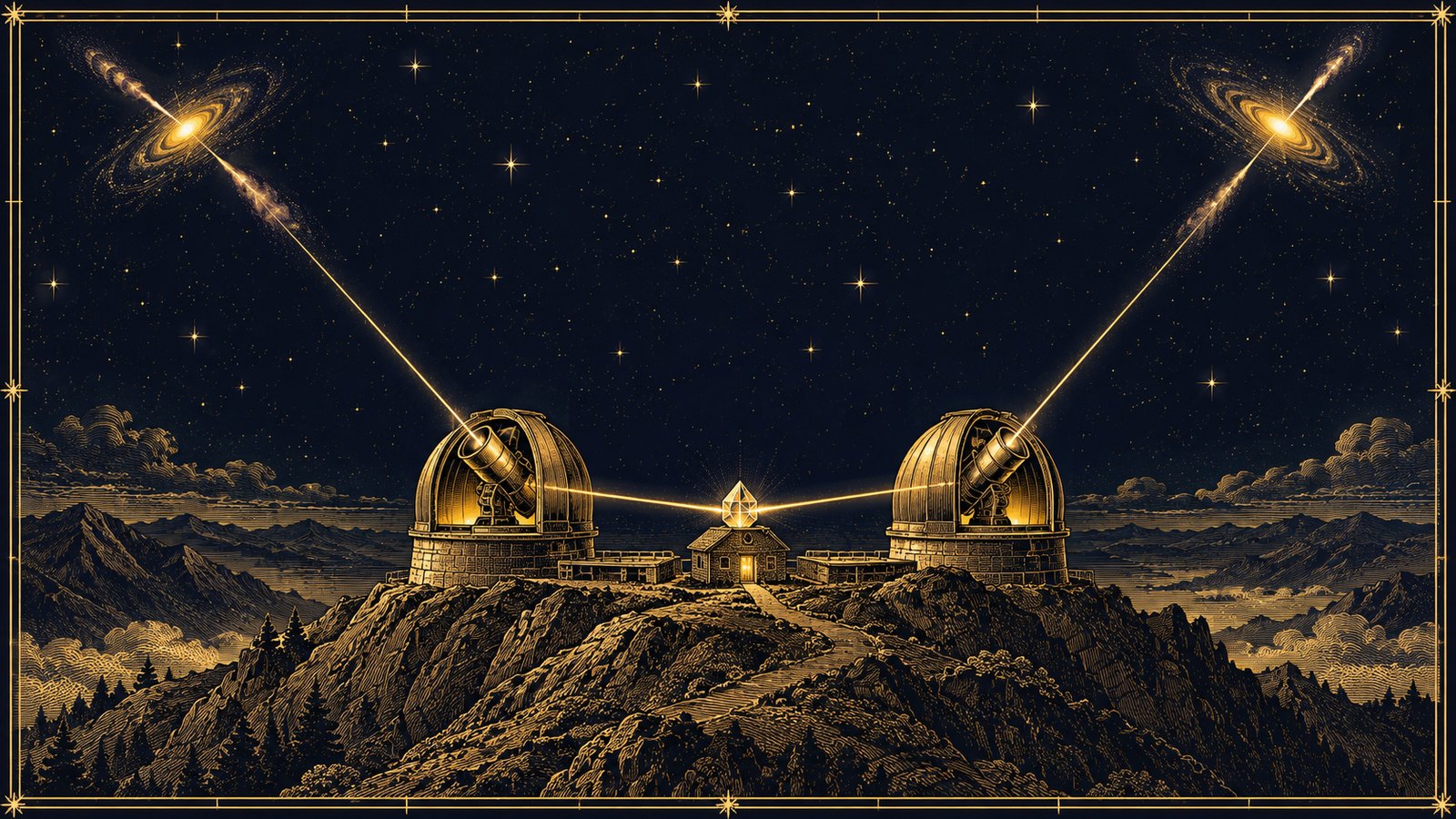
The last loophole is the strangest. Who chooses the settings? If the choice is made by a machine, the machine's choice could in principle share a cause with the particles, somewhere back in the past. In November 2016 a hundred thousand people playing a game online supplied the choices for thirteen experiments on five continents in one day, ninety-seven million random bits typed by hand. In 2018 a team on La Palma used two of the largest telescopes in the world to read the colour of light arriving from two quasars, and set the detectors by it. The light had left one of the quasars nearly eight billion years before, so any common cause for the settings and the particles would have had to be arranged before the Sun was formed. The count came out at the quantum value, as it always has.
Stockholm
On 4 October 2022 the physics prize went to Clauser, to Aspect, and to Anton Zeilinger of Vienna, who had carried entanglement from a thing to be tested to a thing to be used, teleporting the state of one photon onto another in 1997 and sending entangled pairs between two islands of the Canaries, 143 kilometres apart, in 2012. Bell had died in 1990, at sixty-two, of a stroke, the year he was said to have been nominated. The citation named experiments with entangled photons and the establishing of the violation of Bell inequalities, which is a dry way of saying that the question Einstein asked on the walk has an answer, and that the answer is not the one he expected.
Pauli and Jung

There is a reason this page sits on this site and not only in a physics textbook. The lineage shelf here holds the Stoics, who said the world is one body with one breath; the Hermetica, which said what is above is as what is below; and Jung, who said that events can be joined by meaning without being joined by cause. All three were saying, in their own words, that distant things can be of one piece. Entanglement is the first time physics has said something that sounds like that and meant it, and the first time it has been measured.
The thread is not a loose one. Wolfgang Pauli, who had the exclusion principle, the rule that gives atoms their structure, and the Nobel Prize for it, came to Jung as a patient in 1932 after his mother's suicide, a divorce and a year of drinking. The treatment ended and the letters did not. For twenty-six years, eighty letters, they argued about whether the physics Pauli did by day and the dreams he brought to Jung by night were two views of one order. Jung's essay on synchronicity, the one the Jung page is about, was shaped in those letters and published in 1952 in a single volume with Pauli's own essay on Kepler. Pauli was also, among physicists, a walking coincidence: equipment was said to fail when he entered a laboratory, and once, when an expensive apparatus at Gottingen broke for no reason, it turned out that Pauli's train from Copenhagen had been standing at the Gottingen station at that minute. The director, James Franck, wrote to tell him that this time he was innocent. That story now has its own place on the coincidences shelf, with the honest note under it.
What Pauli would want said here is the thing that keeps this page honest. Entanglement is not a connection you can use. The two detectors each see a random string of answers, and neither string carries any trace of what the other detector was asked. Only when the two strings are brought together, by a message that travels no faster than light, does the correlation appear. Nothing is sent. No one can signal with it, no one can feel it, and it says nothing whatever about two people thinking of each other at the same moment. It is a correlation without a cause, which is Jung's phrase for synchronicity almost exactly, and it is the only such correlation that has ever been found, and it lives between particles.
The Moon
So does it? The theorem does not say the Moon vanishes. What Bell proved, and what the experiments confirm, is that two things Einstein believed cannot both be true. One is that each particle carries its answers before it is asked. The other is that nothing a detector does on one side of a campus can have any bearing on what happens on the other side faster than light could carry it. Keep the first and you must give up the second: the particles are of one piece across any distance, and the universe is not made of separate local facts. Keep the second and you must give up the first: there is no answer until the question is asked, and the asking makes it. Physicists are divided on which to drop, and the division has not narrowed in sixty years. There is a third way out, which is to deny that measurements have single outcomes at all, and that is Everett's reading, which keeps both of Einstein's beliefs by multiplying the world.
The Moon is large and warm and is being looked at constantly by the sunlight, the dust, and its own rocks, so its answers are fixed long before any of us turn around. The theorem bites at the scale of single particles, and it bites hard, and what it says there is that Einstein's picture of a world of small separate things, each carrying its own facts, each minding its own business, is not the world we have.
The instrument
The disc below is the experiment. A source at the centre fires pairs, one particle to each detector, and each detector asks its particle one question, set by the angle of its dial. Turn the dials with the sliders, or drag the dial faces themselves, and watch the tally of agreements change. In one mode the particles carry instruction cards written at the source, as Einstein wanted; in the other they carry nothing and answer as the theory says. The graph fills in as you sweep the angle between the dials: a straight line for the cards, a curve for the theory. Then run Bell's test. The instrument sets the four angles the test uses, fires a few hundred pairs at each, and adds the agreements up. With the cards the total cannot pass two. Without them it climbs to nearly three, and the needle goes through the line that was supposed to hold it.

The honest part
The source in the instrument fires one pair at a time and every particle is counted, which is the ideal experiment and not any real one; real detectors miss photons and the 2015 experiments are remarkable because they got close enough to this ideal to close the loophole. The instruction cards are drawn the simplest way, as a hidden angle each particle carries, answering yes when the detector is within forty-five degrees of it. Bell's theorem covers every possible card, not only this one, and the straight line is what this one gives; other rules give other shapes, and none of them pass two. The quantum answers are drawn from the theory's own probabilities for photon pairs, and the curve the dots fall on is the cosine of twice the angle, which is what every laboratory since Berkeley has measured. The test's number, with a few hundred pairs at each setting, wanders by a tenth or so from run to run, which is also what the laboratories see.
What is settled is the number. Two is the ceiling for any world of instruction cards and the world gives nearly three, and that has been checked in diamonds, in photons, in atoms and in superconducting circuits, with the settings chosen by machines, by a hundred thousand strangers and by quasars. What is not settled is what to give up, and the choice is as open as it was when Bell made it unavoidable. This shelf is for questions that the instruments have not closed. This one is unusual: the instrument closed the question Einstein asked and opened a harder one in its place.