
1932 to 2020, Berlin, Princeton, Cambridge, Zurich, Heidelberg, Edinburgh, Brisbane and a mountain top on La Palma
Is there one observer?
John von Neumann, Eugene Wigner, Erwin Schrodinger, Wolfgang Pauli, Dieter Zeh, John Wheeler, and the laboratories in Edinburgh, Brisbane and La Palma
The quantum theory describes everything as a wave until something measures it, and never says what counts as measuring. Von Neumann showed in 1932 that the line between the measured and the measurer can be drawn anywhere along the chain, from the particle to the dial to the eye. Wigner put a friend inside the laboratory and asked whose look made the fact. Schrodinger concluded there is only one mind. Since 2019 the friend has been built out of photons, and a fact for one observer need not be a fact for another. The instrument below lets you slide the line outward, room by room, until no one is left outside it.
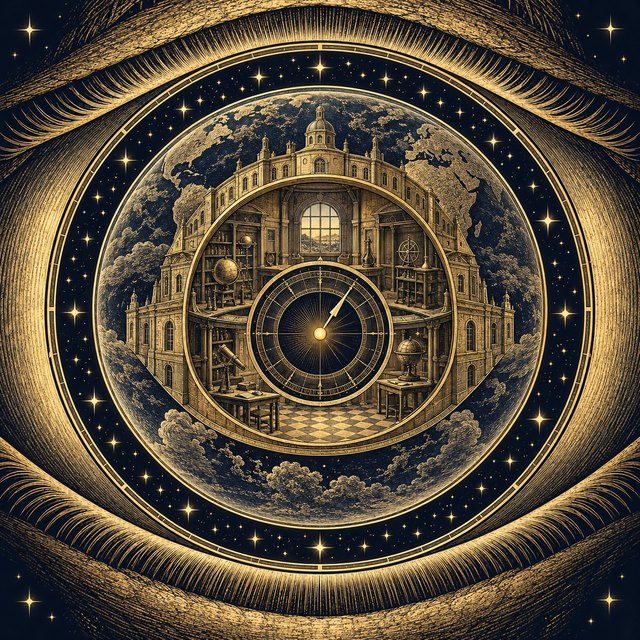
Every account of the quantum theory has a line in it. On one side of the line is the thing being measured, which the theory describes as a wave of possibilities, all of them present at once. On the other side is the thing doing the measuring, which the theory treats as ordinary, solid, and definite, a dial that reads one number and not two. The theory works beautifully on both sides. What it has never done, in a century, is say where the line is.
This page is about that line, the people who tried to find it, and the answer that keeps surfacing when they fail: that it is not anywhere in the world, because the world is observed all at once, by one observer, or by everything.
The chain
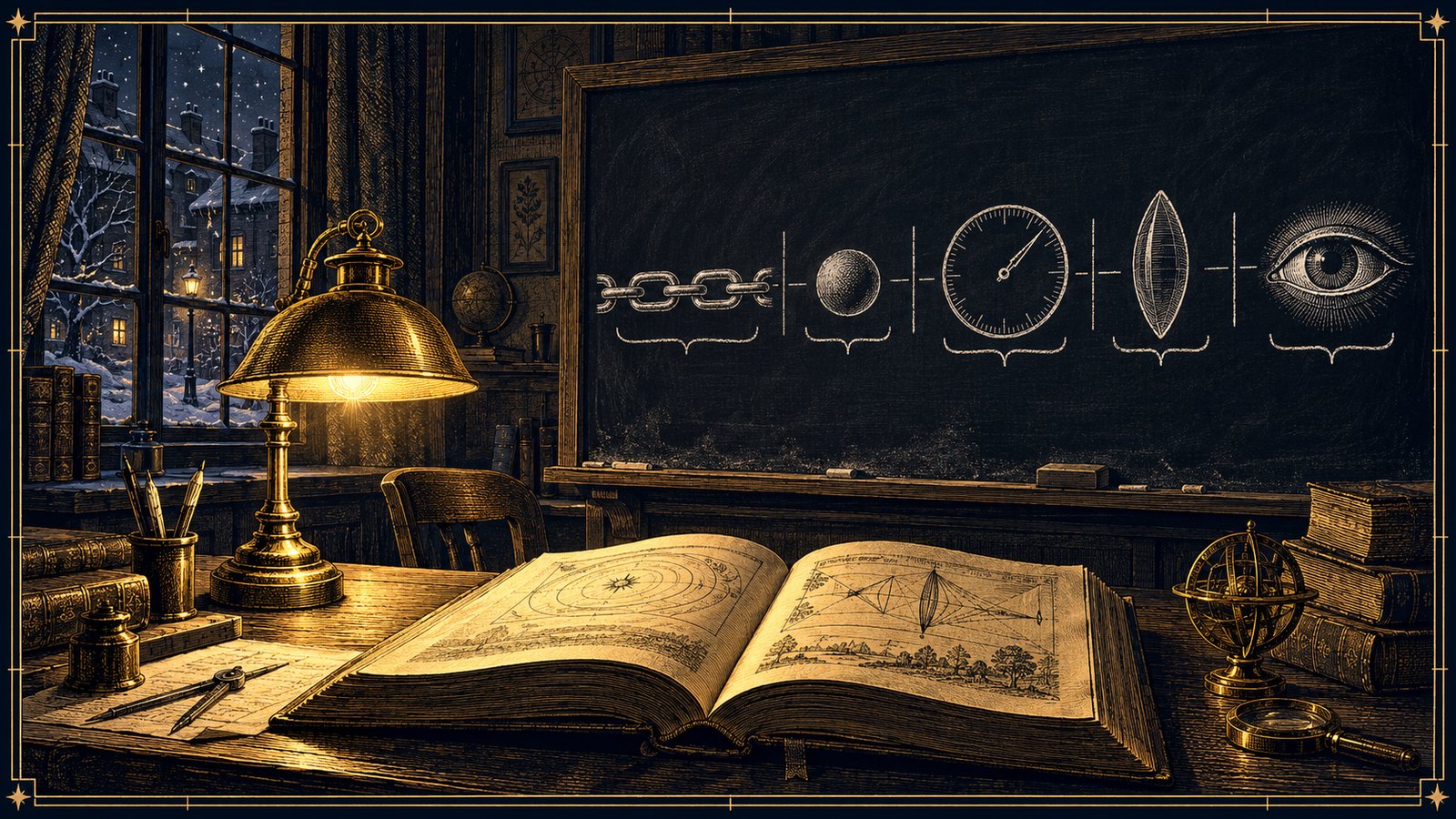
In 1932 John von Neumann, who was twenty-eight and had already rebuilt the mathematics of the theory from the ground up, published the book that is still its foundation. Its last chapter is about measurement, and it contains a result that is easy to state and has never been got round. Suppose a particle is in two states at once and a detector measures it. You can draw the line between the particle and the detector, say the particle collapses to one answer and the detector reads it. Or you can treat the detector as a quantum object too, so that the particle and the detector together are now in two states at once, and draw the line between the detector and the eye that reads the dial. Or between the eye and the brain. Von Neumann showed that wherever you draw it, the predictions for what anyone sees come out the same. The line, which the physicists came to call the cut, can be moved anywhere along the chain without changing a single number.
That sounds like good news, and in practice it is. It is why the theory can be used without settling the question. But it means the theory itself does not contain the cut. It is put in by hand, by whoever is doing the calculation, and it is put wherever is convenient. Von Neumann himself followed the chain to its end and placed the final step at what he called the abstract ego of the observer, the point where somebody knows the answer. He was not comfortable there and said so. Nobody since has been comfortable anywhere.
The friend
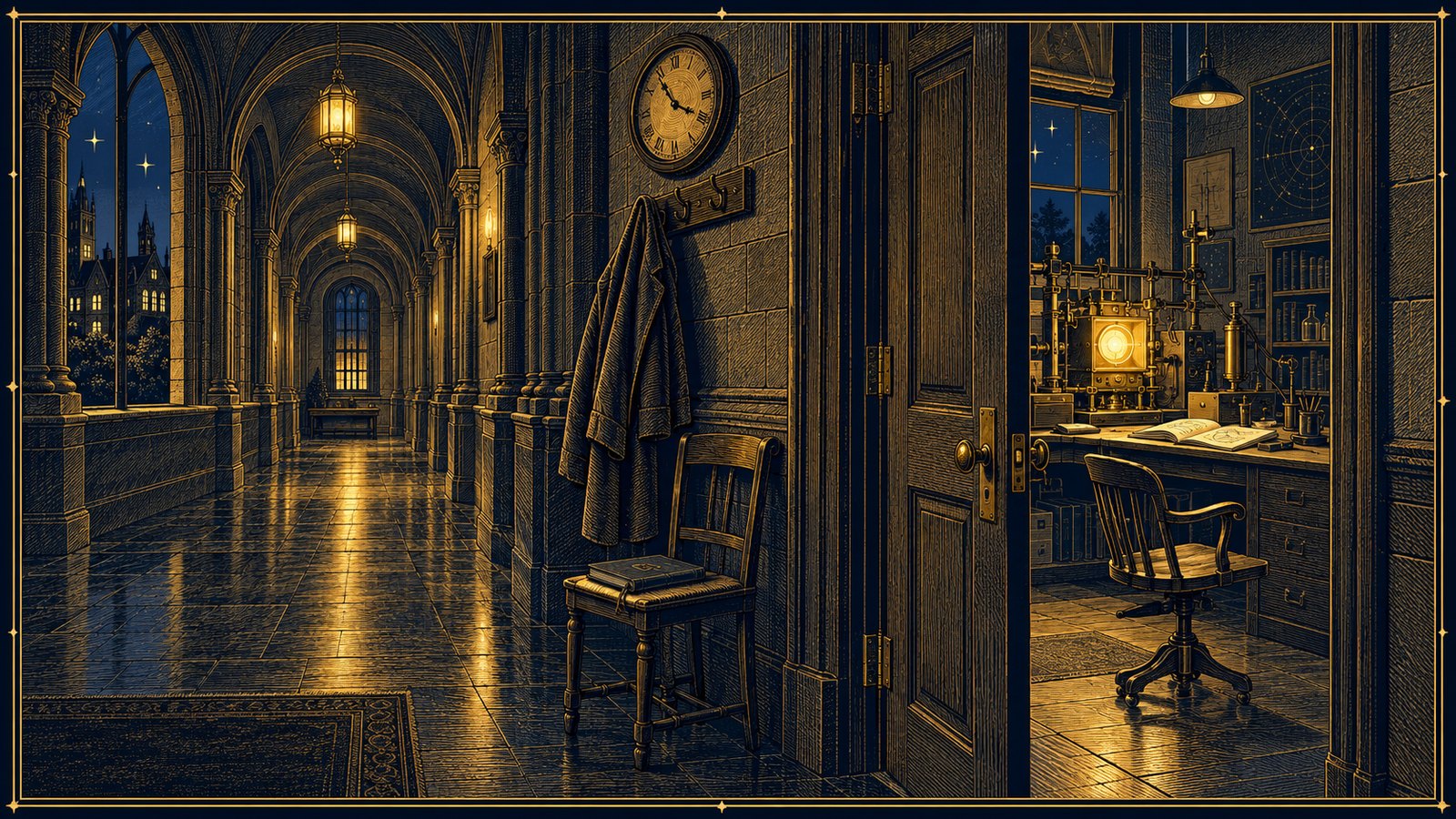
Eugene Wigner, who shared the 1963 Nobel Prize and had been von Neumann's schoolfellow in Budapest, took the chain seriously enough to be troubled by it for thirty years. In 1961 he wrote a short essay for an anthology of scientific speculation and put a person into the problem. A friend is in a laboratory with a particle and a detector. The friend measures the particle and sees a flash, or no flash. Wigner is outside in the corridor. For Wigner, who has not looked, the theory says the friend, the detector and the particle are together in two states at once: the friend who saw a flash and the friend who saw none, both present until Wigner opens the door. But the friend, asked afterwards, will say that there was a definite flash or a definite absence long before the door opened, and the friend was there.
Wigner's conclusion in 1961 was that the chain ends at consciousness. The friend's experience is what made the fact, and the theory's description of the friend as two friends at once is simply wrong, because a conscious being cannot be in two states. He said this carefully and he meant it as physics, not mysticism: the theory had to be changed where minds were involved. Then, in the early 1980s, he read the work on decoherence described below and withdrew the idea. By the end of his life he no longer held that a mind collapses anything. The friend stayed in the literature without him, and in the last ten years the friend has been built.
The one mind

Erwin Schrodinger, whose equation is the wave that all of this is about, got to the same place from the other side. In October 1956, two years after returning to Austria from his long exile in Dublin, he gave the Tarner lectures at Trinity College, Cambridge, and they were published in 1958 as Mind and Matter. The question he set himself was the one Wigner would set five years later: where does the world of the physicist, made of particles and fields, meet the world that is actually experienced, made of colours and sounds and a sense of being here. His answer was that they never meet, because they are not two worlds. The picture of a mind in each skull looking out at a shared world of matter is, he said, a convenient fiction, and the plain reading of the evidence is that the over-all number of minds is just one.
He took this from the Vedanta, which he had read since his twenties, and he did not pretend otherwise. He also did not pretend it was physics. It was his private conclusion about the only question that interested him more than the equation. But it is worth noticing what it does to Wigner's friend. If there is one mind and the friend and Wigner are two windows of it, there is no puzzle about whose look made the fact. There was only ever one looker.

The one world
Wolfgang Pauli, who appears on this site more often than any physicist except Einstein, spent the last twenty-six years of his life in correspondence with Carl Jung about exactly this. Their joint book of 1952 put Jung's essay on synchronicity beside Pauli's essay on Kepler, and the letters around it reach for a word the alchemists had used, unus mundus, one world. The idea was not that mind makes matter or that matter makes mind. It was that both are faces of a single underlying reality which is neither, and which shows itself as physics when approached from one side and as psyche when approached from the other. Pauli thought the quantum theory was the first physics to have run into this directly, because the theory could not describe the measurement without the measurer and could not say where one stopped and the other started. He did not solve it. He wrote, near the end, that the problem of the observer was the problem the century had been handed and had not yet earned.

The friend goes into the apparatus
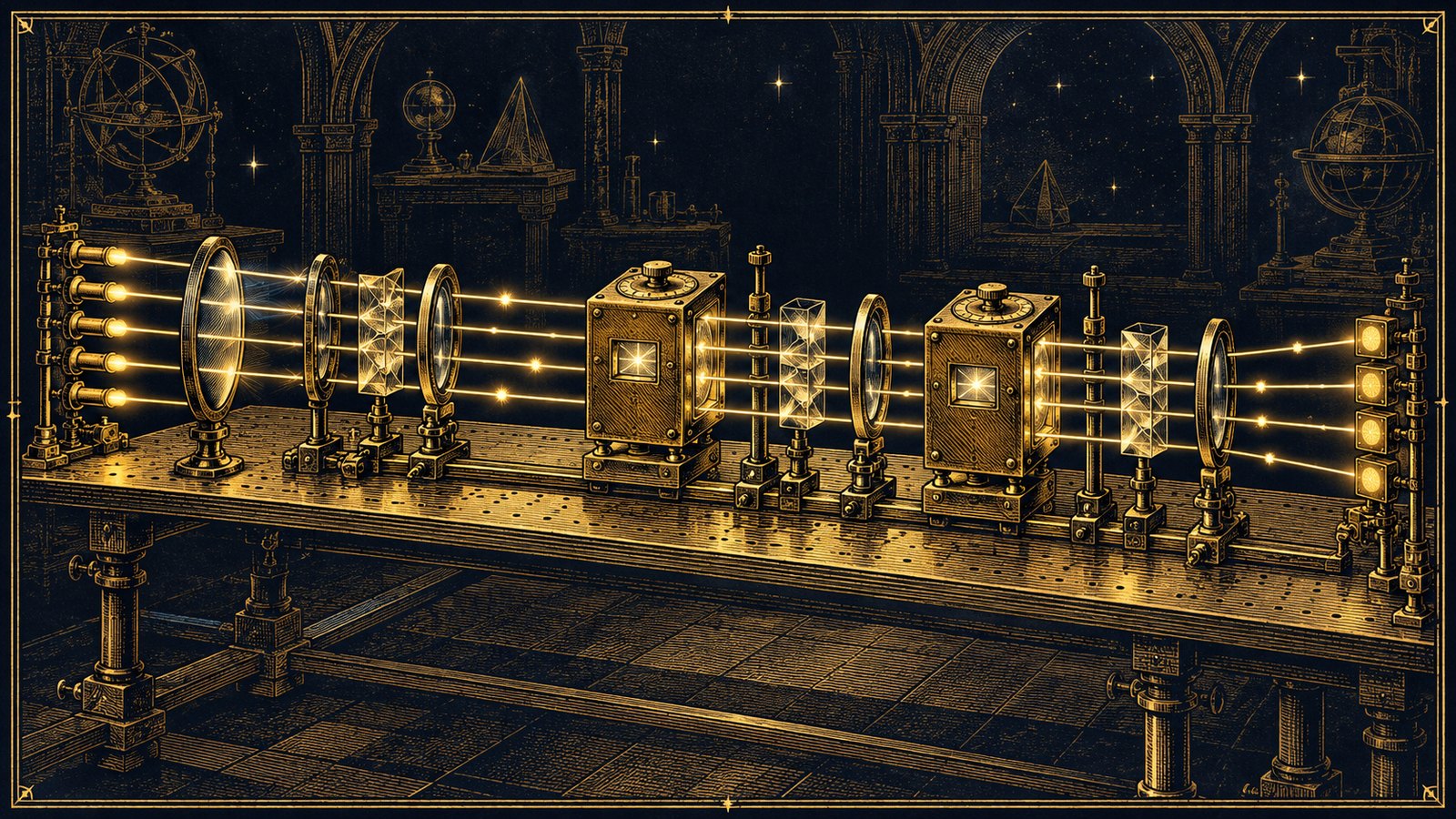
For fifty years the friend was a thought experiment, since no one could keep a person, or even a large molecule, in two states at once long enough to ask. Then the argument was sharpened to the point where a photon could stand in for the friend. In 2018 Daniela Frauchiger and Renato Renner in Zurich published a version with two friends and two Wigners, and showed that if each of the four reasons about the others using the theory, and the theory is assumed to apply to everything, they reach a contradiction. Something has to give: either the theory does not apply to observers, or facts are not shared between them, or the outcomes were fixed in advance.
The following year a group at Heriot-Watt University in Edinburgh built the scenario out of six entangled photons. One photon in each pair played the particle, a second played the friend who measures it, recorded in the photon's path, and the outer measurements played the two Wigners, who could either ask the friend what was seen or measure the friend and particle together as one wave. The result violated the inequality that any shared, observer-independent set of facts must obey, by five standard deviations. In 2020 a group in Brisbane led by Howard Wiseman stated the theorem in its cleanest form and tested it: if quantum theory can be applied at the scale of an observer, then one of three things is false. Either the outcomes were predetermined, or influences travel faster than light, or an event observed by one observer is not simply a fact for all. The first two are the assumptions Bell's tests already ruled out on the entanglement page. What is left to give up is the third.
The friends in these experiments were photons, and a photon's path is not a person's memory. Everyone involved says so in print. The point is narrower and still remarkable: the theory predicts that the friend's fact is not Wigner's fact, and in the laboratory the theory's prediction holds.
The light that chose
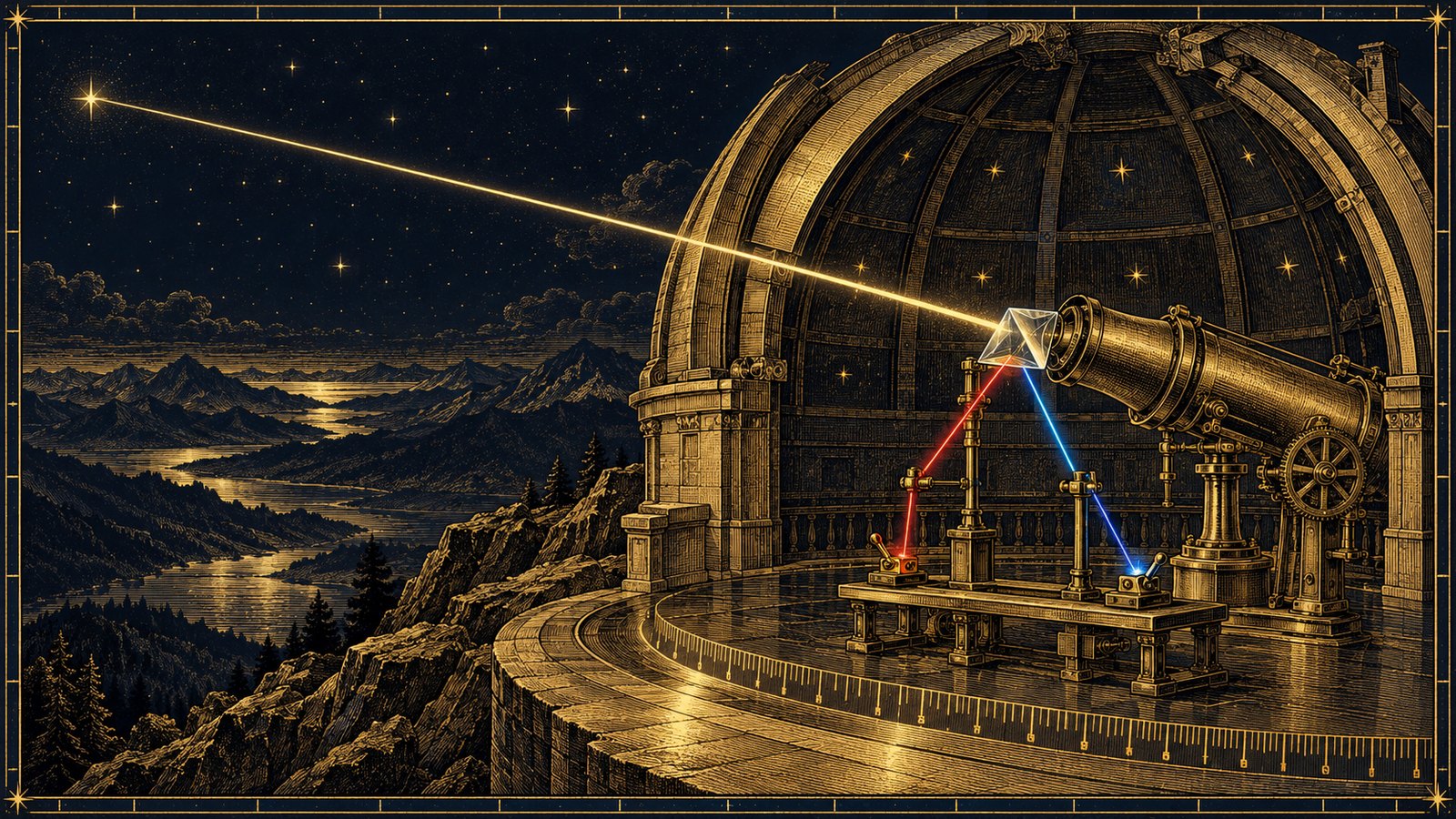
John Wheeler, who taught Feynman and named the black hole, asked a related question in 1978. In a two-path experiment, a photon behaves as a wave if both paths are open and as a particle if one is blocked. Wheeler asked what happens if the choice to block a path is made after the photon has already entered the apparatus. The answer, confirmed in Orsay in 2007 with single photons and a forty-eight metre interferometer and a random choice made while the photon was in flight, is that the photon behaves as if it knew. The choice made later governs what the photon did earlier. Wheeler's reading was that the past is not fixed until it is registered, and he spoke of a participatory universe, one in which observation is not a late addition to the world but part of what brings it about.
The grandest version of this was run on La Palma in 2018. A Bell test needs the two dials to be set at random, and the loophole that worried everyone was that the random choice might be secretly correlated with the particles. So the Vienna and MIT group let the universe choose. Two telescopes pointed at two quasars on opposite sides of the sky, and the colour of each arriving photon, redder or bluer than a chosen line, set the dial on that side. The light from the farther quasar had left it 7.8 billion years ago, three billion years before the Earth existed. The test came out as the theory says, past the ceiling of two. If anything arranged those outcomes in advance, it had to have done so before there was a planet to arrange them on.
Everything watches
There is a respectable physics in which everything observes everything, and it is the physics that changed Wigner's mind. In 1970 Dieter Zeh in Heidelberg pointed out that no detector, and no particle, is ever alone. Air molecules strike it, light scatters off it, heat leaks out of it, and every one of those encounters carries away a trace of what state it was in. Within a trillionth of a second the surrounding world holds a record, spread over millions of particles that nobody could ever gather back together. The two states of the detector are still both there in the full description, but they can no longer interfere with each other, because the environment has told them apart. Wojciech Zurek built this into a working theory in the 1980s and called the process decoherence. It explains, better than anything before it, why a dial reads one number and why a cat is never seen half alive. The cut is drawn by the environment, and it is drawn very fast and very far out.
This page began with a remark made while the last one was being read: that everything likely has consciousness in some form, and so everything is always being observed. Decoherence is the sober version of that remark. The observer does not need to be a mind. The dust in the room is observer enough, and the Moon is observed by every photon of sunlight that leaves it. Einstein's Moon is there whether or not anyone looks, because the universe is looking.

But it does not finish the job, and the people who built it say so. Decoherence explains why you never see both outcomes. It does not say which one you see, or why there is a which. In the full description both friends are still there, each in a world the environment has sealed off from the other, and the theory has no line in it that picks one. If you follow Zeh and Zurek all the way, you arrive at the many worlds. If you stop short, you have to add something the theory does not contain, and the something has to act on both ends of an entangled pair at once, across any distance, which is the one thing Bell's tests allow and local instruction cards do not.
One observer
Put the pieces side by side. The cut can be anywhere, so it is nowhere in particular. A fact for the friend is not a fact for Wigner, so facts belong to observers and not to the world. Nothing local wrote the answers in advance, so whatever settles them settles both ends together. And the thing that settles them cannot be any one of us, because the choice was made by light that left before there was an us.
That leaves two readings, and they are closer than they look. One is that there is no observer at all, only the wave, and every outcome happens in its own branch. The other is Schrodinger's and Pauli's: that there is exactly one observer, not located anywhere, of which the friend and Wigner and the dust in the room and the quasar are all aspects, and that what the physics calls collapse is this one observer settling with itself. Neither reading can be tested against the other yet, and the honest statement is that the experiments of the last decade have closed off the readings in between. A world of many separate observers each watching their own corner, with the facts adding up, is the one picture the laboratories have now ruled out.
The instrument
The disc below is von Neumann's chain drawn as rooms. At the centre is the particle. Around it, ring by ring, are the detector, the friend, the corridor where Wigner waits, the building, the Earth and the sky. The dial sets where the cut is. Everything inside the cut is drawn as the theory describes it, a wave with both answers present, and everything outside is drawn as a record with one answer. Press Measure and watch the answer get written on every ring outside the line and on none inside. Then turn the dial outward, one room at a time, until the cut passes the sky and there is nobody left outside it to hold the record. That last position is the one this page is about.

The honest part
The experiments described here are real and the numbers in them are as published. What they show is narrower than the title of this page. They show that the theory's description of an observer as a wave holds in the laboratory for observers made of light, and that the three assumptions of predetermined outcomes, no faster-than-light influence, and facts shared by all observers cannot all be true. They do not show that there is one observer, and no experiment proposed so far could. Schrodinger's one mind and Pauli's one world are conclusions two great physicists reached in private, and they are on this page because the physics has moved toward them and not away. The reader who prefers the many worlds has the same evidence and a reading that is at least as sober. The cut is still wherever you put it.