
1881 to 1995, Washington, Schenectady and Atlanta
The first digit
Simon Newcomb, Frank Benford, Theodore Hill and a worn book of logarithms
Take the lengths of the world's rivers, the populations of its cities, the constants in a physics handbook or the numbers on the front page of a newspaper, and look only at the first digit of each. About three in ten begin with a 1. Fewer than one in twenty begin with a 9. Nobody arranged this, it holds in any unit you like, and tax inspectors now use it to catch people who make numbers up. This page is the law, the man who found it in the dirt on a book, and a bin you can drop real numbers into.

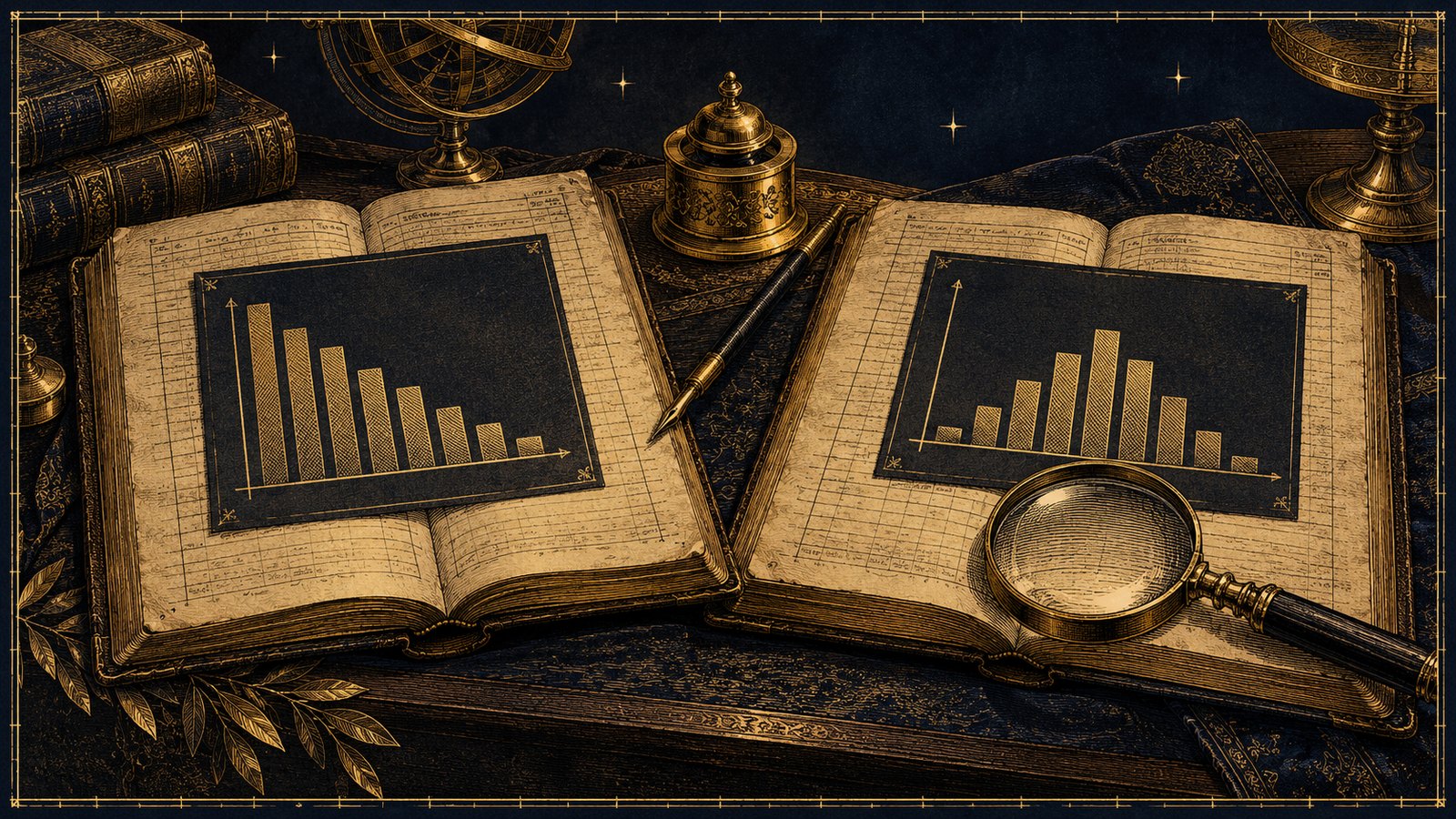
In 1881 Simon Newcomb, who ran the Nautical Almanac Office in Washington and was the most famous astronomer in America, noticed something about the books of logarithms that every working astronomer kept at his elbow. The first pages were filthy. The last pages were clean. A table of logarithms runs from the numbers that begin with 1 at the front to the numbers that begin with 9 at the back, and the men who had been using those books for years, looking up whatever the day's calculation required, had plainly been looking up numbers that began with 1 far more often than numbers that began with 9. Newcomb wrote it up in two pages, gave the rule, and said why: if you take the quantities that turn up in nature and in calculation and spread them out on a scale where each step across is ten times the last, they lie evenly, and on that scale the stretch between 1 and 2 is wider than the stretch between 9 and 10. The share that begin with 1 should be the logarithm of 2, which is 30.1 percent. The share that begin with 9 should be the logarithm of 10 over 9, which is 4.6. Nobody paid any attention.

Benford's numbers

Fifty-seven years later a physicist at General Electric in Schenectady named Frank Benford, who had noticed the same dirty pages and apparently not Newcomb's paper, set out to test it, and did it the way a man does who has no computer and a great deal of patience. He collected 20,229 numbers from twenty different places: the areas of 335 rivers, the populations of 3,259 towns, the constants of physics, the molecular weights of 1,800 compounds, the numbers in an issue of Reader's Digest, the addresses of the first 342 people in American Men of Science, the death rates, the street numbers, the scores of baseball games. He counted the first digits. The rivers, the populations and the constants came out close to the law on their own; the lists that had no business following it, like street addresses, came out worse; and when he threw all twenty sets together the total matched the logarithms to within a percent in every bin. He called it the law of anomalous numbers, and it has carried his name since, though the rule was Newcomb's and the dirt was everyone's.
Why it holds
The reason is in the instrument below, in the two sets that follow the law exactly rather than roughly. The Fibonacci numbers and the powers of two obey it to the last digit, and neither of them has anything to do with rivers. What they have is growth by multiplication. Take anything that doubles, or grows by a steady fraction, and watch the first digit as it climbs. From 1 to 2 is a doubling, so the quantity spends a whole doubling time beginning with 1. From 2 to 3 is only half a doubling. From 9 to 10 is a sixth of one. A quantity that climbs by multiplying spends the longest part of its life beginning with 1, then less with 2, and the least with 9, in exactly the proportions of the logarithms. Populations grow that way. Prices do. Anything spread over many powers of ten, whether it grew or was simply measured, behaves the same, because on the scale of powers of ten it is spread evenly and the bin for 1 is the widest. In 1961 a mathematician showed what Benford had only noticed: a set that follows the law in metres follows it in feet, in miles and in furlongs, and it is the only distribution of first digits with that property. If the digits of nature had a favourite unit they could not do this. They have none, so they must.
The proof that it holds for mixtures, which is the honest case, came in 1995 from Theodore Hill at Georgia Tech: numbers drawn from many different distributions, mixed together in a way that does not itself favour any scale, tend to the law even when none of the sources follows it alone. That is why the front page of a newspaper obeys it, and the back pages of a tax return, and a spreadsheet of a company's invoices. It is also why a fraud does not. Someone inventing figures spreads them out the way a person imagines numbers, with too many 5s and 6s and too few 1s, because the invented numbers have no growth in them. Since the 1990s auditors have run first-digit tests on ledgers as a matter of course, and courts in the United States have accepted the result as evidence that a set of figures was not what it claimed to be.
The instrument
Six sets of numbers, dropped one at a time into the bin of their first digit. The marks are what the law expects. The rivers run from the Nile to the creeks of Delaware, the towns from Tokyo to the villages of Sussex County, and the constants are a page of the handbook; all three are real and follow the law roughly, as real sets do. Fibonacci and the powers of two follow it exactly. The dice are a hundred numbers drawn evenly from a fixed range, and they do not follow it at all, which is the control. Tap the disc to shuffle and drop again.


The honest part
The law is a statement about rulers, not about rivers. A river is not thirty percent likely to be some particular length; it is thirty percent likely to have a length that begins with a 1 when written in a unit, and that is a fact about how numbers spread over scales, not about water. It also has edges. Anything measured within a narrow range does not obey it: the heights of adults in centimetres nearly all begin with 1, telephone numbers begin with whatever the exchange assigns, and the lottery is flat by construction. The sets on this page are chosen because they span many powers of ten, and a set that does not span them has no reason to agree. The figures here are rounded from the standard references, and rounding a river from 1,998 to 2,000 kilometres moves it from one bin to the next, which is a reminder that the law is a tendency over many numbers and not a rule for any one of them.
The fraud test has its own edges. A clean first-digit fit does not prove honesty, since a careful forger can fit the law on purpose, and a bad fit does not prove fraud, since plenty of true ledgers are narrow by nature. The analyses that claimed to find rigged elections and doctored epidemic counts by this method have mostly not held up, because counts of votes in districts of similar size are exactly the narrow kind of set the law does not cover. What is solid is the thing Newcomb saw on the dirty pages: given numbers that have been free to spread, the 1s come first, in every language, in every unit, and for a reason that can be written in one line.