
1679 to 1716, Hanover, Paris and Peking
Everything from one and nothing
Gottfried Wilhelm Leibniz, with a Jesuit in Peking
In 1679 Leibniz worked out how to count with nothing but 0 and 1, and in 1703 a letter from Peking showed him the same figures in a Chinese diagram older than Pythagoras. He thought it proved creation from nothing. He also built the first machine that could multiply, invented the calculus Newton spent his last years fighting him over, and said that every speck of the universe mirrors the whole of it. A wheel of the sixty-four, with the arithmetic that lives in it.
On the second day of January 1697 the librarian of the ducal library at Wolfenbuttel sent his duke a New Year's letter with a design for a medal. One face was to show the numbers from 0 to 16 written out in a notation nobody used, a column of noughts and ones, with the sums of them in the margin. Over it, rays of light falling on dark water, and the motto he had chosen: Omnibus ex nihilo ducendis sufficit unum. One is enough to draw everything out of nothing. The librarian was Gottfried Wilhelm Leibniz, who was also the duke's historian, the Elector of Hanover's legal adviser, the man who had invented the calculus thirteen years before, and the only person in Europe who thought the medal would be understood. The duke was polite, and as far as anyone knows the medal was never struck. Leibniz went on writing about the thing on the medal for the rest of his life, because he thought it was a picture of how God had made the world.
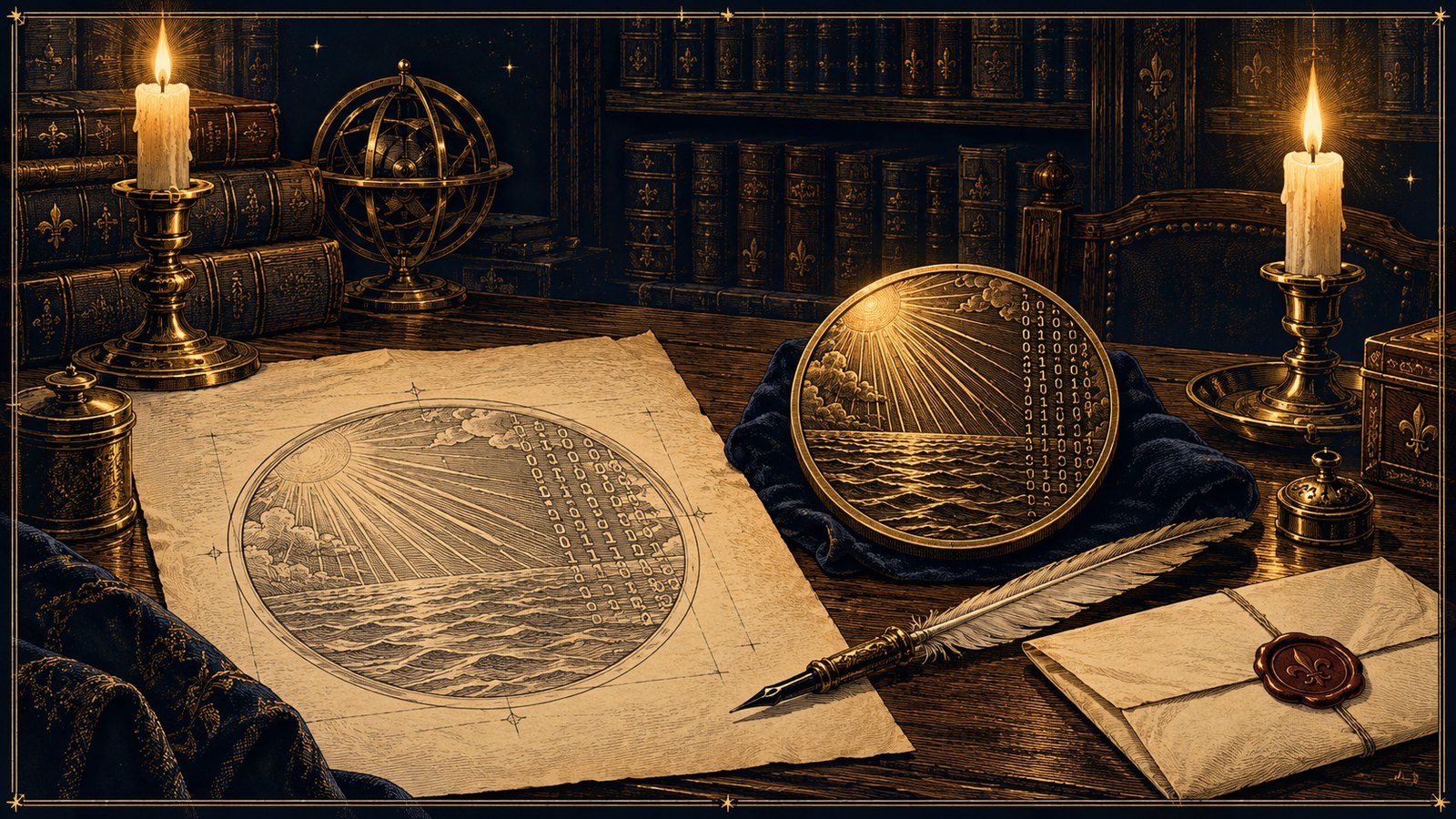
He had found it in March 1679, on a few sheets he dated and kept. Ordinary counting uses ten marks and starts again at ten; Leibniz asked what happened if you used two and started again at two. One is 1. Two is 10. Three is 11, four is 100, five is 101, and so on up, every number a row of noughts and ones and nothing else. Adding was almost nothing: one and one is nought, carry one. Multiplying was shifting. On the same sheets he sketched a machine to do it, a box in which balls would run along channels and drop through holes or not, which is a 0 and a 1 in brass. He did not build that one. He had already built the other.
The letter from Peking
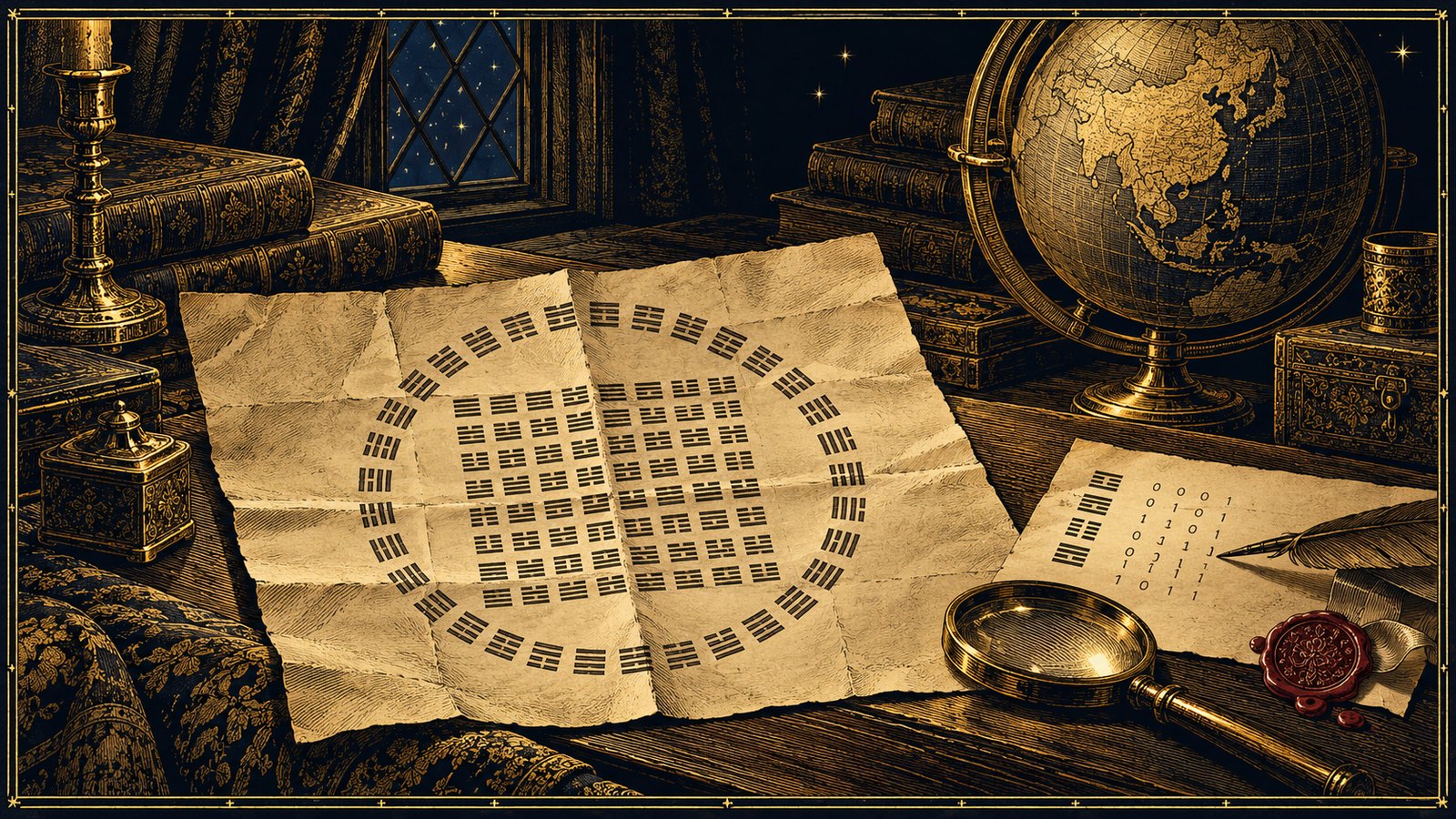
Leibniz wrote to everybody. One of his correspondents was Joachim Bouvet, a French Jesuit who taught geometry to the Kangxi emperor in Peking and shared Leibniz's hope that China and Europe would turn out to have been thinking the same thoughts all along. In February 1701 Leibniz sent him the binary arithmetic and the idea of the medal. Bouvet's answer was written on 4 November 1701 and took seventeen months to reach Hanover. Inside it was a woodcut: sixty-four figures, each made of six short lines, some whole and some broken in the middle, arranged once around a circle and once in a square of eight rows. It was the diagram that goes with the I Ching, the Chinese book of changes, which was already old when Pythagoras was born, and Bouvet said the figures were the work of Fuxi, the first emperor, who had drawn them before writing existed.
Leibniz read a broken line as 0 and a whole line as 1, read each figure from the bottom up, and found that the sixty-four figures stood in the exact order of his numbers from 0 to 63. Six broken lines were nothing. Six whole lines were sixty-three. The square counted along its rows and the circle counted up one side and down the other, and every figure faced its opposite across the centre. He had the Explication of the binary arithmetic in the post to the Paris Academy within a week, with a title that promised it would also give the meaning of the ancient Chinese figures of Fohy. He believed, and said in print, that the first emperor had known binary four thousand years before him, that China had lost the key, and that a diagram proving the creation of everything from one and nothing was the thing most likely to bring the emperor of China to Christianity. Bouvet agreed. The emperor was not consulted.
The other Newton
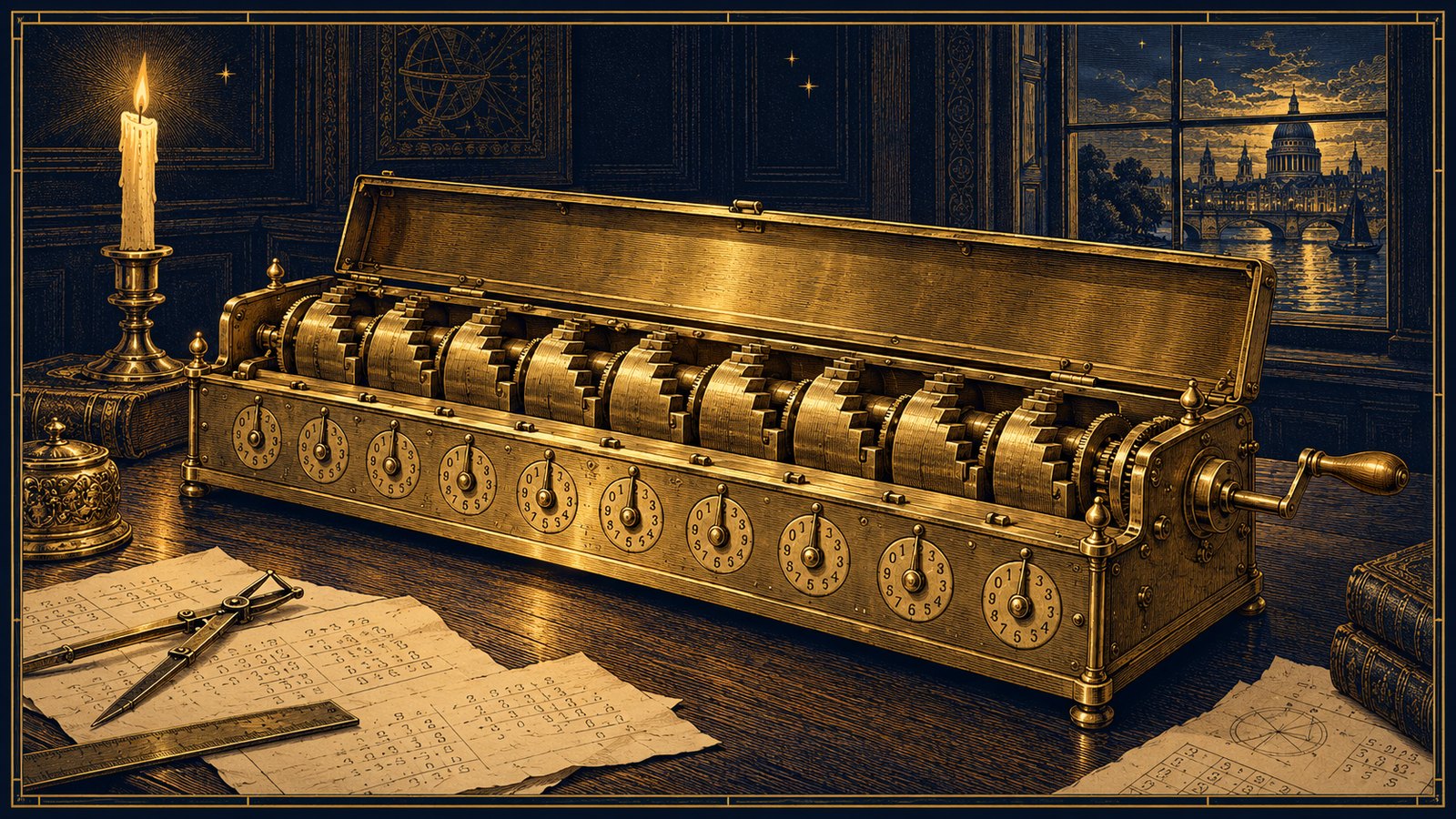
The machine he had built was the stepped reckoner, finished enough to show the Royal Society in London in 1673: a brass drum with nine teeth of nine lengths along it, so that turning a crank added a chosen digit as many times as you turned, which is multiplication. Pascal's box of thirty years before could add. This could multiply and divide, and the drum inside it was still being built into desk calculators in the 1940s. The Society made him a Fellow. He wrote that it was unworthy of excellent men to lose hours like slaves in the labour of calculation that could be given to a machine, and spent the rest of his life trying to extend the thought to arguments: a universal alphabet of ideas and a calculus of reasoning, so that two men who disagreed could sit down together and say, let us calculate.
The calculus he actually finished was the other one. He had worked it out in Paris between 1672 and 1676, with the d and the long s that every student still writes, and published the first of it in a Leipzig journal in October 1684. Newton had found the same thing twenty years earlier in Lincolnshire, had told a few friends, and had published nothing. For a while the two were civil. Then Newton's friends decided that Leibniz had seen Newton's letters and stolen it, and in 1712 the Royal Society, with Newton in the president's chair, appointed a committee, which found for Newton in a report Newton had drafted himself, and which Newton then reviewed, anonymously and favourably, in the Society's own journal. Leibniz was in Hanover, and the Elector he served had just become King of England and had not asked him to come. He died there on 14 November 1716 with the quarrel unsettled. His secretary was the only man from the court who followed the coffin.
The mirror
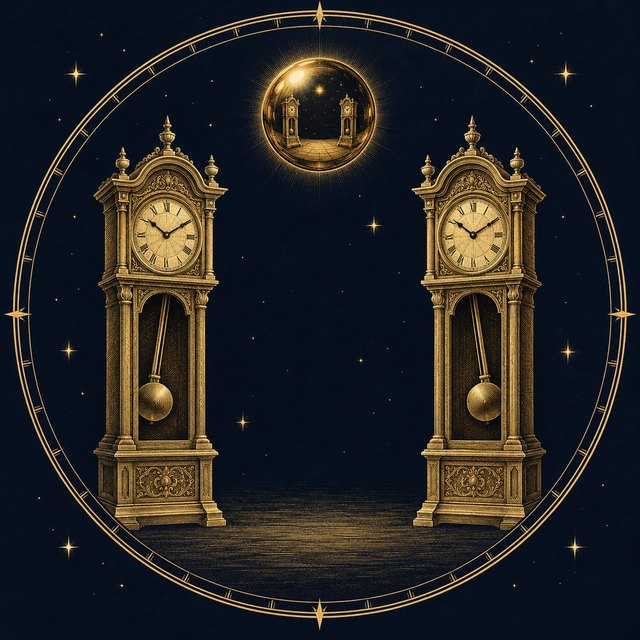
What he left was stranger than the arithmetic. In 1695 he published a short piece on the new system of nature, and in it the idea he is on this shelf for. Mind and body, he said, do not act on each other at all. Neither does anything else. Each substance runs its own course from the inside, and the courses agree because they were made to agree, the way two good clocks keep the same time without a wire between them. He had Huygens' clocks in mind, the ones on the Stoic page that swing into step through a beam; his clocks did not need the beam. The agreement was settled when the clocks were made. He called it the pre-established harmony, and in the Monadology of 1714, ninety numbered paragraphs written for a prince, he took it the whole way. The world is made of simple substances he called monads. They have no windows. Nothing comes in and nothing goes out. And yet every one of them is a living mirror of the entire universe, seen from its own place, so that a mind that read any one of them completely could read everything that is, and the present of each is big with its future.
That is the Emerald Tablet set out as a system, which is why it is here. As above, so below, because the below was made as a picture of the above. Four years earlier he had published the Theodicy, the only book of philosophy he published in his lifetime, and argued that a God who could see every possible world and chose this one must have chosen the best, which is the sentence Voltaire put in the mouth of Dr Pangloss after the Lisbon earthquake had killed tens of thousands of people on the morning of All Saints' Day. And in the last year of his life, through the Princess of Wales, he argued with Newton's spokesman Samuel Clarke in five letters each about what kind of universe Newton had built. Newton's God, Leibniz said, was a poor workman who had to wind his watch and mend it from time to time. Space was not a box the world sat in but the order of things beside each other. Nothing happens without a reason why it is so and not otherwise. And no two things in the world are exactly alike: a gentleman at Herrenhausen, hearing this in the garden, ran about the grounds looking for two identical leaves and came back without them. Clarke's fifth letter arrived and Leibniz died before he could answer it.
The instrument
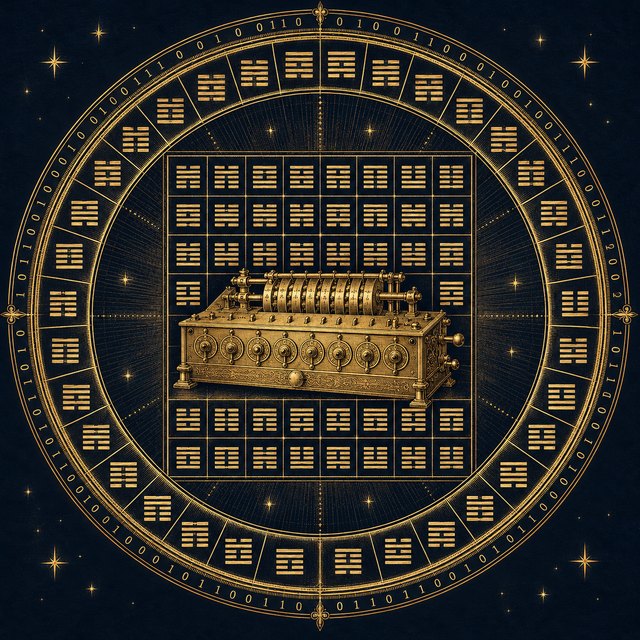
The wheel below is the diagram from Bouvet's letter with Leibniz's reading laid over it. Turn it and the centre shows the figure under your hand, its lines read as noughts and ones, the number they make, and the name the book of changes gives it. The count runs through all sixty-four in order, the way the medal was meant to. The third mode draws the lines across the circle that Leibniz noticed, each figure to its opposite, whole for broken, every pair adding to sixty-three.
The part the clean story leaves out
Fuxi did not draw the diagram. The circle and the square in Bouvet's woodcut are the arrangement of Shao Yong, a philosopher of the eleventh century, and the book itself orders its sixty-four chapters quite differently, in a sequence attributed to King Wen that counts nothing at all. No Chinese writer used the figures for arithmetic. The pattern Leibniz found is really there, the figures really do count in Shao Yong's order, and the story he told about it, of a first emperor with a lost key, was his own, exactly as Kepler's five solids were Kepler's own. Three pages running, now, a real pattern and a wrong explanation of where it came from.
Nor did the binary arithmetic go anywhere for a long time. Leibniz's own machine was decimal. The noughts and ones sat in the journals for a hundred and fifty years until George Boole made an algebra of true and false in 1847, and sat another ninety until a graduate student at MIT named Claude Shannon showed in 1937 that Boole's algebra was what relay circuits did, and Konrad Zuse built a machine in Berlin in 1941 that counted the way the medal did. Every device this page is read on counts that way. It is a straight line from the 1679 sheets only in hindsight, which is the kind of line this site is suspicious of.
And nothing on this page says that the sky does anything to you. Leibniz did not think it did. The mirror in each monad is not a channel; it is an agreement made once, and the whole point of his system was that no influence crosses between things. The site next door owes him nothing but the arithmetic its computers run on and the calculus that puts the planets where they stand.
What crossed the gap
The agreement without a cause. Leibniz is the first man on this shelf to say in so many words that two things can match perfectly with nothing passing between them, and to make that the rule of the universe rather than a puzzle in it. He did not know what to do with it beyond theology. Two hundred and thirty-six years after his death a psychiatrist in Zurich, trying to give a name to coincidences that mean something, went back through the history for anyone who had said it before, found the pre-established harmony and the windowless mirrors, and put them in his essay beside the Chinese book that Bouvet had sent, which he had been throwing stalks for since the 1920s. He is next.