
1897 to 2014, Kansas, the Mojave, New Hampshire, Pascagoula, Dulce and a hotel ballroom in Denver
A field guide to the visitors
Alexander Hamilton of Le Roy, George Adamski, Betty and Barney Hill, Paul Bennewitz, Phil Schneider and a thin man in a black suit
Ask anyone who has been down this rabbit hole to name the species and they give you the same list: the Greys, the tall blond Nordics, the Reptilians, the Mantis, the Tall Whites, the hybrids. People who have never met each other, in different countries and different decades, describe the same creatures down to the eyes. That is either the strongest fact in the whole subject or a clue about how the list was made. This page is the field guide, each visitor drawn the way its witnesses described it, with the year and the person it first entered the record, and then the chain: who read whom, from a Kansas farmer in 1897 to the videotapes of 1995, and why one small pool of documents is enough to explain the agreement. Nobody has ever produced a specimen. The catalogue is the specimen.
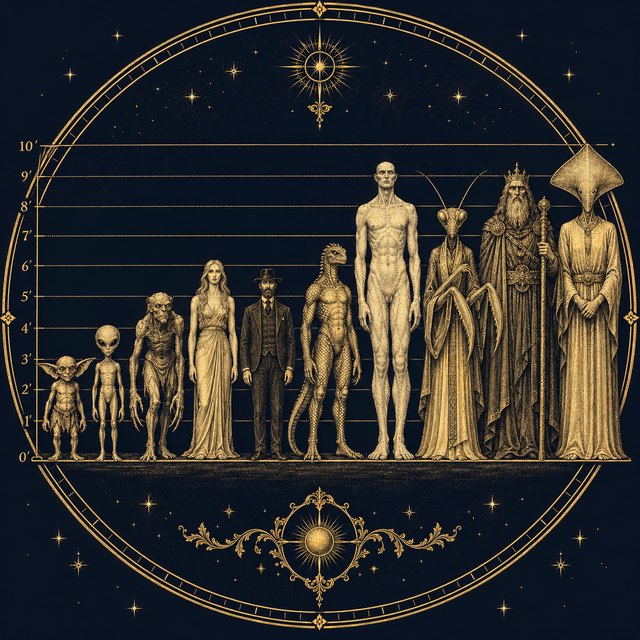
Ask anyone who has spent a night on this subject to name the species and you get the same list back, in the same order, with the same details. The small Greys with the black eyes. The tall blond Nordics. The Reptilians. The Mantis in its robe. The Tall Whites of the Nevada desert. The hybrids, half us and half them. Then the counts: eleven species, fifty-seven, eighty. The agreement is the thing that pulls people in. Witnesses in Brazil and New Hampshire and Kentucky, who never met and in some cases never heard of each other, describe the same creatures down to the shape of the eyes. Either that is the strongest fact in the whole field or it is a clue about how the list was made, and this page is written to find out which. It has two halves. The first is the field guide: each visitor drawn as its witnesses described it, with the name and the year it entered the record. The second is the chain: who read whom, and how one small pool of documents reached everybody.
The newspaper era
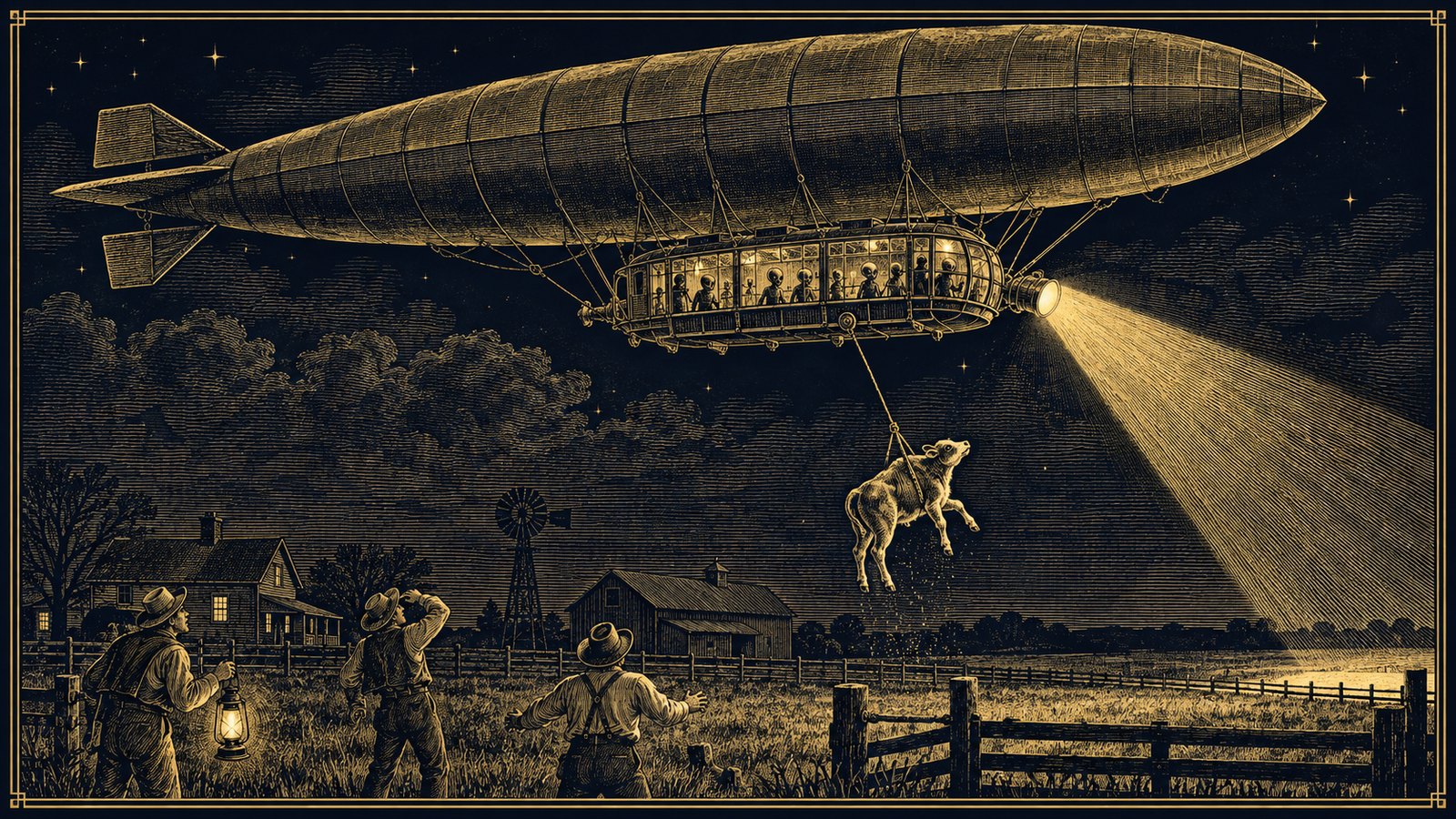
The visitors arrived in the papers before they arrived in the sky. Through the winter of 1896 and the spring of 1897 thousands of Americans reported a great airship crossing the country at night, a cigar-shaped hull with a lit carriage slung beneath it and a searchlight that swept the fields. In April 1897 a Kansas farmer named Alexander Hamilton swore an affidavit that the ship had hovered over his pasture, that its crew were six of the strangest beings he ever saw, jabbering in a language he could not follow, and that they had lassoed one of his heifers and hauled it into the air. Twelve of the leading citizens of Le Roy signed to his honesty. That same week the Dallas Morning News reported an airship hitting a windmill at Aurora, Texas, and the pilot, not an inhabitant of this world and in the writer's view a native of Mars, buried in the churchyard with Christian rites. Hamilton's heifer turned out, decades later, to be the prize entry of a local liars' club, and the Aurora story was filed by a correspondent with a dying town to promote. But the pattern was set in that one week: a strange craft, a stranger crew, an animal taken, a body kept. Everything that came afterward would fit it, because the century had already been told the shape.
The field guide
What follows is each visitor as the record describes it. These are the descriptions people gave, not a claim that any of them exists. Heights are the witnesses' own.
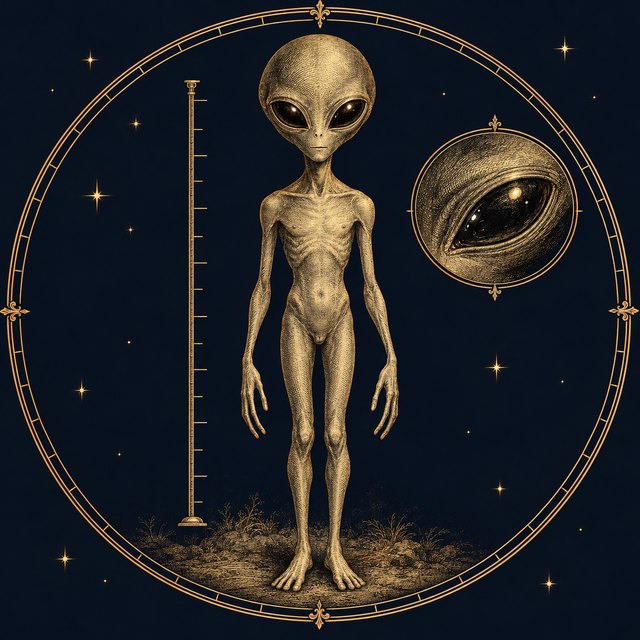
The Grey. Three and a half to four and a half feet tall, a head too big for the body, hairless, grey or putty-coloured skin, two enormous black almond eyes that slant up toward the temples, no nose to speak of, a slit for a mouth, a thin neck and thin limbs, hands with four long fingers. It does not speak; the witnesses hear it in their heads. A Brazilian farmer, Antonio Villas Boas, described small helmeted beings in 1957, but the Grey proper enters the record on the night of 19 September 1961 on Route 3 in New Hampshire, when Betty and Barney Hill lost two hours of a drive home and under hypnosis three years later described the crew: short, grey, large eyes, in matching uniforms. Through the 1970s the Grey stayed one of several types. Then in February 1987 Whitley Strieber's Communion went to the top of the bestseller list with a painting of that face on the cover, and from that year the Grey is the alien. Every drawing since is a copy of Ted Seth Jacobs's painting, including the ones made by people who insist they never saw it. Phil Schneider's large Greys of Dulce, seven feet tall and smelling, as he put it, like something dead, are the same creature scaled up.
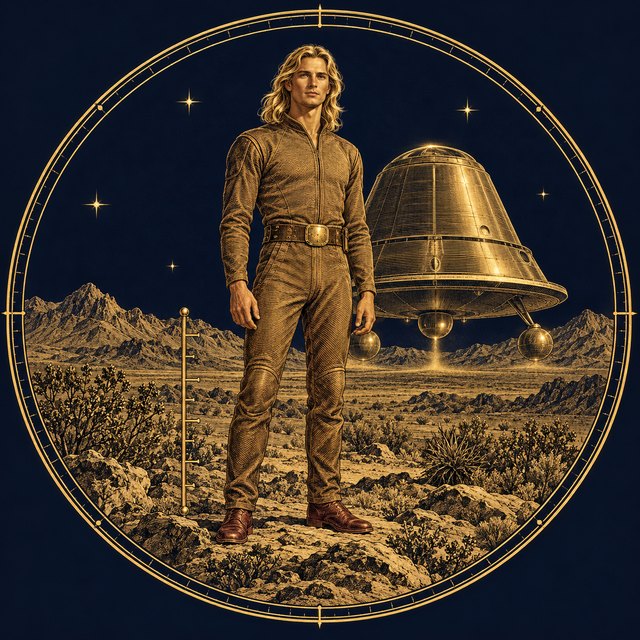
The Nordic. Human in every respect, and better looking: medium to tall, long fair hair, tanned or pale skin, calm eyes, a one-piece suit. It arrives in the desert near Desert Center, California, on 20 November 1952, when George Adamski, who ran a hamburger stand on the road up to Mount Palomar, walked out to meet a man he called Orthon, who had come from Venus to warn about the bomb and who communicated by telepathy and hand signs. Adamski's photographs of the scout ship, a dome with three balls beneath it, became the most reproduced UFO pictures of the decade, and the ship was later matched to a chicken brooder lamp. Through the 1950s the contactees at Giant Rock in the Mojave all met the same kind of being, the Space Brothers, and in 1975 a Swiss farmer named Billy Meier began meeting a woman called Semjase from the Pleiades, who is the Nordic with a new home star. The Nordic is the visitor people meet when the news is good.
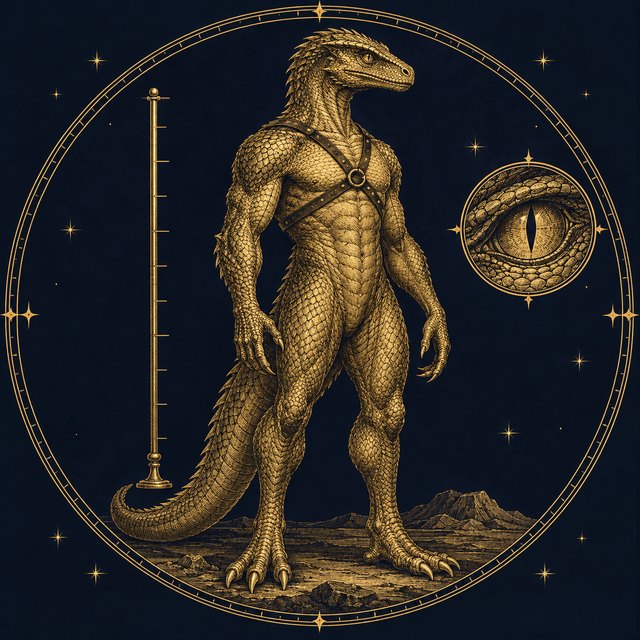
The Reptilian. Six to nine feet, upright, muscular, covered in fine green or brown scales, a long jaw, eyes with vertical slit pupils, clawed hands, often a tail, sometimes wings. It was a pulp creature first: Robert E. Howard's serpent men who wore human faces appeared in Weird Tales in 1929, and the Shaver Mystery that filled Amazing Stories from 1945 put a wicked race under the earth. It enters the UFO record through the Dulce papers of 1987, a set of documents said to come from a security officer at an underground base in New Mexico, where the Reptilians run the deep levels and the Greys work for them, and through the compilations a writer called Branton posted to the early internet. David Icke's The Biggest Secret in 1999 made them the secret rulers of the earth, wearing human faces like Howard's serpent men seventy years before, and from then on the Reptilian belongs to politics as much as to the sky.
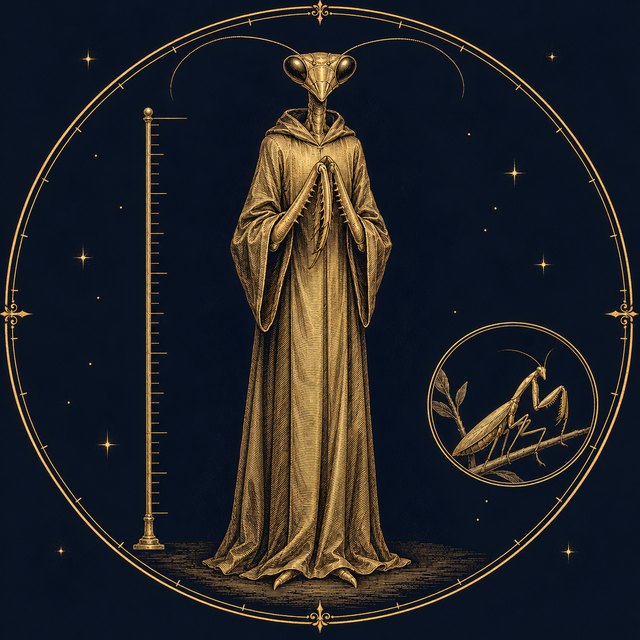
The Mantis. Six to eight feet, the triangular head and huge dark eyes of a praying mantis, a thin neck, long jointed arms folded at the chest, nearly always in a long robe, nearly always described as the one in charge while the Greys do the work. It comes out of the abduction literature of the late 1980s and 1990s, the accounts gathered under hypnosis by Budd Hopkins, David Jacobs and John Mack, where it stands at the back of the room and is felt to be old. Nobody saw a Mantis in the 1950s, and that matters later.
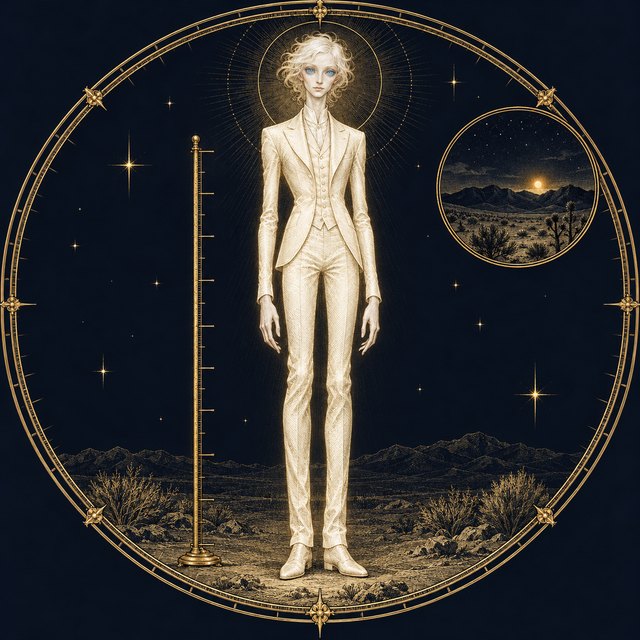
The Tall White. Seven feet and more, and they keep growing with age, chalk-white skin that is nearly translucent, large pale blue eyes bigger than ours, wispy white-blond hair, long thin fingers, a fitted white suit, a temper, and a life span of hundreds of years. They belong to one witness, Charles James Hall, an Air Force weather observer who says he met them on the ranges north of Las Vegas between 1965 and 1967 and who wrote it up in three volumes called Millennial Hospitality from 2002. No one else has ever reported one. They are in every list made after 2002 and in none made before it.
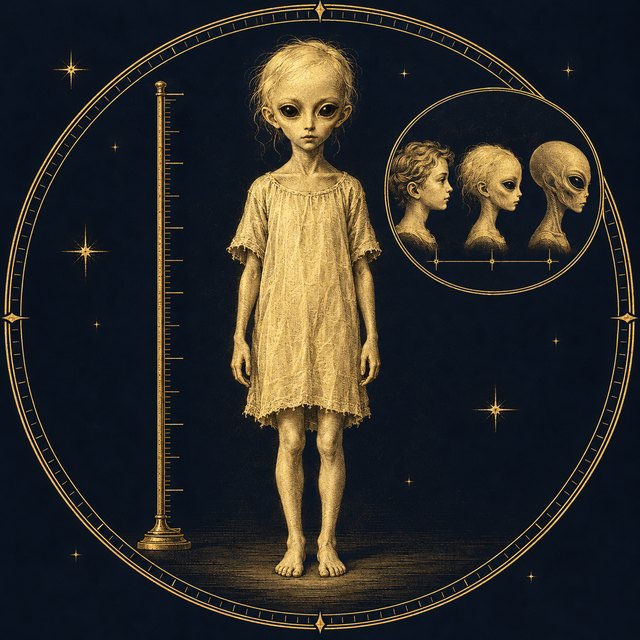
The hybrid. Child-sized or slight, pale, almost human, with a face halfway to the Grey: eyes too large and dark, a few wisps of fine hair on a big head, a small nose and mouth, thin limbs. The hybrid is the point of the abductions in the accounts of Budd Hopkins's Intruders in 1987 and David Jacobs's Secret Life in 1992: the Greys are breeding a race that is half us, and the abductees are shown the children. It is the one visitor whose existence is the plot of the story rather than a sighting.
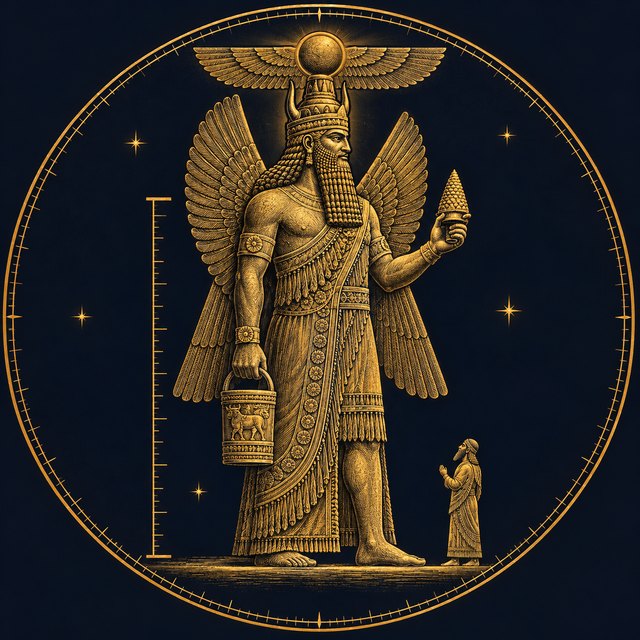
The Anunnaki. Giants in the shape of men, eight or nine feet tall, bearded, crowned, the figures on the palace walls of Assyria. Zecharia Sitchin's The 12th Planet in 1976 read the Sumerian tablets as history: the Anunnaki came from a planet called Nibiru on a 3,600-year orbit, mined gold in Africa, and made us as a labour force by mixing their blood with the apes. Sitchin's Sumerian has been taken apart by every Assyriologist who has looked at it, but the Anunnaki came into the alien catalogue through the internet in the 1990s, where they merged with the Reptilians, and they have been there since.
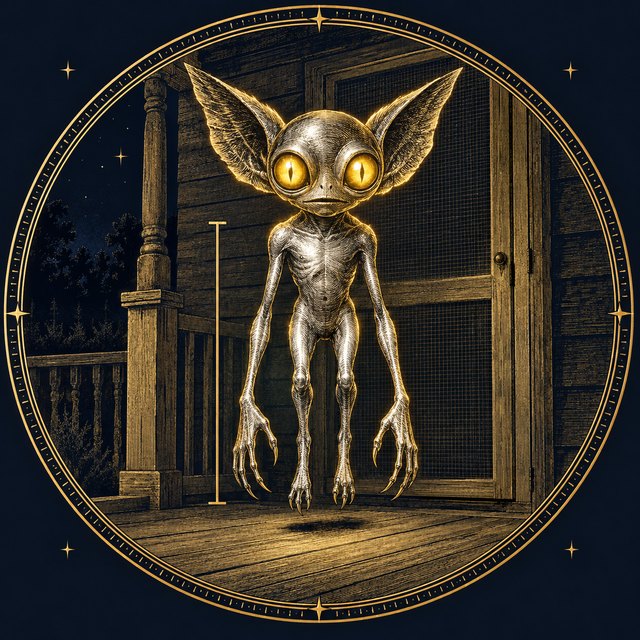
The Hopkinsville goblin. Two to four feet, a round head with huge pointed ears, large glowing yellow eyes set wide, a slit mouth, long arms hanging to the ground with clawed hands, spindly legs, skin that shone like silver, and a habit of floating. On the night of 21 August 1955, eleven people at the Sutton farmhouse near Kelly, Kentucky, say a dozen of them came out of the woods, and the men shot at them for hours with a shotgun and a .22 while the creatures tumbled off the roof and floated back up. The police found holes in the screens and no blood. The skeptics say great horned owls, which are the right height, the right eyes, and fight back. The goblins never appeared again and belong to no family in the catalogue.
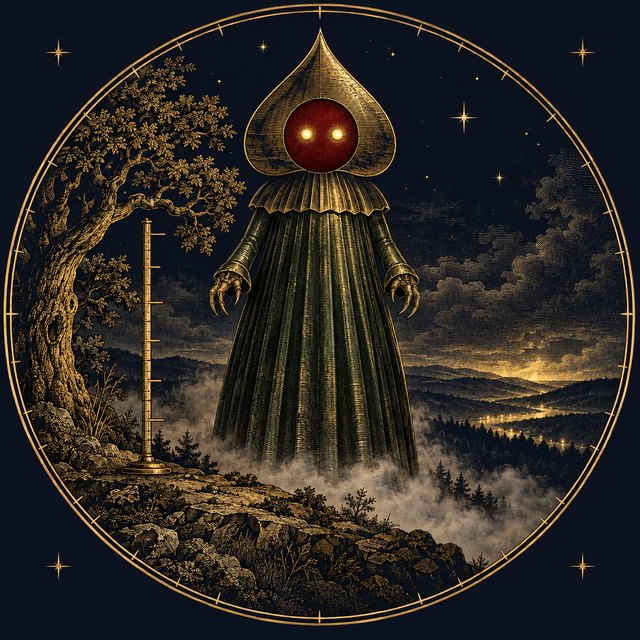
The Flatwoods creature. Ten feet tall by the witnesses' account, a head shaped like the ace of spades with a round red face inside it and two glowing eyes, a dark metallic pleated body like a skirt with no legs visible, small clawed hands, a hiss, a mist, and a smell that made the children sick. A group of boys and a mother saw it on a hilltop in Braxton County, West Virginia, on the evening of 12 September 1952 after a bright object crossed the sky, and the whole county was in the papers for a week. The skeptics say a barn owl on a branch, seen in a flashlight beam by frightened people, with the meteor supplying the sky. Like the goblin, it came once.
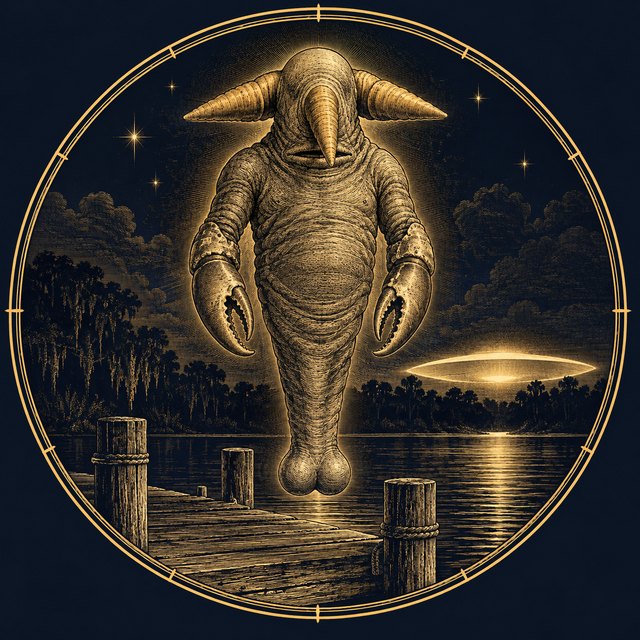
The Pascagoula creature. About five feet, grey wrinkled skin like an elephant's, no eyes, three carrot-shaped projections from the head where a nose and ears would be, a slit mouth, arms ending in pincers like a crab's, legs fused into one column with round feet, and it floated. Charles Hickson and Calvin Parker were fishing from a pier on the Pascagoula River in Mississippi on the night of 11 October 1973 when three of them, by their account, took the two men aboard a craft and examined them. The sheriff left the men alone in a room with a hidden tape recorder, and what they said to each other when they thought no one was listening is the reason the case is still argued about. The creature matches nothing before or after it.
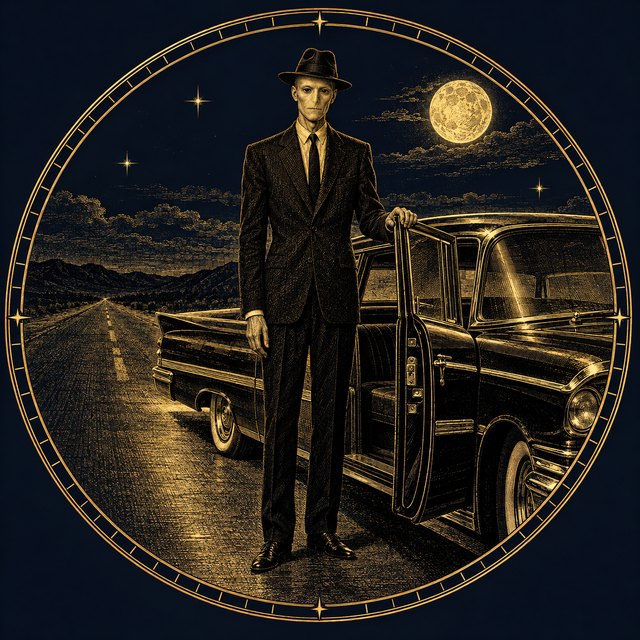
The man in black. Human height, thin, a new black suit, black tie and black hat that are somehow wrong, olive skin stretched tight, no eyebrows, a lipless mouth, an old black sedan that is never traced, and a warning to stop talking about what you saw. In September 1953 Albert Bender, who ran a saucer club from Bridgeport, Connecticut, shut it down and said three men in black had visited him and frightened him out of the subject; Gray Barker's They Knew Too Much About Flying Saucers in 1956 made them a fixture. Whether they are aliens, government men, or something stranger is left open in every account, which is the point of them.
What they put on the table
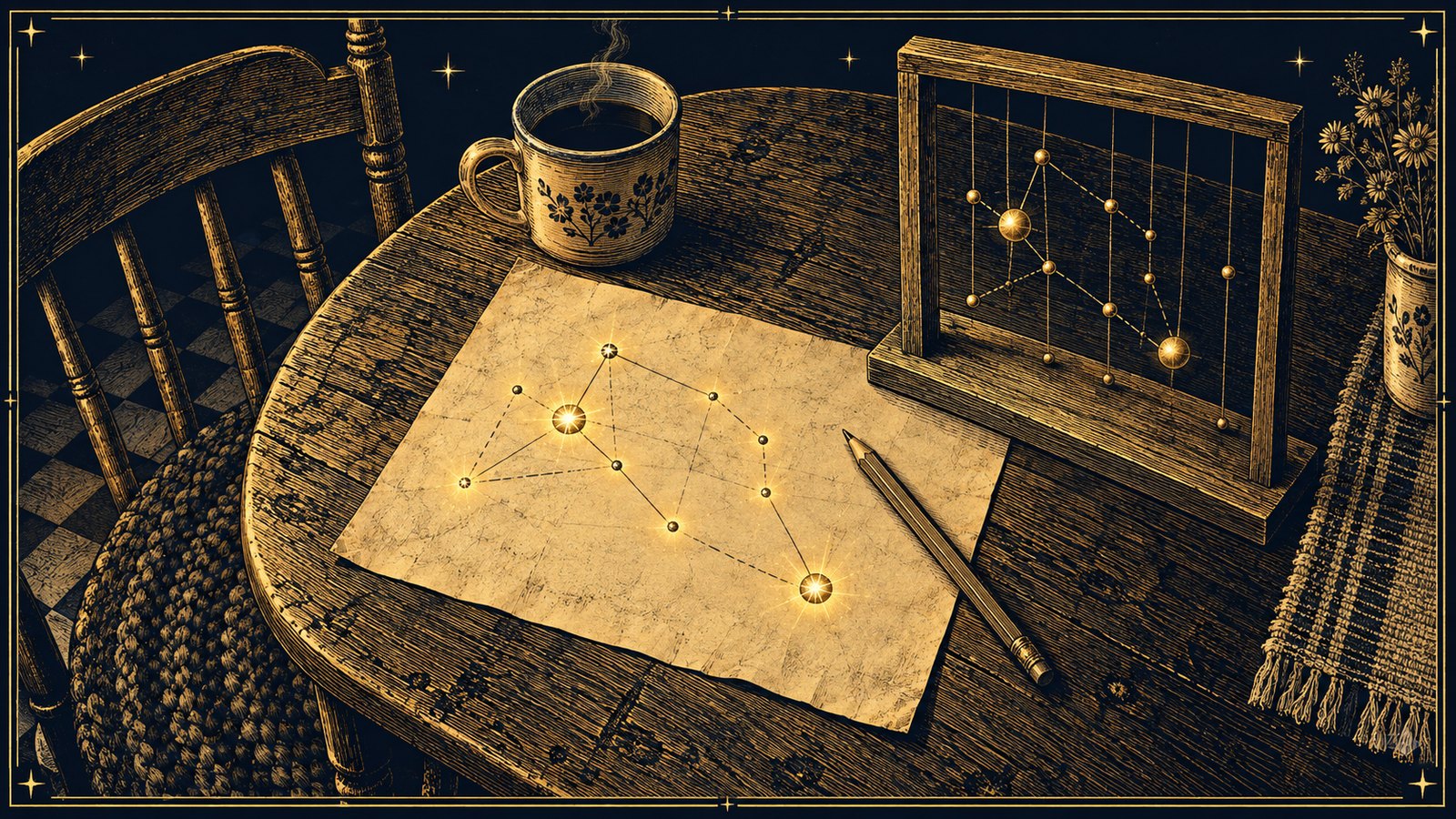
Each witness offered something you could hold. Adamski offered photographs and plaster casts of Orthon's footprints, with symbols in the soles. Betty Hill offered a map she had drawn under hypnosis of the stars the leader showed her, and an Ohio schoolteacher named Marjorie Fish spent years building bead models of the nearby stars until she found a view that matched it, from a pair of stars called Zeta Reticuli; Astronomy magazine printed it in December 1974 and the Greys had a home. Phil Schneider offered his own body: in the lectures he gave across 1995 he held up a hand missing fingers and described a chest wound, both from a firefight in 1979, he said, in which he and a drilling crew broke into a cavern at Dulce, New Mexico, met large Greys, and sixty-six soldiers and agents died. He was found dead in his flat in Wilsonville, Oregon, in January 1996, ruled a suicide, with a catheter tube around his neck according to the people who do not believe the ruling. Bob Lazar offered element 115, which did not exist in 1989 and was made in a laboratory in 2003, which his supporters count as a prediction and chemists do not, since 115 is where the table was always going next. Clifford Stone offered a book: at the Disclosure Project's press conference in Washington in May 2001 he said that as an Army sergeant he had been shown a military reference listing fifty-seven species, many of them humanoid. The book has never surfaced.
The chain
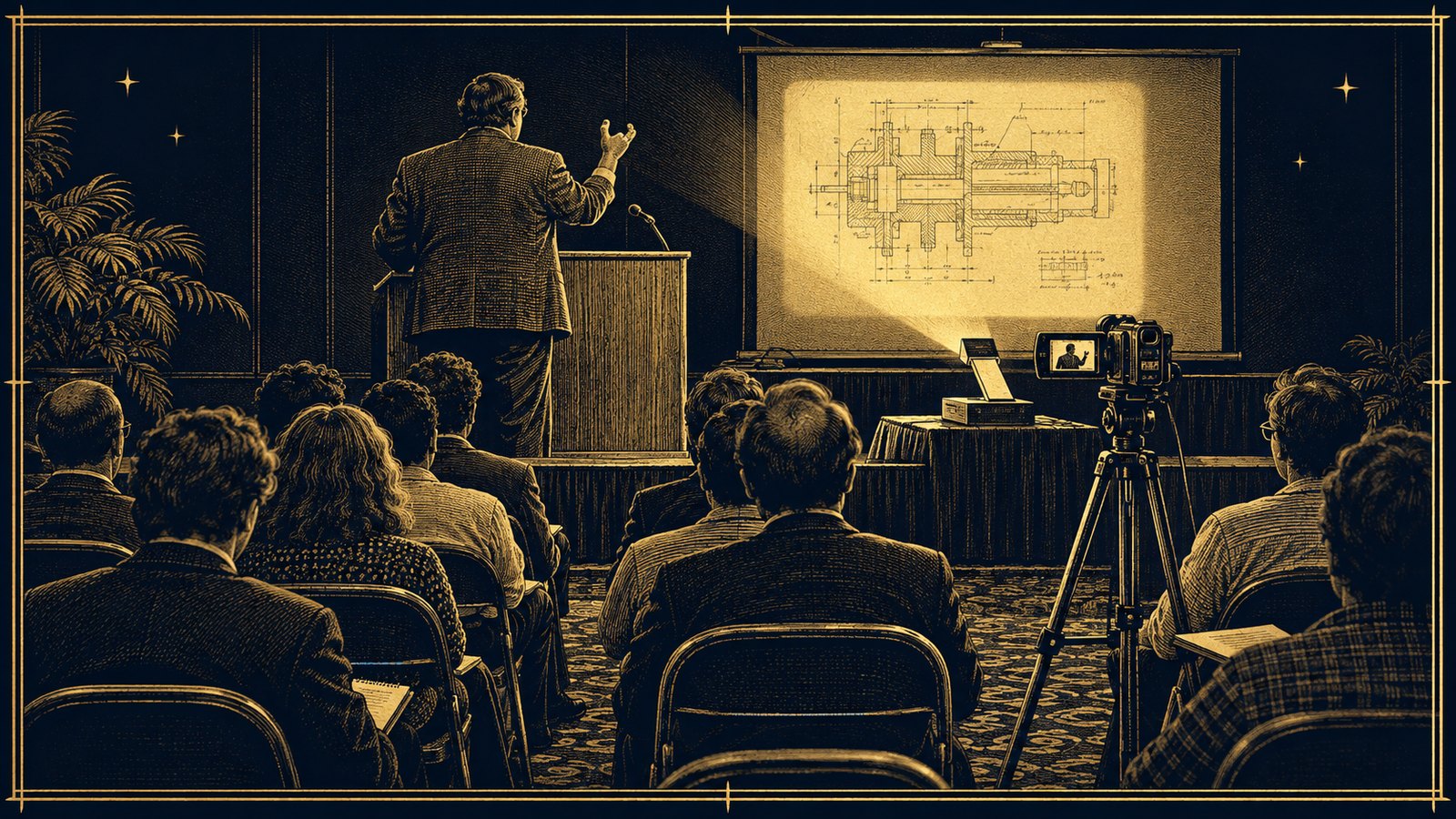
Now the question the page is for. Why do people who never met describe the same creatures? Lay the record out by year and the answer is in the dates. Nobody saw a Grey with the Communion face before 1987, and after 1987 nearly everyone did. Nobody saw a Reptilian in a base before the Dulce papers, nobody saw a Tall White before Hall's book, nobody saw a Mantis in the 1950s. Each species has a first teller, and after the first teller the species spreads at the speed of the medium: a decade by paperback, a year by videotape, a week by Usenet.
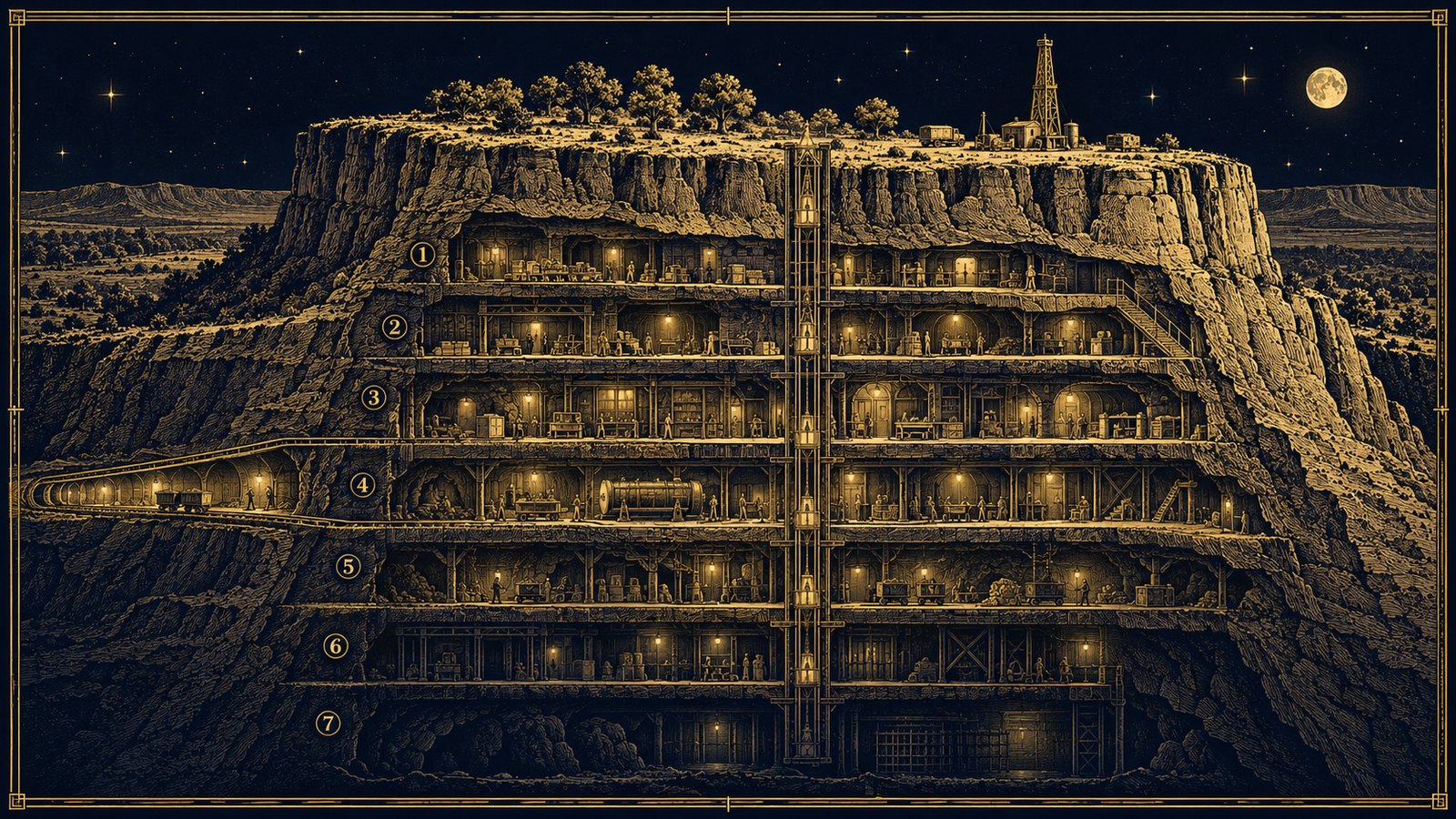
The Dulce story is the clearest case, because the people who built it have been identified. In 1980 a Albuquerque physicist named Paul Bennewitz began picking up what he took to be alien signals near Kirtland Air Force Base, and told the Air Force. Air Force counterintelligence, in the person of a special agent named Richard Doty, fed him a story to keep him away from what he was actually recording: an underground base at Dulce, Greys, treaties, cattle, human experiments. Doty has said so on camera, and Greg Bishop's Project Beta of 2005 lays the operation out with the names. Bennewitz, who was not well, believed it, and told John Lear, who put it in a statement in December 1987 that went up on the ParaNet bulletin board. A document signed O. H. Krill, which did not exist, packaged it in 1988. Bill Cooper took it into his lectures in 1989 and into Behold a Pale Horse in 1991. Lazar put a Nevada base on television in November 1989. Schneider added the firefight and the wounds in 1995 and died in 1996, which gave the story a martyr. By then it was on alt.alien.visitors, and anyone who went looking in 1996 found the whole catalogue waiting, species, levels, treaty and all, and could repeat it as something they had always known. The witnesses are quoting the same five documents and one book cover. That is the convergence. It is a better story than independent witnesses would have been, because it can be traced.
The census
The counts tell the same story in a different way, because no two of them agree and they rise with the decade. Schneider said eleven species, two of them friendly. Stone said fifty-seven in a book no one has seen. A Russian document that went around the internet from 2013, the so-called KGB book of alien races, listed fifty-eight in one version and eighty-two in another. Paul Hellyer, who had been Canada's minister of defence in the 1960s, testified to a citizens' hearing in Washington in 2013 that at least four species had been visiting for thousands of years, said in later interviews that he had once thought two to twelve, and by 2014 was saying as many as eighty. If you have heard that there are thirteen, that number appears in the lists too, and it probably crossed over from the thirteen bloodlines of the conspiracy books of the 1990s, which is how the Anunnaki got in as well. Nobody has ever named all the species in their own count.
The instrument
Four faces. The flashlight puts you on the Flatwoods hilltop on the night of 12 September 1952: move the beam until you find the eyes, and turn the fright dial between what the witnesses described and what the skeptics say was on the branch. The witness is the field guide as a key: describe what you saw with five dials, height, eyes, skin, shape and how it moved, and the specimen plates brighten as they match, with the closest match in the folklore brought to the centre and the name of whoever described it first. The relay is a screen in 1995 passing the Dulce story from hand to hand, from the agents who planted it in 1980 to Icke in 1999, adding something at every hop. The record lays every visitor out by year with its first teller ringed.

The honest part
Everything above is a description of what people said, and the page has tried to say who said it and when. Here is what has been checked against them. The Hill star map was the best physical evidence the subject ever had, and it did not survive better data: the Hipparcos satellite remeasured the distances to the nearby stars in the 1990s and Fish's pattern no longer matches from Zeta Reticuli or from anywhere else. The Bennewitz operation is not a theory about disinformation; the agent who ran it has described it. Hamilton's affidavit was a liars' club entry and the Aurora story a boost for a town the railroad had bypassed. Adamski's scout ship matches a brooder lamp, and Orthon's footprints were cast from a shoe. The goblins and the Flatwoods creature have owls standing behind them that fit the descriptions uncomfortably well. Schneider's wounds were real and his claims about where he got them have never been matched to any record, including the Rhyolite clearance he said he held, which does not exist. The hybrids, the Mantis and the Tall Whites rest on hypnosis or on one witness.
And the largest fact is this. The parts of the subject that governments have actually put on paper, Project Blue Book, the Pentagon office that the New York Times revealed in 2017, the intelligence assessment of 2021, the hearings of 2023, are entirely about objects: things in the sky that move oddly and have not been identified. Not one of those documents names a species, describes a being, or mentions a treaty. The catalogue, the whole field guide above, lives only in the chain. That does not prove the sky is empty; the page on where everybody is takes that question seriously, and the page on the other end follows the people who hear the visitors rather than see them. It proves something narrower and, to this page, more interesting: a species list that thousands of people agree on can be assembled, without any of them lying, out of a hoax, a book cover, a counterintelligence operation and a modem. We built the visitors. They look the way we drew them.