
1913 to 1999, Jena, Cambridge Massachusetts, Paris and Pittsburgh
The second city is half the first
Felix Auerbach, George Kingsley Zipf, Benoit Mandelbrot, Herbert Simon and a monkey at a typewriter
Take the cities of a country and line them up by population. The second has about half the people of the first, the third a third, the tenth a tenth. Take any book and line up its words by how often they appear: the second word is used half as often as the first, the tenth a tenth. The same line comes out of surnames, the sizes of companies, the traffic of websites and the craters on the Moon, and it comes out of a monkey hitting a typewriter at random. It has been known for ninety years and there is still no agreed reason for it. This page is the line, the man who found it in the words of Ulysses, and an instrument that drops real cities and real words onto it.

In 1913 a physicist in Jena named Felix Auerbach published a short paper with a dull title, the law of population concentration, and one sharp observation. If you take the cities of a country, rank them by population, and multiply each city's rank by its population, you get nearly the same number every time. The largest city times one, the second times two, the tenth times ten: one constant, give or take. Nobody noticed. Twenty years later a Harvard philologist named George Kingsley Zipf found the same thing in a place no one had thought to look, the words of a novel, and spent the rest of his life finding it everywhere else. The law carries his name, the cities were Auerbach's, and the question of why it holds is still open.
Zipf's count was of Ulysses. A word index of Joyce's novel had been published in 1937 with every word and the number of times it appeared, and Zipf ranked them: the most frequent word first, the next most frequent second, and so on through all 29,899 distinct words of the book's 260,430. Then he multiplied rank by count. The tenth word appeared 2,653 times; ten times that is 26,530. The hundredth appeared 265 times; a hundred times that is 26,500. The thousandth appeared 26 times, the ten thousandth twice. The product barely moved across four orders of magnitude. He did it for the Iliad, for Chinese, for Plains Cree, for the speech of children, and it was always the same line: the second word used half as often as the first, the tenth a tenth, the hundredth a hundredth. The word in first place changes with the language. The shape never does.

The cities
Zipf's 1949 book put Auerbach's cities beside the words, and the cities are where the law is easiest to check with your own eyes. Rank the hundred largest cities of the United States, draw rank along the bottom and population up the side, both on scales where each step is ten times the last, and the dots fall on a straight line sloping down at forty-five degrees. That is the whole law in one figure: a line of slope minus one on log paper means the second is half the first and the tenth a tenth. It held in the 1790 census, when the largest city was Philadelphia with forty thousand people, and it holds now with New York at eight million, through two centuries in which every city on the list changed and the country grew a hundredfold. It holds for France, India, Japan and Brazil, and for the world's cities taken together. It holds less well in a few places with one overgrown capital, and the places where it fails are themselves a subject of study.
Everywhere
Once you know the line you find it in things that have nothing to do with each other. The number of people carrying each surname. The sizes of American companies, which a 2001 study of five and a half million firms found on the line almost exactly. The number of visitors to each website, measured in the first years of the web. The number of papers each scientist publishes and the number of times each paper is cited. The sizes of the craters on the Moon, where one great basin is followed by a few large craters, dozens of middling ones and hundreds of thousands of pocks, and the sizes of earthquakes, where the same straight line on log paper is called Gutenberg and Richter's law and has a different slope. The notes in a piece of music. The sales of books, the populations of species in a patch of forest, the sizes of files on a computer, the wealth of households. Not every one of these sits at exactly the slope Zipf named; many are straight lines on log paper at some other angle, which is a wider family of patterns, and the page on the first digit is the same family seen from a different side. But words and cities sit on the slope of exactly minus one, and nobody has explained why that particular angle.

The monkey
Zipf himself thought he knew why. His 1949 book is called Human Behavior and the Principle of Least Effort, and it argues that a speaker wants few words that do a lot of work and a listener wants many words that each mean one thing, and that the line is the compromise between them. It is a beautiful idea and it ran into a monkey. In 1953 Benoit Mandelbrot, and in 1957 the psychologist George Miller in a paper called Some Effects of Intermittent Silence, pointed out that a monkey hitting the keys of a typewriter at random, with the space bar among them, produces words, and that if you rank the monkey's words by how often they come up you get Zipf's slope. The counts come down in a staircase rather than a smooth line, every one-letter word about as common as every other, then every two-letter word, then the three-letter words, but the corners of the stairs sit on Zipf's line. No speaker, no listener, no meaning, no effort. Short strings are simply more likely than long ones, and there are more long ones than short ones, and those two facts between them fix the slope. Wentian Li ran the experiment properly on a computer in 1992 and the monkey's text obeyed the law about as well as English does. Whatever the law is telling us about language, the monkey says it is not telling us much.

The cities got their own explanation, and it is a different one. In 1955 Herbert Simon, who would later win the Nobel prize in economics for other work, showed that if things grow in proportion to their size, so that the big get bigger faster, and new small things keep arriving, the sizes settle onto the line. In 1999 Xavier Gabaix did the cities exactly: if every city grows by a random percentage each year, with the same odds for a village and a metropolis, and nothing else is assumed, Zipf's law follows, slope minus one. Paul Krugman, who had written three years earlier that the law was an embarrassment to economics because it fitted the data better than any theory in the field, called it the first real answer. It is an answer for the cities. It is not the monkey's answer for the words, and it is not obviously anyone's answer for the craters. Three things that make the same line for three different reasons is either a coincidence or the deepest fact on this page, and the people who study it do not agree which.
The instrument
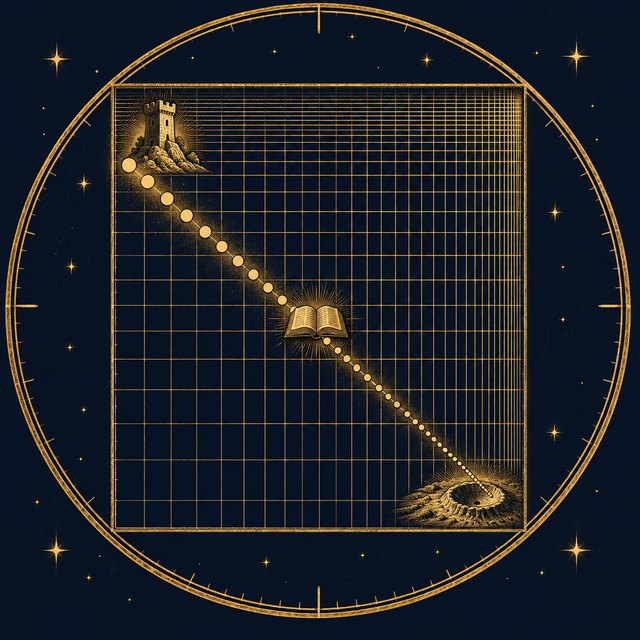
Rank along the bottom, size up the side, both on scales that step by tens, and the law drawn as the faint straight line. Cities drops the hundred largest American cities onto it one at a time, from the census. Words drops the hundred commonest words of a million words of American English. Monkey hits twenty-six letters and the space bar at random, builds its words as you watch, and ranks them out to the thousandth; let it run a while and watch the stairs form and their corners find the line. Tap the disc to start again.

The honest part
The line is a tendency, and it frays at both ends. The most common word in English is used a little less often than the law says and the rarest words a little more, so that the real curve on log paper bends slightly, and the Mandelbrot correction that fixes the top is itself a fitted number. Cities depend on where you draw the city: inside the city limits, Los Angeles is half of New York and the law looks exact; by metropolitan area it is two thirds, and the top of the line bends. Countries with one capital that swallowed everything, like Thailand with Bangkok or Peru with Lima, sit well off the line at the top, and nobody treats that as the law failing so much as the country being strange. A 2014 review of the word law by Steven Piantadosi concluded that after eighty years of models, none of them could be told apart by the data, which is a polite way of saying the question is open.
What is not open is the line itself. Auerbach's cities, Zipf's words, Axtell's firms, the craters and the monkey are measured facts, and the instrument below draws them from the real counts. The honest claim is narrower than the famous one and stranger for it: whenever a great many things of very different sizes come about by growing, or by being assembled from parts, their sizes fall onto a straight line on log paper, and for words and cities the line sits at the one angle where the second is half the first. The cause of the angle is not known. It is, after Benford's, the second law on this shelf that everyone can see and no one can explain.