
1858 to 2012, a steamboat below Memphis, the East Room, a Welsh schoolhouse, the step of an omnibus at Coutances, a library cubicle at Duke
Something just told me
Mark Twain, Abraham Lincoln, a psychiatrist in Shrewsbury, Henri Poincaré, four decks of cards in Iowa, a fire commander, J. B. Rhine, Daryl Bem and a worldwide network of random numbers
Every page on this site asks whether the universe is ordered. This one asks whether any of that order leaks forward: whether a person can know a thing a moment before there is any way to know it. The famous cases are here, Twain's coffin, Lincoln's catafalque, the Aberfan letters, the mathematician on the omnibus step, and so are the laboratories that spent forty years trying to catch the three seconds before. Each one gets walked back to whatever actually moved the needle, and the answer, every time so far, is more interesting than magic.
Something just told me. Everyone has said it, and everyone who has said it meant the same thing: a piece of knowledge arrived without a sender. The phone rang and you knew who it was. You took the other road and the first road was closed. You put the book down at the page where the thing you needed was waiting. The feeling is as common as weather, and this site, which has spent thirty pages asking whether the universe runs on an order, owes it a page, because if the order is real then this is the place a person would feel it first: not in a telescope but in the stomach, a moment early.
So here are the hunches with the best paperwork, the ones that have been told for a century, and here are the laboratories that tried to catch one happening. Each gets the same two questions. What did the needle do? And what moved it?
The receiving set
The modern vocabulary of the hunch was written in 1937 by a man selling a book about money. In the fourteenth chapter of Think and Grow Rich, Napoleon Hill names a thirteenth principle, the sixth sense, and describes it as the part of the mind he calls the creative imagination, the receiving set through which ideas, plans and thoughts flash in. The flashes, he says, are what people call hunches or inspirations, and their source is outside the person: the sixth sense is the point of contact between a finite mind and what he calls Infinite Intelligence. Millions of readers took that as the mechanism and never asked the next question. Hill is already on this site's page about the other side, with his imaginary council of advisers and the Carnegie commission nobody has been able to confirm, so he is here as the opening voice only. He named the feeling and gave it a sender. Every entry below asks who was transmitting.
The metal coffin

In the spring of 1858 Samuel Clemens, a cub pilot on the Mississippi, found his younger brother Henry a place as a mud clerk on the steamboat Pennsylvania. By his own account, told half a century later, he dreamed one night of Henry laid out in a metal coffin that rested on two chairs, wearing one of Sam's own suits, a bouquet of white flowers on his chest with a single red rose at its center. He woke, believed it, walked a block before he realised it had been a dream, and put it away.
On 13 June the Pennsylvania's boilers blew up near Ship Island below Memphis. Henry was scalded and lingered for a week; Sam reached Memphis and sat with him until he died on 21 June. In the room where the dead were laid out, the others were in plain wooden coffins. Henry was in a metal one, paid for by the women of Memphis who had nursed him, and he was wearing a suit of Sam's. As Sam stood there a woman came in and laid a bouquet of white flowers on the chest, with one red rose in the middle.
The honest note. Twain told this story in his autobiographical dictations of 1906, forty-eight years after the fact, and he was the best storyteller alive. Nobody wrote the dream down in 1858. The shape of the account, a dream told before and details that match after, is the shape every premonition story takes, and it is also exactly the shape a memory settles into when it is retold for half a century by a professional. The case has been re-examined in the Journal of the Society for Psychical Research as recently as 2017, which tells you both that it is the best of its kind and that there is nothing new to examine.
The East Room

Ward Hill Lamon, Lincoln's friend and self-appointed bodyguard, wrote that a few days before the assassination the President told him of a dream. He had wandered the silent White House, following the sound of weeping, until he came to the East Room and found a catafalque with a body on it, soldiers on guard, a crowd of mourners. He asked who was dead. "The President," a soldier told him. "He was killed by an assassin." Lamon said he set the story down as nearly in Lincoln's own words as he could, from notes made right after it was told.
The honest note. The account was not published until Lamon's Recollections of 1895, thirty years after the murder and two years after Lamon himself died; his daughter edited the book. Don and Virginia Fehrenbacher, who graded every recollected Lincoln quotation for reliability, found internal contradictions (Lamon dates the dream to a few days before, Lincoln's words in the same passage say about ten days) and no mention of it by anyone in 1865, and they put it among the doubtful. Lincoln's own reaction, in Lamon's telling, was to shrug: the assassin had tried his hand on someone else. The dream is quoted as fact in a great many respectable books. That is a fact about books.
The bureau

On the morning of 21 October 1966 a coal spoil tip above the village of Aberfan in south Wales slid onto Pantglas Junior School and killed 144 people, 116 of them children. John Barker, a psychiatrist from Shrewsbury with an interest in the unexplained, went down to the village and then asked, through Peter Fairley's science column in the London Evening Standard, whether anyone had seen it coming. Letters arrived by the dozen. The best known concerns Eryl Mai Jones, ten years old, who told her mother she had dreamed she went to school and it was not there, that something black had come down all over it. Accounts differ on whether she said it two weeks before or the night before, and the version Barker published differs from the one her parents signed.
Barker and Fairley drew the right conclusion from the pile of letters: a premonition is only worth anything if it is written down before the event. In January 1967 they opened the British Premonitions Bureau at the newspaper and invited the public to send in their forebodings in advance. In fifteen months it logged more than 700. Eighteen were judged, afterward, to have come true. Twelve of the eighteen came from two people.
The honest note. Every Aberfan premonition was collected after Aberfan, from people who had just watched it on the news. The bureau was the honest experiment, and it gave the honest answer. Out of 700 forecasts of disaster in a country where disasters happen weekly, eighteen matches is roughly what guessing produces, and when 700 people predict something, a few of them will be right about whatever then happens. Barker died of a brain haemorrhage in August 1968 and the bureau closed with him. Sam Knight's book of 2022 tells the whole story, including the two star correspondents, with more sympathy than this paragraph and the same arithmetic.
The step of the omnibus
Henri Poincaré had spent weeks failing to prove that the functions he would later call Fuchsian could not exist, and then weeks building them once he found that they could, and he was stuck. He left Caen for a geological excursion. At Coutances the party boarded an omnibus, and as he put his foot on the step, by his own account in Science et Méthode, the idea came to him with nothing in his previous thoughts seeming to have prepared it: the transformations he had used to define the functions were the same as those of non-Euclidean geometry. He did not check it. He got on, carried on the conversation he had been having, and felt complete certainty. Back in Caen he verified it at leisure and it was right.
The honest note. This is the best-documented hunch in the history of thought, and the man who had it also gave the correct explanation. Poincaré's reading is that the flash on the step was the end of a long unconscious labor, not the beginning of anything: weeks of conscious failure had set the problem, the mind kept working on it while he looked at rocks, and the answer surfaced when it was done. The hunch came from inside, from work already performed. Nothing arrived from outside the omnibus.
The four decks

In February 1997 Antoine Bechara, Hanna Damasio, Daniel Tranel and Antonio Damasio published a short paper in Science with a title that is the whole finding: "Deciding advantageously before knowing the advantageous strategy." Players drew cards from four decks for play money. Two decks paid large sums and punished with larger ones; two paid small and came out ahead over time. The players were wired for skin conductance, the faint sweat of arousal. Healthy players' skin began to respond when they reached toward a bad deck before they could say which decks were bad, and they began steering away from those decks before they had a reason they could state. Patients with damage to the ventromedial prefrontal cortex never developed the anticipatory response and kept drawing from the bad decks even after they could explain the game out loud.
The honest note. This is the best hunch a laboratory has ever caught, and it has nothing to do with the future. The body had added up the losses before the sentence was ready. Tiago Maia and James McClelland asked players sharper questions in 2004 and found they knew more about the decks than Damasio's questionnaire had let them say, so the gap between gut and words is narrower than the famous version claims. But the gap is there. A hunch, in the one place it has been measured properly, is knowledge that has not found its words yet.
The quiet fire
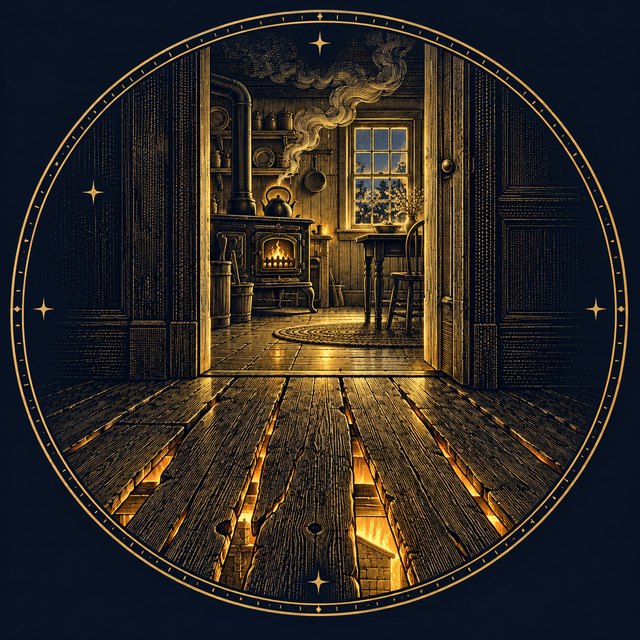
Gary Klein spent years interviewing people who make life and death decisions fast, and the story he tells most often came from a fire commander. A crew was called to what looked like a routine kitchen fire in a single-storey house. They hosed the flames from the living room. The fire did not die down the way a kitchen fire should. The commander ordered everyone out of the building, with no reason he could have given, and moments later the floor they had been standing on collapsed. The fire had been in the basement underneath them. He told Klein it had been a sixth sense, ESP. Klein walked him back through the minutes. The room had been far too hot for a kitchen fire of that size, and far too quiet, because the real fire was under the floor and the floor was muffling it. His experience had registered both and sounded the alarm before his sentences caught up.
The honest note. Klein's conclusion, and Daniel Kahneman's with him in a paper they wrote together in 2009 after years of disagreeing, is that this kind of intuition is pattern recognition earned in a world regular enough to learn and with feedback fast enough to learn from. Firefighters, chess players and nurses have it. Pundits and stock pickers mostly do not, because the world does not hand them clean feedback. A hunch is exactly as good as the practice behind it, and it is never better. The commander's was very good.
The five signs

In 1930 J. B. Rhine set up at Duke University to test whether minds could reach each other directly, and his colleague Karl Zener designed the deck: twenty-five cards, five each of a circle, a cross, three wavy lines, a square and a star, so that pure guessing scores five. Rhine's best subject was a divinity student named Hubert Pearce. In the series everyone cites, run in 1933 and 1934, Pearce sat in a library cubicle while J. G. Pratt, about a hundred yards away in another building, turned one card a minute face down without looking at it, then recorded the order and sealed a copy for Rhine. Across thirty-seven sittings Pearce scored around thirty percent where chance gives twenty, odds against chance that run to many zeros. Rhine's book of 1934 put the phrase extra-sensory perception into the language.
The honest note. Nobody was watching the cubicle. The psychologist C. E. M. Hansel pointed out that Pearce could have walked across to Pratt's building and looked through a transom, which does not prove he did and does remove the series from evidence, because an experiment that cannot rule out the dull explanation has not tested the exciting one. In earlier series Pearce had handled and shuffled the cards himself. James Crumbaugh spent years trying to repeat the scores and never could. As Rhine's controls tightened his high scorers vanished, which is the signature of an effect that lives in loose conditions. The cards themselves are honest. The instrument below deals them.
The three seconds before
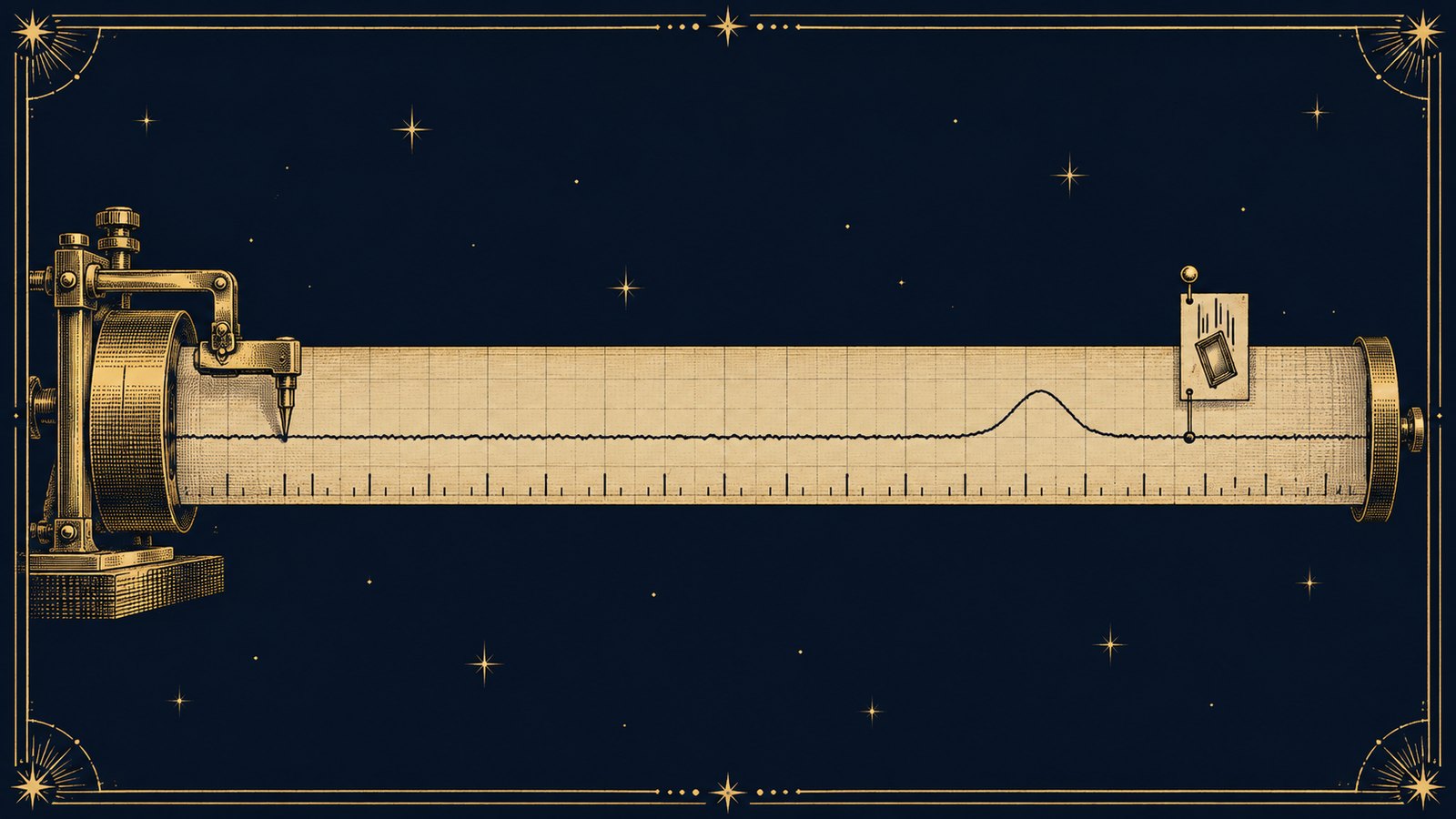
If the future leaks, the leak should be measurable, and in 1997 Dean Radin built the instrument. Volunteers sat wired for skin conductance while a computer showed them photographs in random order, most of them calm and a few of them violent or erotic. The trace, Radin reported, began to rise a few seconds before an arousing picture appeared, before the computer had even chosen it. Other laboratories tried the same thing with heart rate, pupil size and brain activity. In 2012 Julia Mossbridge, Patrizio Tressoldi and Jessica Utts pooled twenty-six such reports published between 1978 and 2010 and found a small effect, about a fifth of a standard deviation, at odds the paper gives as better than one in a hundred billion. The better-run studies showed larger effects, not smaller, and by the authors' estimate eighty-seven unpublished null results would be needed to cancel the pooled one. They proposed no mechanism and said plainly that the cause was undetermined.
The honest note. The same authors' follow-up two years later conceded that questionable research practices and plain physiological artifacts could produce such results, and the plainest artifact is the body itself. After three calm pictures in a row a person braces for the fourth, so arousal drifts upward through a run and happens to be highest just before the violent card finally falls; when that drift is modelled, the effect shrinks. No large preregistered presentiment study has found the three seconds. The needle moves. What moves it is the question, and the dull answer has not been ruled out.
Feeling the future

In 2011 Daryl Bem of Cornell published nine experiments in the Journal of Personality and Social Psychology, the most respected journal in his field, under the title "Feeling the future." Each took a standard, well-replicated effect and ran it backwards. Students who practised a list of words after being tested on it remembered more of those words on the test. Students chose the curtain with the erotic picture behind it a little more often than chance, before the computer had decided where the picture would go. More than a thousand participants, eight of nine studies significant. It looked like the most careful case for precognition ever made, and it had passed the field's own gate.
The honest note. Stuart Ritchie, Richard Wiseman and Christopher French preregistered three exact replications of the ninth experiment at three universities and found nothing; the journal that had published Bem declined to send their paper out for review, on the grounds that it did not publish replications, and PLoS ONE took it in 2012. Jeff Galak, Robyn LeBoeuf, Leif Nelson and Joseph Simmons ran seven replications of the eighth and ninth experiments with 3,289 participants and found nothing. Bem's paper did not demonstrate precognition. It demonstrated that the accepted methods of an entire field could demonstrate anything, and it helped set off the reckoning over replication that psychology has been living through since. Bem's reply was that the sceptics' own expectations may have shaped their results, which is the one answer that can never lose and therefore never wins.
The eggs

Since 1998 the Global Consciousness Project, run from Princeton by Roger Nelson, has kept a worldwide network of hardware random number generators, which the project calls eggs, ticking away in dozens of countries, and has asked whether their output departs from chance when billions of minds turn to one event at once. The claim everyone has heard is 11 September 2001. The running sum of the network's deviations, the project reported, swung in the hours around the attacks, and in some tellings the swing began before the first plane struck.
The honest note. Jeffrey Scargle, an astrophysicist at NASA Ames, published the dull answer in 2002. A cumulative sum of any zero-mean noise produces exactly such swings, because adding up random numbers turns flat noise into a random walk, and a random walk always looks like it is going somewhere. Choose the window and the statistic after the event and a swing can be found around any date you like. Edwin May and James Spottiswoode, who are not sceptics of such research, reanalysed the network's output for that day independently and found it consistent with chance. The project continues. It has never stated, in advance, one specific prediction that could fail.
One a month

The Cambridge mathematician J. E. Littlewood set the closing arithmetic down in his Miscellany. A person is awake about eight hours a day and notices roughly one event a second, so around a million events a month. A one-in-a-million coincidence should therefore happen to each of us about once every thirty-five days. Eight billion people have hunches every day. Most are wrong and forgotten by lunch. The one that lands is told for a century, and the telling improves it. Memory is the instrument that does the selecting, and memory is biased in exactly the direction a story needs.
The instrument
Rhine's deck, dealt honestly. Twenty-five cards, five each of the five signs, in a true random order every run. Guess the sign before the card turns. The brass gauge keeps your hits against the line that chance draws, five expected and almost always between one and nine, and after the twenty-fifth card the verdict face tells you how many people guessing blind do as well as you did. The bureau face keeps your own ledger across runs, in your browser only: your best run, which you will remember, and your average, which is the truth. The second run is the honest one.

The honest part
No laboratory has caught the three seconds before. The presentiment trace has a dull explanation that has not been ruled out, the nine experiments that felt the future could not be repeated by anyone who tried with the doors locked, Rhine's best scores lived in the years before anyone watched the cubicle, and the eggs on their ring produce the same swings on any date the analyst picks afterward.
Every hunch on this page that could be walked back to its source turned out to be a person knowing something early. Poincaré's foot on the step was weeks of unconscious work surfacing. The Iowa players' skin had counted the losses before their mouths could. The fire commander's neck had felt the heat and heard the silence before he had a sentence for either. The dreams of Twain and Lincoln and the letters that reached Barker's bureau are the other kind: the one hit that memory kept out of a month of misses, told by people who had no reason to lie and every reason to remember.
That is not nothing. It means the thing that spoke to you was not the heavens. It was you, a few seconds ahead of yourself, with everything you had ever noticed about the room. The page cannot end with a measurement, the way the others do, because the measurement was tried for forty years and came back empty. It can end with the one instrument that never fails: deal the deck, guess, and watch what chance looks like when it is you.